
By Marc Gilman
Questions?
Call (800) 927-9326 or email
Key Takeaways
-
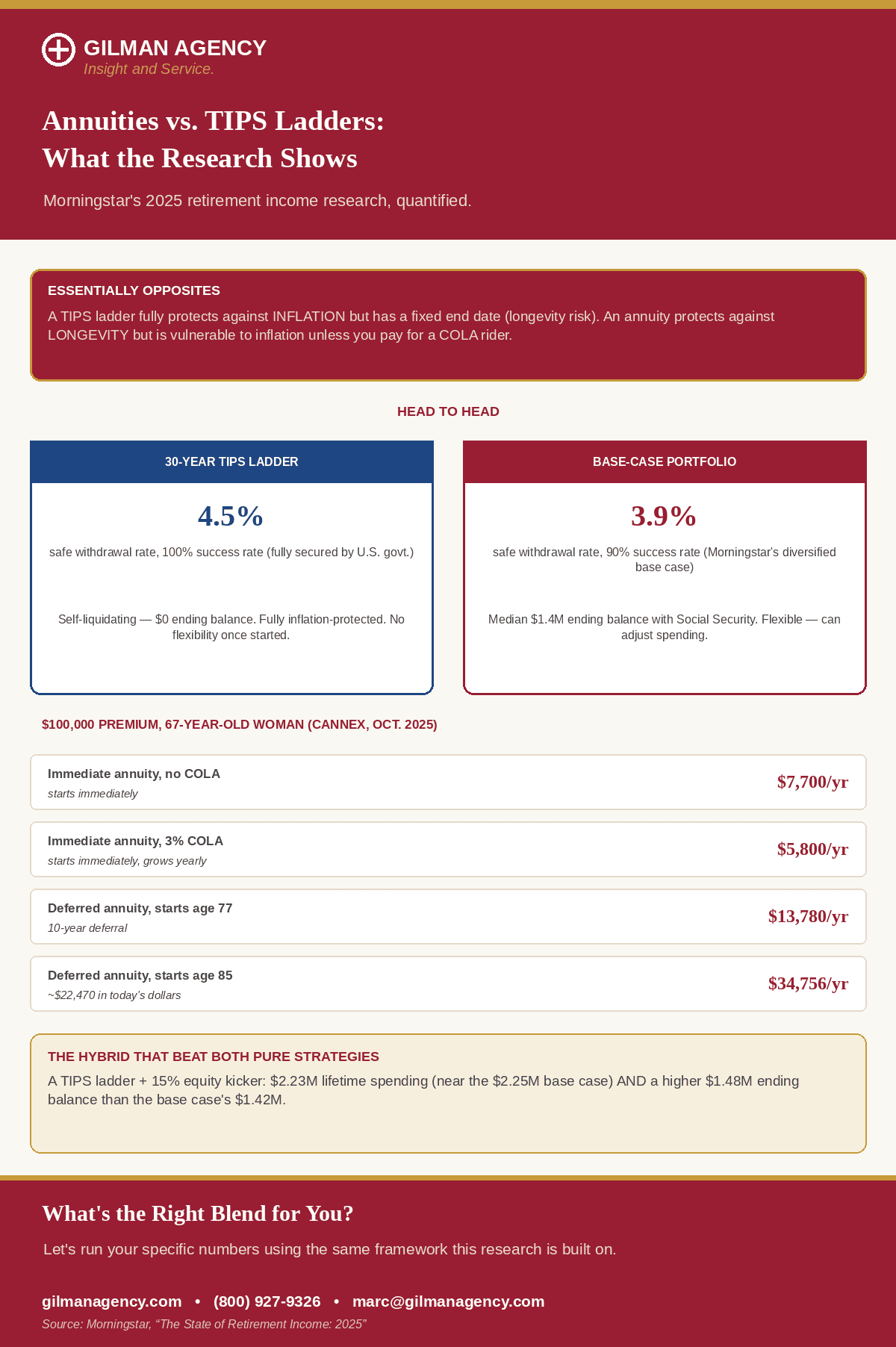
TIPS ladders and annuities solve essentially opposite problems. A TIPS ladder fully protects against inflation but has a fixed end date — it’s vulnerable to longevity risk. An annuity protects against outliving your money but is generally vulnerable to inflation, unless you pay extra for a cost-of-living rider.
-
Morningstar’s 2025 research puts a 30-year TIPS ladder’s safe withdrawal rate at 4.5%, compared with a 3.9% base-case for a diversified portfolio — and unlike every other strategy in their study (except RMD-based withdrawals), a TIPS ladder carries a 100% success rate rather than a targeted 90%, because payments are fully secured by the U.S. government.
-
A real-world immediate annuity example: a 67-year-old woman putting $100,000 into an immediate annuity in October 2025 would receive about $7,700 a year for life — a 7.7% payout rate, per pricing research firm Cannex Financial Exchanges. Adding a 3% inflation rider drops that first-year payment to $5,800, though it grows every year after.
-
Deferred income annuities pay dramatically more the longer you wait — the same $100,000 premium starting payments 10 years later pays about $13,780 annually; waiting until age 85 more than doubles that to $34,756 — though inflation quietly erodes a meaningful chunk of that larger, later number in real terms.
-
A hybrid approach — a TIPS ladder plus a modest equity allocation — can outperform either pure strategy. Morningstar found a TIPS ladder with a 15% equity “kicker” nearly matched a diversified portfolio’s lifetime spending while also producing a higher ending balance than the base case.
Why This Comparison Matters
Beyond Social Security, TIPS ladders and annuities are the two most direct ways to add genuinely guaranteed or near-guaranteed income to a retirement plan. Morningstar’s “State of Retirement Income 2025” research — from analysts Amy Arnott, Christine Benz, Jason Kephart, and Tao Guo — devotes an entire section to quantifying exactly how each one performs, using the same 30-year retirement horizon and portfolio assumptions as the rest of their widely followed annual study. The findings are specific enough to actually inform a decision, not just describe the concepts in the abstract.
TIPS Ladders: Full Inflation Protection, No Flexibility
Treasury Inflation-Protected Securities (TIPS) pay interest and principal adjusted for inflation, backed by the full faith and credit of the U.S. government. A TIPS ladder buys TIPS across a range of maturities — one year through 30 years, in Morningstar’s model — so that as each rung matures, its principal and accumulated interest fund that year’s spending, creating a predictable, inflation-adjusted income stream for a predetermined period.
The core tradeoff: a TIPS ladder is self-liquidating. By design, it runs out exactly when the ladder ends — there’s no ending balance, no legacy value, nothing left over. In exchange for giving that up, Morningstar’s research found real advantages: as of September 30, 2025, a 30-year TIPS ladder supported a 4.5% inflation-adjusted withdrawal rate, compared with 3.9% for the strongest diversified base-case portfolio — and because payments are fully secured rather than modeled to a 90% success probability, the ladder effectively offers a 100% success rate over its term.
Combined with Social Security claimed at 67, Morningstar calculated $2.43 million in total lifetime spending with 100% safety from the TIPS-ladder approach, versus $2.25 million with a 90% success rate from the base-case portfolio plus Social Security. The catch is the ending balance: the base-case-plus-Social-Security approach finishes with a median $1.4 million left over after 30 years, useful for retirees who outlive the 30-year projection or want to leave a bequest — money the TIPS ladder, by definition, doesn’t have.
A hybrid fix: add a modest equity allocation. Morningstar tested combining a TIPS ladder with an “equity kicker” — investing a portion in stocks left untouched while the TIPS ladder funds spending. A 15% equity kicker came out close to the best of both worlds: $2.23 million in lifetime spending (nearly matching the base case’s $2.25 million) while producing a higher median ending balance ($1.48 million versus $1.42 million for the base case) — though still offering less flexibility than a dynamic withdrawal strategy.
Immediate Annuities: Simple, but the Tradeoffs Are Real
An immediate annuity converts a lump sum into guaranteed income starting right away. Morningstar cites a concrete example from Cannex Financial Exchanges, an annuity pricing research firm: a 67-year-old woman purchasing an immediate annuity with $100,000 in October 2025 would receive about $7,700 annually for life — a 7.7% payout rate. (Men typically receive somewhat higher payouts, reflecting shorter average life expectancy.)
That “life-only” structure delivers the highest possible payout precisely because payments stop entirely at death — but most buyers don’t actually choose it. Morningstar notes that life-only annuities are relatively rare in practice; most people add survivor benefits, refund provisions, or a guaranteed payment period so something remains for a spouse or heirs, each of which reduces the payout rate in exchange for shifting some risk back to the insurer.
Adding inflation protection changes the math substantially. A fixed 3% cost-of-living adjustment drops the same contract’s initial payout from 7.7% to 5.8% — $5,800 in year one instead of $7,700 — though it then grows: $5,975 in year two, $6,163 in year three, and onward. It takes roughly 10 years for the inflation-adjusted payments to catch up to what the non-adjusted contract paid from day one. After that point, the inflation-protected version becomes the stronger long-term hedge — the same “the longer you live, the more it’s worth” logic that applies to delaying Social Security.
Morningstar also modeled funding an immediate annuity from different portions of a $1 million portfolio (10%, 30%, and 50%), funded specifically from the fixed-income side rather than equities, since annuities behave more like bonds than stocks. Because the annuity’s income rate outpaced the base-case bond portfolio’s projected returns, and included the 3% COLA, larger annuity allocations actually improved both lifetime spending and median ending balances — the equity portion left behind, now representing a larger share of a smaller remaining portfolio, had more room to compound.
The real caveat, and it’s a significant one: buying an immediate annuity locks up that principal. You lose liquidity and the flexibility to respond to an emergency or a change in circumstances, and if you die earlier than expected without additional provisions, that capital doesn’t come back. Morningstar’s own conclusion: an annuity allocation can make sense for retirees seeking guaranteed income today, but it should be done in moderation.
Deferred Income Annuities: A Longevity Hedge That Rewards Patience
A deferred income annuity works differently — you fund it now, but payments don’t begin until a future date you choose, often 10 to 20 years later. Because the insurer is betting on fewer people living long enough to collect, it can offer a substantially larger payout the longer that start date is pushed out.
Morningstar’s example: the same 67-year-old woman putting $100,000 into a deferred annuity with a 3% COLA, starting payments 10 years later (October 2035), would receive about $13,780 annually to start, growing to roughly $14,193 in year two. Push the start date all the way to age 85 — the latest a deferred annuity payment can typically begin — and the first-year payout more than doubles to $34,756.
That larger number needs an inflation-adjusted reality check. Because the COLA rider doesn’t start adjusting until payments actually begin, inflation quietly erodes the purchasing power of that headline figure over the deferral period. Using Morningstar’s 2.46% inflation assumption, the $34,756 first-year payment starting at age 85 is worth only about $22,470 in today’s dollars — still meaningfully more than the immediate annuity option, but a smaller gap than the sticker-price numbers alone suggest.
There’s also a real cost during the waiting period: money committed to a deferred annuity has to come from somewhere, typically requiring the retiree to draw more heavily on the remaining portfolio (alongside Social Security) until those payments actually begin — which produces a lower median ending balance after 30 years compared with not buying the deferred annuity at all. And because payouts are further in the future, the issuing insurer’s long-term financial strength matters even more here than with an immediate annuity — worth confirming directly before committing funds for a decade or two.
The Core Structural Difference, in One Line
TIPS ladders and annuities are, in Morningstar’s own framing, essentially opposites: a TIPS ladder fully protects against inflation but is vulnerable to longevity risk because it has a fixed end date. An annuity protects against longevity risk — it can pay for as long as you live — but is generally vulnerable to inflation unless you specifically pay for a COLA rider, and even then, that fixed-rate adjustment is a weaker hedge than the actual inflation-linked adjustments Social Security recipients receive. Annuities are also backed by the issuing insurer and state guaranty funds, not the full faith and credit of the U.S. government the way TIPS are.
Questions Worth Asking
-
Does your retirement plan need full inflation protection, full longevity protection, or some blend of both — and does your current allocation actually reflect that priority?
-
If you’re considering an immediate annuity, have you weighed the life-only payout against the cost of adding survivor benefits or a guaranteed period?
-
If a deferred annuity’s headline payout looks appealing, have you translated that figure into today’s dollars to see what it’s actually worth after years of inflation?
-
Have you considered a hybrid approach — like a TIPS ladder with a modest equity allocation — rather than treating this as an all-or-nothing choice?
What To Do Next
If you’re weighing a TIPS ladder against an annuity — or trying to figure out what blend of guaranteed income actually fits your retirement plan — let’s run your specific numbers together using the same framework this research is built on.
Questions? Call (800) 927-9326 or email
Prefer we reach out to you instead? Complete our Permission to Contact form and a licensed Gilman Agency agent will follow up.
Sources: Amy C. Arnott, Christine Benz, Jason Kephart, and Tao Guo, “The State of Retirement Income: 2025,” Morningstar Portfolio and Planning Research (December 3, 2025), Section V: The Role of TIPS and Annuities, citing annuity pricing data from Cannex Financial Exchanges (October 2025).
This article is for general educational purposes and is not personalized financial advice. Figures cited reflect specific hypothetical examples (a 67-year-old woman, October 2025 pricing) from Morningstar’s research and will differ based on age, sex, interest rates, and the specific insurer and contract at the time of purchase. This is not a recommendation regarding any specific product or carrier. Consult a licensed advisor for guidance specific to your situation.


