

By Marc Gilman
Call (800) 927-9326 | Email
It’s one of the most common questions veterans ask as they approach 65: “I already have VA health care. Do I really need to pay for Medicare Part B?”
The short answer is no, you’re not required to. But the VA itself encourages veterans to sign up for Medicare as soon as they’re eligible, and waiting can cost you a penalty for the rest of your life. Here’s how VA health care and Medicare work together, and how to decide.
Key Takeaways
-
Part B isn’t required if you have VA health care, but VA encourages you to sign up when you’re first eligible.
-
VA and Medicare are separate. Medicare doesn’t pay for care at VA facilities, and VA generally doesn’t pay for care outside the VA unless it approves it first.
-
Part B covers you at non-VA doctors and hospitals, including the ones closest to home.
-
VA coverage doesn’t let you delay Part B without a penalty. If you sign up later, you’ll likely pay 10% more for each full year you went without it.
-
If you have TRICARE, you must have Part A and Part B to keep TRICARE For Life.
Is Part B Required If You Have VA Health Care?
No. You can keep VA health care whether or not you sign up for Medicare. Most veterans get Part A (hospital insurance) without a premium, because they or their spouse paid Medicare taxes while working. Part B (doctor visits, outpatient care, tests and equipment) has a monthly premium, which is why many veterans wonder whether to skip it.
VA’s own guidance is clear on what it recommends. In its words: “We encourage you to sign up for Medicare as soon as you can.” VA gives several reasons:
-
Medicare covers you if you need a non-VA hospital or doctor.
-
Your VA priority group, wait times and health needs may change over time.
-
Signing up on time avoids the Part B late enrollment penalty.
-
A Medicare drug plan lets you fill prescriptions from non-VA doctors at your local pharmacy.
How VA Health Care and Medicare Work Together
VA health care and Medicare are separate programs, and they generally don’t coordinate:
-
Medicare doesn’t pay for care at VA facilities.
-
VA doesn’t bill Medicare, and it doesn’t pay Medicare deductibles, copays or coinsurance.
-
You choose which benefit to use each time you get care. At a VA clinic, VA covers it. At a non-VA doctor or hospital, Medicare covers it.
-
VA covers non-VA care when it approves it first, through its community care program. If VA authorizes care at a non-VA hospital but doesn’t pay for everything, Medicare may pay for other Medicare-covered services during that stay.
What about emergencies?
VA can pay for emergency care at a non-VA hospital, but only when certain conditions are met. For example, you must be enrolled in VA health care, and VA must be notified within 72 hours of when the emergency care starts. For an emergency that isn’t connected to your service and wasn’t approved in advance, you also must have gotten VA care within the past 24 months. If you have other health insurance, VA’s coverage of emergency care can be limited.
Without Part B, a trip to the nearest emergency room that doesn’t meet VA’s rules could leave you with the bill for the doctors and outpatient services.
Why Many Veterans Sign Up for Part B
-
Care close to home. For many New Hampshire veterans, the nearest VA medical center or clinic is a long drive. Part B lets you see local doctors and specialists.
-
Choice of hospitals. In an emergency, you’ll usually go to the closest hospital, not the closest VA.
-
Protection if things change. VA eligibility depends on your priority group, and VA funding, services and wait times can change. Part B is a backup you can’t easily add later.
-
More coverage options. You need both Part A and Part B to buy a Medicare Supplement (Medigap) policy or join a Medicare Advantage plan.
-
Avoiding a lifetime penalty. Signing up when you’re first eligible keeps your premium at the standard amount.
What Part B Costs, and What Waiting Costs
In 2026, the standard Part B premium is $202.90 a month, and the yearly deductible is $283. People with higher incomes pay more (an income-related adjustment called IRMAA). CMS hadn’t announced the 2027 amounts when this was written.
The late enrollment penalty
If you don’t sign up for Part B when you’re first eligible, and you don’t have group health coverage from a current job, your premium goes up 10% for each full 12-month period you could have had Part B but didn’t. You pay that higher premium for as long as you have Part B.
For example, a veteran who waits three full years would pay 30% more than the standard premium. At the 2026 rate, that’s about $61 more every month, for life.
VA coverage doesn’t protect you from this penalty. Unlike group health coverage from a current employer, VA health care doesn’t give you a Special Enrollment Period. If you skip Part B and change your mind later, you’ll generally sign up during the General Enrollment Period, January 1 to March 31, with coverage starting the month after you sign up.
VA also notes that if you drop Part B after you have it, you can’t get it back until the next General Enrollment Period.
Drug coverage is different
VA prescription coverage counts as creditable drug coverage, so you won’t owe the Part D late penalty if you rely on VA for prescriptions. If you later want a Medicare drug plan, sign up within 63 days of losing VA drug coverage to avoid the penalty.
Help paying for Part B
If your income and savings are limited, a Medicare Savings Program through New Hampshire DHHS may pay your Part B premium. NH ServiceLink (1-866-634-9412) can help you apply.
Part B Rules by Situation
Your other coverage changes the answer:
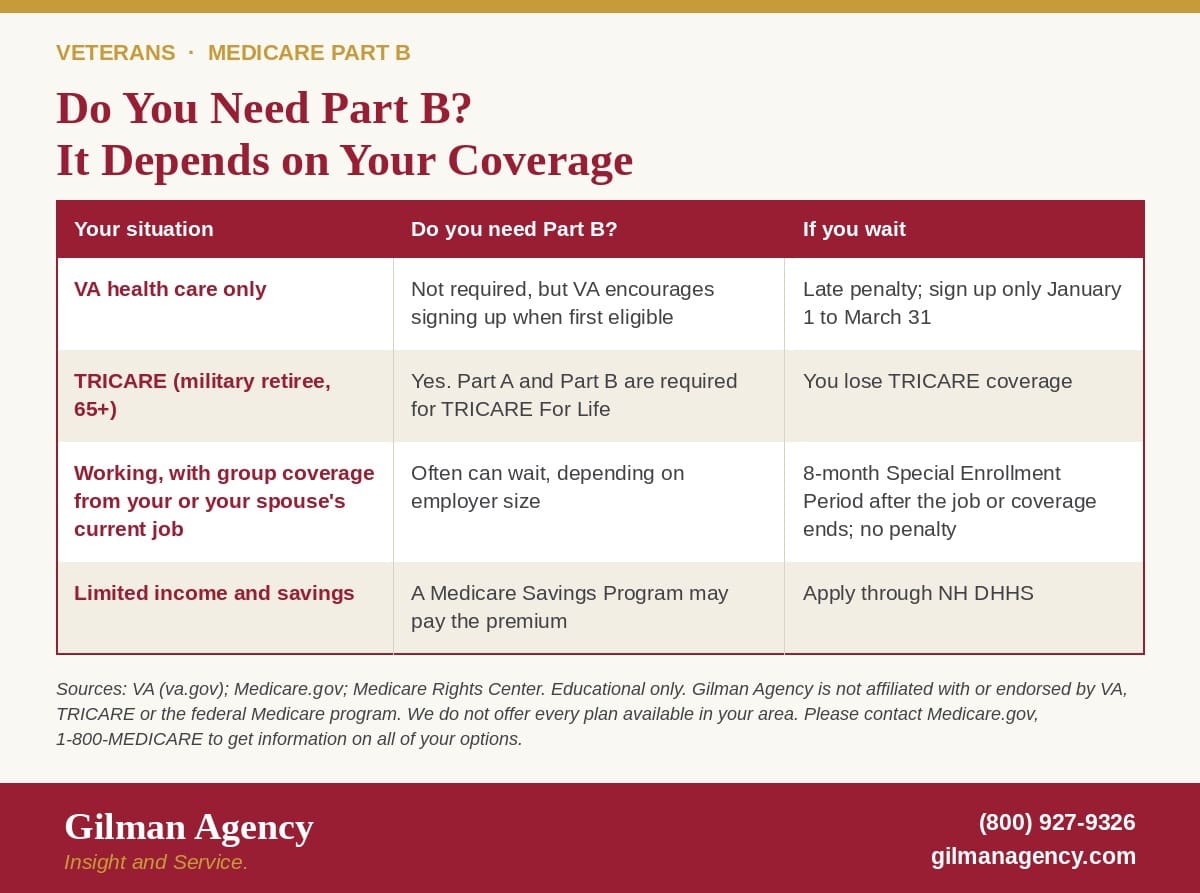
TRICARE For Life is for military retirees and their families, and it’s different from VA health care. Once you have Part A and Part B, TRICARE For Life generally pays after Medicare, covering most of what Medicare doesn’t. If you’re on active duty, or covered as an active-duty family member, different rules apply; check with TRICARE before you decide.
If you’re still working, ask your employer how its plan works with Medicare. With a smaller employer, Medicare usually pays first, so you may need Part B even while working.
When to Sign Up
Your Initial Enrollment Period is 7 months long. It starts 3 months before the month you turn 65, includes your birthday month, and ends 3 months after. Signing up in the months before your birthday month means coverage starts the first day of your birthday month.
-
Already getting Social Security? You’ll be enrolled in Part A and Part B automatically, and your Medicare card arrives in the mail about 3 months before your 65th birthday.
-
Not getting Social Security yet? Sign up at ssa.gov, by phone at 1-800-772-1213, or at your local Social Security office.
Talk with VA and a licensed agent before you turn down Part B. It’s much easier to sign up on time than to fix a missed window later.
What To Do Next
If you’re a veteran approaching 65, or you skipped Part B and are wondering whether to sign up, we can go over how Medicare would work alongside your VA health care, what it would cost, and which coverage options fit how you use VA care.
Call Gilman Agency at (800) 927-9326 or email .
We do not offer every plan available in your area. Please contact Medicare.gov, 1-800-MEDICARE to get information on all of your options.
This article is for educational purposes only. Gilman Agency is not affiliated with or endorsed by the U.S. Department of Veterans Affairs, TRICARE or the federal Medicare program. Confirm your VA eligibility with VA and your Medicare enrollment with Social Security.


