

By Marc Gilman
Questions?
Call (800) 927-9326 or email
Key Takeaways
-
They are two different ways to get Medicare. Original Medicare (Parts A and B) is run by the federal government. Medicare Advantage (Part C) is offered by private insurers that must cover what Original Medicare covers.
-
The premium is only one piece of the cost. Deductibles, copays, coinsurance, drug costs and the plan’s out-of-pocket maximum can matter more than the monthly premium.
-
Your doctors and your health needs should drive the choice. Networks, referrals and prior authorization work differently in each path.
-
The Annual Enrollment Period (AEP) runs Oct. 15 to Dec. 7, 2026. Changes take effect Jan. 1, 2027.*
What Is the Difference Between Original Medicare and Medicare Advantage?
Original Medicare includes Part A (hospital) and Part B (medical). You can see any doctor or hospital in the country that accepts Medicare. It has deductibles and generally 20% coinsurance for many Part B services, and it has no annual limit on what you pay. Most people add a Part D drug plan and often a Medicare Supplement (Medigap) plan to help with the gaps.
Medicare Advantage bundles Part A and Part B, usually includes drug coverage, and often adds extras such as dental, vision, hearing or an over-the-counter allowance. These plans use provider networks, may require referrals or prior authorization, and have an annual out-of-pocket maximum. You still pay your Part B premium, and the plan may charge its own premium on top. Once you reach the plan’s out-of-pocket limit, you pay nothing more for covered services for the rest of the year. You can’t buy a Medigap plan to go with a Medicare Advantage plan.
How Do the Costs Compare?
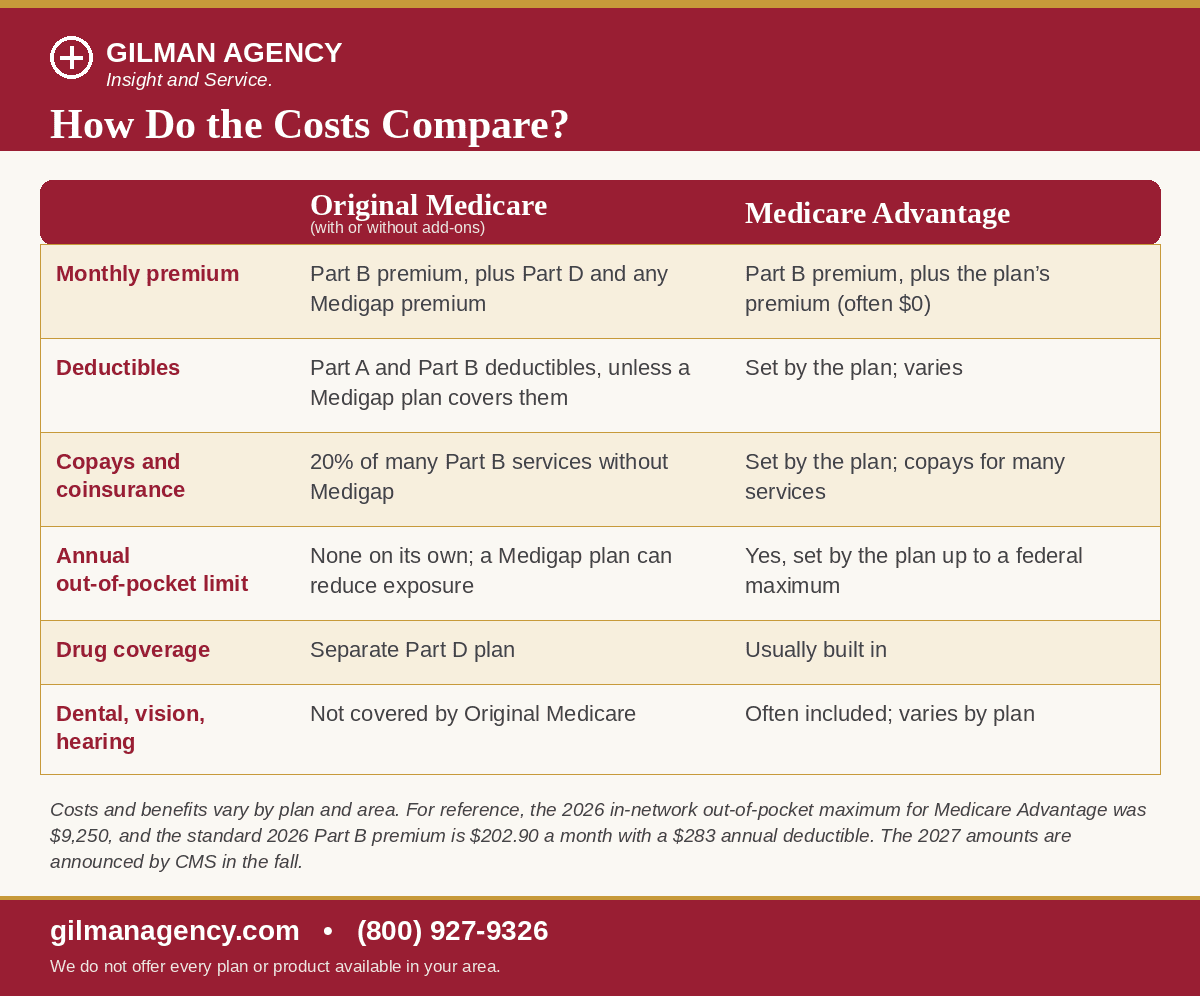
Costs and benefits vary by plan and area. For reference, the 2026 in-network out-of-pocket maximum for Medicare Advantage was $9,250. For reference, the standard 2026 Part B premium is $202.90 a month with a $283 annual deductible. The 2027 amounts are announced by CMS in the fall.
Why Isn’t the Lowest Premium Always the Lowest Cost?
A $0 premium plan can look like the obvious winner, but the premium only tells you what you pay for coverage, not what you pay when you use it. Compare these:
-
The out-of-pocket maximum. This is the most you could pay in a year for covered in-network services. Federal rules set a ceiling; for 2027, reporting based on CMS standards puts the in-network limit at $9,850, and plans may set lower limits. A plan with a low premium and a high maximum can cost more in a year with serious health needs.
-
Copays and coinsurance. Specialist visits, hospital stays, imaging, therapy and skilled nursing can carry different charges, and they add up.
-
Prescription costs. Check the plan’s deductible, your drugs’ tiers and which pharmacies are preferred. For 2027, the Part D out-of-pocket cap is $2,400 (up from $2,100 in 2026) and the maximum deductible is $700 (up from $615), according to Medicare.gov. What you pay before reaching the cap depends on your plan.
-
Doctors and network. Care outside a plan’s network can cost more or may not be covered, depending on the plan type.
-
Extras you’ll actually use. Dental, vision and hearing benefits only add value if you use them, and they may have limits.
A plan with a higher premium can be less expensive overall for someone who expects frequent care, and a plan with a low premium can be a good fit for someone who rarely uses it. The only way to know is to compare your own doctors, prescriptions and likely care.
How Does Doctor Access Differ?
With Original Medicare, you can use any provider that accepts Medicare, nationwide, and you generally don’t need referrals. Medicare Advantage plans use networks. An HMO generally requires you to stay in network and may require referrals, while a PPO may let you go out of network at a higher cost. Some plans require prior authorization for certain services. If you split time between two homes or travel often, check how the plan handles care away from home.
What About Switching Later?
This is a major difference and worth understanding before you choose:
-
Moving from Medicare Advantage to Original Medicare is generally possible during AEP or the Medicare Advantage Open Enrollment Period (Jan. 1 to Mar. 31), and you can pick a Part D plan at the same time.
-
Adding a Medigap plan later may involve medical underwriting, depending on your state and timing, so coverage or pricing is not guaranteed. Medigap rules differ by state. Massachusetts, for example, allows year-round guaranteed switching into a Medigap plan, according to U.S. News reporting, while many states do not. Ask about your state’s rules before relying on being able to switch.
Which Is Right for Me?
Neither path is better for everyone. These questions can help:
-
Which doctors and hospitals do I want to keep? Check each one against the plan network.
-
How much care do I expect to use? Think about ongoing conditions, specialists and any planned procedures.
-
How do I feel about predictable vs. variable costs? Copays and an out-of-pocket limit differ from 20% coinsurance with a supplement.
-
Do I travel or live in two places?
-
What are my prescriptions, and what will they cost on each plan?
-
What would I do if my plan changed next year? Plans can change benefits, networks and premiums every year.
*Some 2027 Medicare Advantage plans can set enrollment caps and may close to new members before Dec. 7, so starting your review early helps.
Where Does Insurance Planning Fit In?
Choosing between Original Medicare and Medicare Advantage affects what you pay for the next year, and sometimes longer. Looking at your doctors, medications and expected care side by side, with the plans available in your area, is the most reliable way to compare. We can walk through the options and explain how each one would work for you.
What To Do Next
If you’re deciding between Original Medicare and Medicare Advantage, we’re happy to compare your options before the Dec. 7 deadline.
Questions? Call (800) 927-9326 or email
Prefer we reach out to you instead? Complete our Permission to Contact form and a licensed Gilman Agency agent will follow up.
Sources: U.S. News & World Report, “Medicare Advantage vs. Original Medicare: 2027 Plan Preview” (via WTOP, Aug. 2026); Medicare.gov, “Compare Original Medicare & Medicare Advantage” (medicare.gov); CMS, Contract Year 2027 Part C benefit standards (as reported by BenefitsUSA); Medicare.gov, “Part D costs”; UnitedHealthcare 2027 Part D summary; MedicareGuide.com, “Medicare Advantage vs. Original Medicare: Which Is Better in 2027?” (updated Sept. 1, 2026); CMS 2026 Medicare Parts A & B premiums and deductibles.
We do not offer every plan available in your area. This article is for general educational purposes and is not an offer of coverage or a recommendation of any specific plan. Plan benefits, networks, costs and availability vary by plan and location and can change each year. For more information, contact Marc Gilman, licensed insurance agent, at (800) 927-9326, or call 1-800-MEDICARE for a full list of your options.


