
By Marc Gilman
Questions?
Call (800) 927-9326 or email
Key Takeaways
-
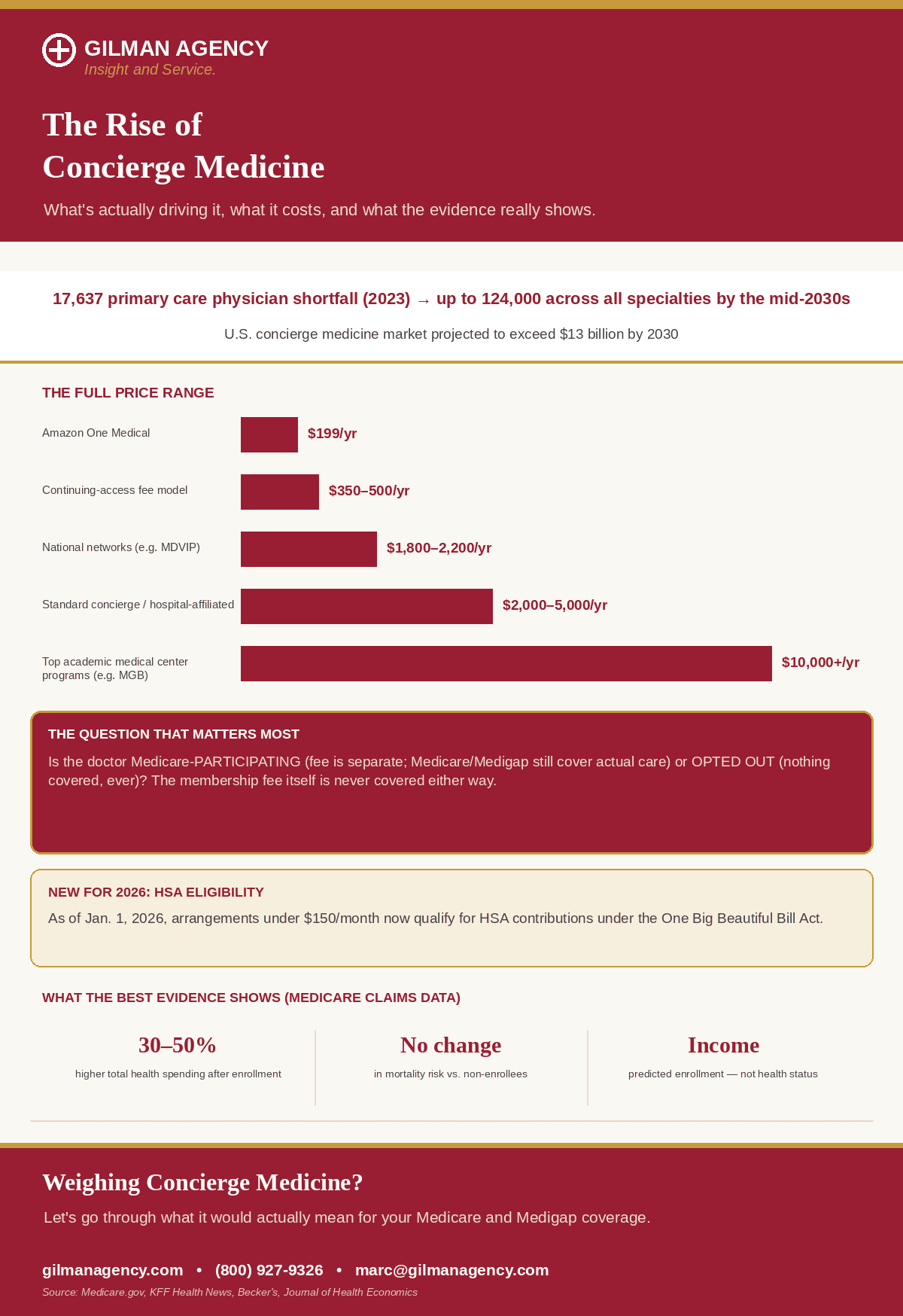
The growth is real and driven by a genuine physician shortage — a specific 2023 shortfall of 17,637 primary care doctors, with broader physician shortage projections running as high as 86,000–124,000 by the mid-2030s. The U.S. concierge medicine market is projected to exceed $13 billion by 2030.
-
“Concierge medicine” spans an enormous price range — from $199/year (Amazon’s One Medical) to $350–500/year paywall-style fees at some independent practices, to $1,800–5,000/year for national networks and hospital-affiliated programs, up to $10,000+/year at top-branded academic medical center programs like Mass General Brigham’s.
-
The membership fee is never covered by Medicare or Medigap — but that doesn’t mean nothing else is. Whether your actual medical care is still billed to Medicare depends entirely on whether the specific doctor is Medicare-participating, non-participating, or has opted out entirely.
-
The strongest available evidence, using Medicare claims data specifically, found no mortality benefit and a 30–50% increase in total health spending among enrollees — with income, not health status, predicting who joined.
-
A new 2026 tax rule genuinely helps lower-cost arrangements: as of January 1, 2026, people with high-deductible health plans can now contribute to an HSA while in a direct primary care or concierge arrangement costing less than $150/month.
Why This Is Growing Right Now
The core driver is a real, well-documented physician shortage, not just marketing. A 2023 count put the primary care physician shortfall specifically at 17,637, with the Association of American Medical Colleges projecting the shortage across all specialties could reach 86,000 to 124,000 physicians by the mid-2030s. The practical result: patients in some metro areas wait three weeks or more for a new-patient appointment, and once inside the exam room, the national average visit runs under 20 minutes.
Concierge medicine — also called retainer medicine, boutique medicine, or membership medicine — responds directly to that squeeze. A doctor who might otherwise carry 2,000 to 3,500 patients instead limits their panel to somewhere between 100 and 600, funded by an annual or monthly membership fee layered on top of whatever insurance already covers.
The market reflects the demand: the U.S. concierge medicine market is projected to top $13 billion by 2030, with the global market expected to roughly double from $20.5 billion in 2025 to $44.3 billion by 2034.
The Full Price Range, Low to High
“Concierge medicine” isn’t one product — it’s a spectrum, and the differences matter:
-
$199/year: Amazon’s One Medical (with a discount for Prime members)
-
$350–500/year: some independent practices, functioning more as a continuing-access fee than a premium service tier
-
$1,800–2,200/year: national networks like MDVIP, which partner with independent physicians
-
$2,000–5,000/year: the median range for most standalone concierge and hospital-affiliated programs, per industry data
-
$10,000+/year: top-branded academic medical center programs, including Mass General Brigham’s Boston-based concierge practice
Several major health systems now offer their own concierge programs, including Cleveland Clinic, Johns Hopkins, Northwestern Medicine, Penn Medicine, Mass General Brigham, and Rush University System for Health.
What the Fee Actually Buys — And What It Doesn’t
Across nearly every model, the structure is consistent: the membership fee covers access and time — same-day appointments, 24/7 physician contact, longer visits, care coordination — while insurance still covers the actual clinical services: labs, imaging, specialist visits, hospitalizations, and prescriptions.
Medicare.gov states this plainly for anyone on Medicare: the membership fee is never covered. But there’s a genuinely important compliance detail worth knowing — if a doctor accepts Medicare assignment, the fee legally cannot include charges for anything Medicare would normally cover. The fee has to stay limited to the genuinely non-covered extras. If something specific isn’t covered, the doctor is required to provide a written Advance Beneficiary Notice of Noncoverage (ABN) explaining why.
The single most important question to ask any practice: is the doctor Medicare-participating, non-participating, or fully opted out? A participating doctor bills Medicare normally for actual care, on top of the separate membership fee. A doctor who has formally opted out — a small but real share of concierge and direct-care physicians — accepts nothing from Medicare at all, for any service, meaning Medigap has no underlying claim to supplement either. That distinction changes the real cost picture dramatically, and it’s not something you can assume from a practice’s marketing materials.
A New Rule Worth Knowing: HSA Eligibility Changed in 2026
The One Big Beautiful Bill Act, signed into law in 2025, changed HSA eligibility for lower-cost direct primary care and concierge arrangements. Effective January 1, 2026, someone with a high-deductible health plan can contribute to an HSA while enrolled in an arrangement costing less than $150 a month ($1,800/year) — a threshold that captures models like MDVIP’s but not higher-end hospital programs running well above it.
What the Best Available Evidence Actually Shows
Separate from marketing claims and satisfaction surveys, one study stands out for its rigor: a peer-reviewed Journal of Health Economics paper by researchers at UC Berkeley and the University of Pennsylvania, using Medicare claims data specifically. The findings:
-
Enrollment corresponded with total health spending rising 30% to 50% higher than before enrollment.
-
No detectable change in mortality risk between enrollees and comparable non-enrollees.
-
Health status did not predict who enrolled — neighborhood income level was the stronger predictor. Enrollees tended to be slightly older, have fewer chronic conditions, and be more likely to be white.
The researchers’ own conclusion is worth stating directly: if society prioritizes expanding healthcare access to people in worse health and lower-income areas, concierge medicine works against that goal, since it doesn’t appear to redirect physician time toward people in worse health — it redirects it toward people who can pay.
The Access Critique, and Where It’s Sharpest
Several health policy experts have raised a related concern with real teeth: when a physician’s patient panel shrinks from thousands to a few hundred, the patients who don’t or can’t follow into the concierge tier need somewhere else to go — and that “somewhere else” is an already-strained system. One patient in Cambridge, Massachusetts, whose doctor converted to concierge care, said her health plan’s response when she declined to pay was simply: “You can go to urgent care.”
A related critique has specifically targeted nonprofit, tax-exempt hospitals running concierge programs — institutions originally chartered in part to serve the broader public, including the poor. As one hospital finance expert put it, concierge patients “do not come with bad debts or a need for charity care… they are the ideal patient, from the hospitals’ perspective.” Several major systems have opened concierge practices well outside their normal service areas specifically to reach wealthier populations.
Some practices have responded by offering patients who decline the membership a lower service tier within the same practice group — rather than being cut loose entirely — though that tier often means longer waits and more visits with a physician assistant or nurse practitioner rather than the doctor.
Real Experiences, Both Directions
The honest picture includes genuine upside for individual patients. One longtime patient described switching doctors after years of a prior physician repeatedly overlooking a decades-old mastectomy in her chart; her new concierge physician took real time to actually learn her history. A Northampton, Massachusetts physician who opened a direct primary care practice put the motivation for doctors plainly: “It’s a way to practice self-preservation in this field that is punishing patients and doctors alike… It’s either we do something like this or we quit.”
Both things are true at once: real, individual value for people who use it, and a real, documented cost and access tradeoff at the population level.
Questions Worth Asking Before Joining
-
Is this specific doctor Medicare-participating, non-participating, or opted out — and have you confirmed that directly rather than assumed it?
-
What exactly does the membership fee include, and what continues to be billed to insurance or Medicare separately?
-
If you don’t join or later leave, what happens — are you assigned a new provider, or told to find one yourself?
-
Is the annual cost one you could sustain indefinitely, not just for the first year?
-
Does the practice publish its pricing, or does obtaining a quote require a call — and if the latter, why?
What To Do Next
If you or a family member is weighing a concierge medicine membership — or your own doctor has announced a conversion to the model — let’s go through what it would actually mean for your Medicare and Medigap coverage specifically before you commit to anything.
Questions? Call (800) 927-9326 or email
Prefer we reach out to you instead? Complete our Permission to Contact form and a licensed Gilman Agency agent will follow up.
Sources: Medicare.gov, “Concierge Care”; Becker’s Hospital Review, “Concierge Medicine, Explained” (Paige Twenter, October 2025); KFF Health News, “Hospitals Cash In on a Private Equity-Backed Trend: Concierge Physician Care” (Phil Galewitz, April 2024) and “The Concierge Catch: Better Access for a Few Patients Disrupts Care for Many” (John Rossheim, July 2024); Leive, David & Candon, “On Resource Allocation in Health Care: The Case of Concierge Medicine,” Journal of Health Economics (July 2023); Cleveland Clinic, “Concierge Medicine: What Are the Pros and Cons?”; Mass General Brigham, Concierge Medicine FAQ; Journal of Family Medicine and Primary Care literature review (2024).
This article is for general educational purposes and is not personalized medical or financial advice. Concierge medicine arrangements, pricing, and Medicare billing status vary significantly by practice — confirm all details directly with any specific practice before enrolling. This is not a recommendation regarding any specific provider or program. Consult a licensed advisor for guidance specific to your situation.


