

By Marc Gilman
Questions?
Call (800) 927-9326 or email
Key Takeaways
-
The year before retirement is the riskiest year to hit a bad market. A downturn right before you start drawing down your portfolio — “sequence of returns risk” — can do lasting damage that the same downturn ten years earlier or later wouldn’t.
-
New modeling from BlackRock puts numbers on it. Comparing a traditional stock-bond portfolio to one with 30% allocated to guaranteed income, BlackRock found the guaranteed-income portfolio sustained 26% more cumulative spending over 30 years in a normal market — and 29% more when a 2008-style crash was simulated right before retirement.
-
Guaranteed income also cut spending volatility by double digits in every scenario tested. Volatility per dollar of spending dropped 18%–21% across the five market scenarios BlackRock modeled, meaning more predictable spending year to year, not just a higher average.
-
It performed well in both rising and falling rate environments — 33% higher spending in a rising-rate scenario, 19% higher in a falling-rate one — though the advantage was smaller when rates fell, since traditional bond-like assets also do better in that environment.
-
There’s no free lunch. In BlackRock’s one deliberately unfavorable scenario — strong market growth combined with a high annuity purchase price — the benefit shrank to a 4% spending increase and an 8% volatility reduction. Still positive, but a reminder that price and timing matter.
-
This research adds to a growing body of work on “retirement alpha.” Industry research going back to a 2010 Financial Research Corporation study has found that mortality credits — the pooling mechanism behind lifetime income annuities — provide returns uncorrelated to the market that a traditional bond portfolio structurally cannot replicate.
The Risk Most Retirement Plans Don’t Stress-Test
Most people think about market risk the same way throughout their investing life: more risk when you’re young, less risk as you approach retirement. That’s sound advice for growing a portfolio — but it misses a specific and much narrower risk that shows up right at the transition into retirement.
It’s called sequence of returns risk, and it’s about when a bad year happens, not just whether one happens. A 20% market drop absorbed at age 40, with decades left to recover, barely shows up in a long-term plan. The same 20% drop at age 64 — the year before you start withdrawing from that portfolio to live on — can permanently reduce how much you can safely spend for the rest of retirement, because you’re selling shares at depressed prices just as you start drawing them down.
BlackRock’s Retirement Solutions team set out to measure exactly how much that risk matters, and what role guaranteed income can play in softening it.
What BlackRock Modeled
Using its proprietary lifecycle and market-scenario models, BlackRock compared two versions of the same retirement portfolio for a representative saver (starting account balance of $174,000 at age 63, retiring at 65): a traditional 40% equities / 60% fixed income portfolio, and a version that kept the same 40% equity allocation but split the remaining 60% between fixed income (30%) and guaranteed income (30%) — income from an annuity embedded directly into the portfolio.
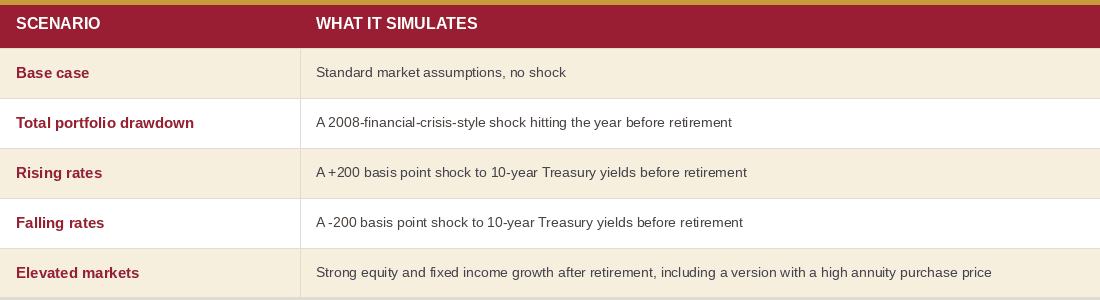
They then ran that comparison across five different market conditions:
What the Numbers Showed
In every single scenario, the portfolio with guaranteed income sustained higher cumulative spending over 30 years of retirement — and with less volatility from year to year:
-
Base case: 26% more cumulative spending with guaranteed income built in, and 18% less spending volatility.
-
2008-style crash right before retirement: 29% more cumulative spending, and 19% less volatility — the scenario where guaranteed income mattered most, precisely because it’s the one where sequence-of-returns risk is at its worst.
-
Rising interest rates: 33% more spending — rising rates actually improved annuity pricing, compounding the benefit.
-
Falling interest rates: 19% more spending — a smaller advantage, since traditional bonds also benefit when rates fall.
-
Strong markets with a high annuity purchase price: Just 4% more spending and 8% less volatility — still an improvement, but BlackRock is explicit that this scenario shows “there’s no free lunch”: when markets are already strong and the cost of guaranteed income is elevated, the relative advantage shrinks.
Why Guaranteed Income Softens the Blow
The mechanism is fairly direct. A traditional portfolio has to actually sell investments to generate spending income — and if a market crash hits right as that withdrawal phase begins, retirees are often selling at the worst possible time to cover expenses, locking in losses that a purely buy-and-hold investor never has to realize. Behaviorally, it’s also when people are most likely to panic-sell into cash at exactly the wrong moment.
Guaranteed income sidesteps that dynamic entirely: an annuitized portion of the portfolio keeps paying out on schedule regardless of what markets are doing that week, month, or year. BlackRock’s research frames this as letting retirees “spend with greater confidence and reduce volatility over time” — and notes it can also let a retiree keep more of their remaining liquid portfolio invested in stocks, since the guaranteed floor already covers essential spending.
The Research Fits a Broader Pattern
BlackRock’s findings echo a line of research the retirement-income industry has been building for over a decade. A 2010 Financial Research Corporation study concluded that income annuities provide cash flow “uncorrelated to market returns” along with what researchers have taken to calling retirement alpha — value that comes specifically from mortality credits, the pooling mechanism where funds from annuity holders who pass away support continued payments to those still living, rather than from picking better investments.
That research also points to why this matters more than most retirement calculators assume: standard planning tools are often modeled only to age 90, but demographic data shows that’s an increasingly poor assumption. Roughly 33% of men, 44% of women, and 63% of married couples live beyond age 90 — meaning a meaningful share of retirees will outlive a plan that wasn’t built for them to. Academic researchers including Dr. Menahem Yaari and Dr. Moshe Milevsky have separately concluded that do-it-yourself withdrawal strategies from a diversified portfolio carry real failure risk over that kind of extended, unlucky timeline — precisely the risk that lifetime income is structurally built to remove.
Questions Worth Asking Yourself
-
If the market dropped 20%–30% in the year or two right before I retire, how would that change my plan?
-
How much of my essential monthly spending would I want protected regardless of what markets do that year?
-
Am I currently planning around a fixed retirement age assumption (like 90), or building in the real chance of living longer?
-
Is my current fixed-income allocation doing anything more for me than an annuitized portion could?
Who Tends to Consider This
Guaranteed income tends to be worth a close look for people who:
-
Are within five to ten years of retirement, when sequence-of-returns risk is most acute
-
Want a defined floor for essential expenses that isn’t exposed to market timing
-
Have a family history or personal health outlook that suggests a longer-than-average retirement
-
Are open to exploring what portion of a traditional bond allocation could be restructured as guaranteed income instead
What To Do Next
BlackRock’s own research is explicit that this isn’t an argument for timing the market to buy an annuity — it’s a demonstration of the range of outcomes retirees can expect with and without guaranteed income built into a portfolio, across very different market conditions. Whether it makes sense for you, and how much, depends on your timeline to retirement, your existing portfolio mix, and how much certainty you want around your essential spending.
If you’d like to see what a guaranteed-income allocation could look like against your own retirement timeline, we’re happy to walk through it.
Questions? Call (800) 927-9326 or email
Prefer we reach out to you instead? Complete our Permission to Contact form and a licensed Gilman Agency agent will follow up.
Sources: Nick Nefouse, Stacey Tovrov, Kate Tan, Hiteeksha Mathur Ghai, and Emma Chu, “Anchor Your Spending Across Choppy Waters,” BlackRock Retirement Solutions (blackrock.com), 2026; Financial Research Corporation, “Income Annuities Improve Portfolio Outcomes in Retirement” (2010), as cited by Tom Hegna, “The Research Behind Retirement Alpha,” tomhegna.com; Dr. Menahem Yaari and Dr. Moshe A. Milevsky, academic research on lifetime income annuities and sustainable withdrawal strategies, as cited by Tom Hegna.
This article is for general educational purposes and is not a recommendation to purchase any specific annuity product. The figures cited come from a third-party modeled analysis using hypothetical assumptions, a single representative persona, and historical and simulated market scenarios; actual results for any individual will vary based on the specific products, timing, pricing, and market conditions involved. Annuity guarantees are backed by the financial strength and claims-paying ability of the issuing insurance company and are further subject to state guaranty association limits — not a government guarantee. Annuities involve trade-offs, including limited liquidity and, depending on the product, fees and surrender charges. This is not investment, tax, or legal advice. Consult a licensed advisor for guidance specific to your situation.


