
By Marc Gilman
Call (800) 927-9326 | Email marc@gilmanagency.com
If you’ve seen ads promising “money back” on your Social Security check, they are usually describing the Part B giveback. It is a real benefit, offered by some Medicare Advantage plans, that lowers the Part B premium you pay each month.
With Medicare Annual Enrollment open through December 7, 2026, giveback plans are getting a lot of attention. Here is how the benefit works, who qualifies, and what to weigh before choosing a plan for the extra money.
Key Takeaways
-
A Part B giveback is a Medicare Advantage benefit that lowers the Part B premium you pay. It is not available with Original Medicare or Medigap.
-
You must have Medicare Part A and Part B, live in the plan’s service area, and pay your own Part B premium.
-
If Medicaid or a Medicare Savings Program pays your Part B premium, you can’t receive a giveback.
-
The reduction is handled by Medicare and Social Security. It can take several months to appear, but you receive full credit.
-
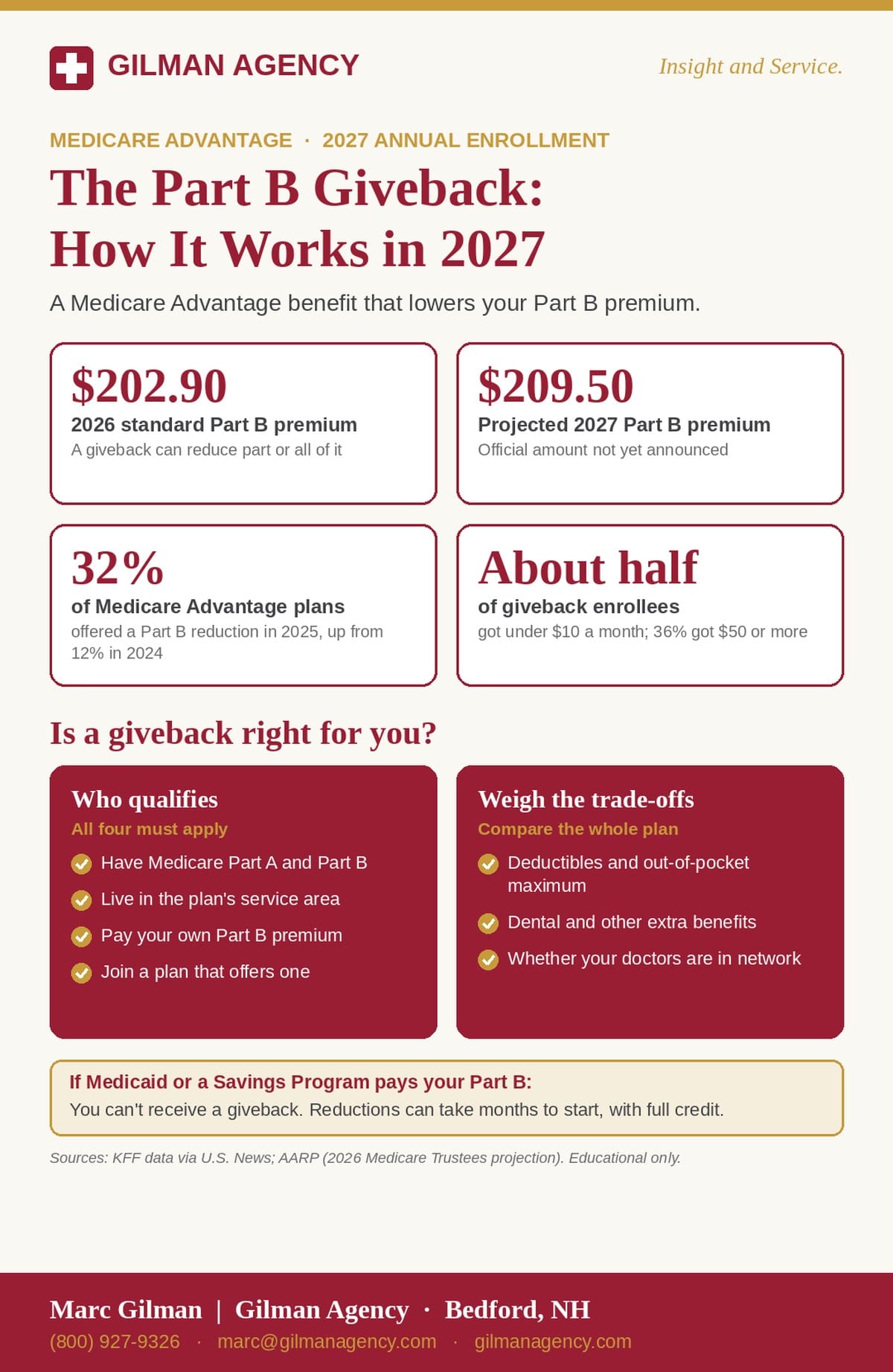
The standard Part B premium is $202.90 a month in 2026 and is projected to be $209.50 in 2027.
-
Giveback plans often trade the extra money for higher out-of-pocket costs or narrower networks, so compare the whole plan, not just the giveback.
How Does the Part B Giveback Work?
Everyone with Part B pays a monthly premium, usually taken out of their Social Security check. A plan with a giveback benefit, also called a Part B premium reduction or “buydown,” pays part of that premium for you.
-
The plan tells Medicare how much it will reduce your premium.
-
Medicare and the Social Security Administration apply the reduction.
-
If your premium comes out of your Social Security check, the reduction is credited to that check. If you pay Medicare directly, your premium bill goes down.
-
It can take several months for the reduction to begin. When it does, you receive full credit for the months you missed. The giveback is a premium credit, not a separate cash payment.
The money comes from how Medicare pays these plans. Medicare sets a benchmark payment for each county. When a plan’s cost to provide Medicare benefits comes in below that benchmark, it receives part of the difference as a rebate, which it must return to members as extra benefits, lower costs, or premium reductions. MedPAC reported an average rebate of $2,255 per enrollee in 2025.
Who Qualifies for a Part B Giveback?
You can receive a giveback if you:
-
Have Medicare Part A and are enrolled in Part B.
-
Enroll in a Medicare Advantage plan that offers the giveback.
-
Live in that plan’s service area.
-
Pay your own Part B premium.
If Medicaid, a Medicare Savings Program, or someone else pays your Part B premium for you, you are not eligible for the reduction.
How Much Is the Giveback?
Amounts vary widely by plan and county, and a reduction can’t be larger than the standard Part B premium. According to KFF data cited by U.S. News:
-
About 32% of Medicare Advantage plans offered some form of Part B premium reduction in 2025, up from 12% in 2024.
-
About half of people in giveback plans received less than $10 a month.
-
About 36% received $50 or more a month.
The standard Part B premium is $202.90 a month in 2026. It is projected to rise to $209.50 in 2027, though Medicare has not yet announced the official amount.
What Are the Trade-Offs?
A giveback isn’t free money. Plans that spend their rebate on premium reductions have less to spend elsewhere. Compared with other plans, a giveback plan may have:
-
Higher deductibles, copays, or out-of-pocket maximums.
-
Smaller allowances for extras like dental care.
-
A narrower provider network, or higher costs out of network.
If you see doctors often, take several medications, or expect a hospital stay, the extra out-of-pocket costs can outweigh the giveback. If you’re generally healthy and your doctors are in the network, the giveback can lower your yearly costs.
Where Does Insurance Planning Fit In?
A giveback is one line in a much bigger picture. The right Medicare choice starts with your doctors, your prescriptions, your budget, and how much cost you’re comfortable carrying if you need care.
A simple test: add up the yearly giveback, then subtract what you could realistically pay in extra deductibles, copays, and drug costs. If the giveback still comes out ahead after a typical year, and your doctors and hospitals are in the network, it may be a good fit.
If you choose a plan with higher hospital copays, some people add a Hospital Indemnity Plan (HIP), which pays a set cash benefit for a covered hospital stay, to help cover those costs.
What To Do Next
Medicare Annual Enrollment runs through December 7, 2026, and changes take effect January 1, 2027. If a Part B giveback sounds appealing, let’s check whether it fits your doctors, prescriptions, and budget before you switch.
Call Gilman Agency at (800) 927-9326 or email marc@gilmanagency.com. If you would like a licensed agent to contact you about your Medicare options, please complete our Permission to Contact form. Veterans with VA or TRICARE coverage can also read our earlier post, “Are You a Veteran? Why You Want a Medicare Part B Giveback Benefit.”
Currently we represent 4 organizations which offer 18 products in your area. You can always contact Medicare.gov or 1-800-MEDICARE for help with plan choices.
This article is for educational purposes only. Benefits, premiums, formularies, provider networks, and eligibility requirements vary by carrier and service area. Always review plan documents, including the Evidence of Coverage, before enrolling. Gilman Agency is not affiliated with or endorsed by the U.S. government or the federal Medicare program.


