
By Marc Gilman
Questions? Call (800) 927-9326 or email marc@gilmanagency.com
Yes. Medicare covers the main ways sleep apnea is diagnosed and treated, from the sleep study to the CPAP machine, and now a medication. But each piece comes with rules, and missing one can mean Medicare stops paying. Here’s what’s covered, what it costs, and what to watch for if you’re choosing a plan for 2027.
Key Takeaways
-
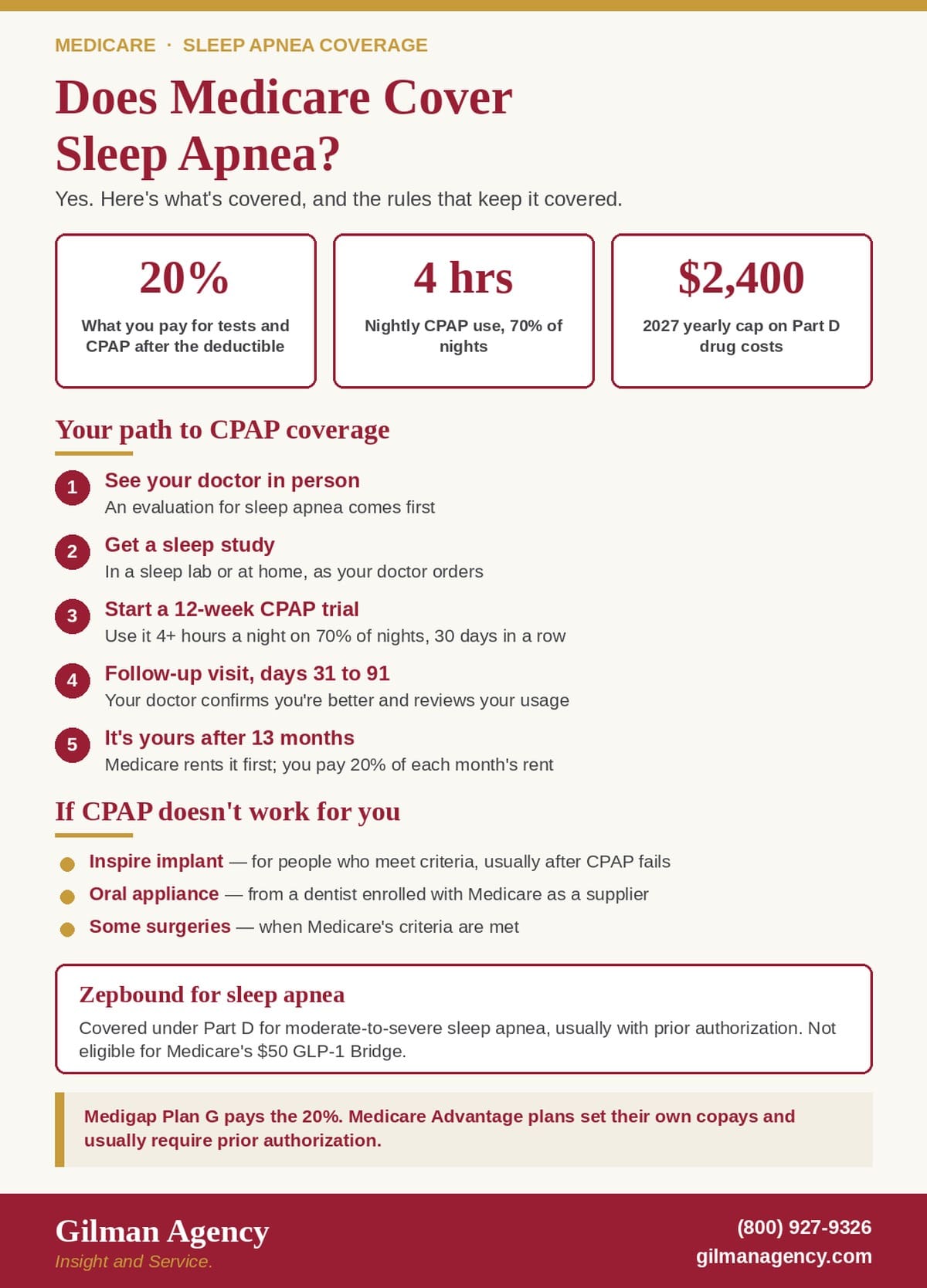
Sleep studies and CPAP are covered under Part B, at 20% of the Medicare-approved amount after the Part B deductible. A Medigap plan such as Plan G pays that 20%.
-
CPAP has a use-it-or-lose-it rule. In your first three months, you must use it at least 4 hours a night on 70% of nights in a 30-day stretch, or Medicare can stop paying.
-
Inspire, an implanted alternative to CPAP, is covered for people who meet specific criteria, usually after CPAP didn’t work.
-
Zepbound is covered under Part D for moderate-to-severe sleep apnea with obesity, through your plan’s drug list and prior authorization.
-
People with moderate-to-severe sleep apnea don’t qualify for Medicare’s $50 GLP-1 Bridge. Their Zepbound coverage runs through their Part D plan instead, with drug costs capped at $2,400 for 2027.
Does Medicare Cover a Sleep Study?
Yes. Part B covers a sleep study when your doctor orders it because of symptoms of sleep apnea, such as loud snoring, pauses in breathing or daytime sleepiness. Depending on what your doctor orders and what Medicare covers for your situation, the test may be done overnight in a sleep lab or at home with a portable monitor.
What you pay: 20% of the Medicare-approved amount after the Part B deductible ($283 in 2026). There’s no lifetime limit. You may need a new study if CPAP doesn’t work out or you stop using it.
Before the test, your doctor needs to see you in person to evaluate you for sleep apnea. That visit is part of what Medicare requires to cover CPAP later.
How Does Medicare Cover a CPAP Machine?
Part B covers CPAP machines, masks, tubing and filters as durable medical equipment when your sleep study shows obstructive sleep apnea. Here’s how it works:
-
Who qualifies: your sleep study must show at least 15 breathing events an hour, or 5 to 14 an hour if you also have symptoms such as daytime sleepiness or conditions such as high blood pressure, heart disease or a past stroke.
-
A 12-week trial: coverage starts with a three-month trial.
-
The 4-hour rule: during those first three months, you must use the machine at least 4 hours a night on at least 70% of nights during 30 days in a row. Your machine records this automatically.
-
A follow-up visit: between day 31 and day 91, your doctor must see you, confirm your symptoms are better and review your usage data.
-
Then it’s yours: Medicare rents the machine for 13 months, then you own it. You pay 20% of each month’s rental after the Part B deductible.
If you miss the 4-hour rule, Medicare can stop paying. To qualify again, you’d need another visit with your doctor and a new sleep study done in a sleep lab.
Already using CPAP when you start Medicare? Medicare can keep covering it if your earlier sleep study meets its rules and your doctor sees you after you enroll to confirm you’re still using it.
Use a Medicare-approved supplier. Equipment from a supplier that doesn’t accept Medicare may not be covered.
What If CPAP Doesn’t Work for Me?
Inspire (an implanted nerve stimulator). A small device placed under the skin keeps your airway open during sleep. Part B covers it when you meet criteria such as:
-
A sleep study within the past 24 months showing 15 to 65 breathing events an hour, mostly obstructive
-
A BMI of generally 35 or less
-
Documented CPAP failure or intolerance
-
A sleep endoscopy showing your airway is suitable
Medicare Advantage plans usually require prior authorization. With Original Medicare, you pay 20% after the Part B deductible, which can add up to a few thousand dollars without a Medigap plan.
Oral appliances. A custom mouthpiece that moves your jaw forward can be covered as medical equipment for some people with sleep apnea. It must be made by a dentist enrolled with Medicare as an equipment supplier, so ask before you order.
Surgery. Some airway surgeries, such as uvulopalatopharyngoplasty (UPPP), are covered when criteria are met. Laser-assisted uvulopalatoplasty is not.
Does Medicare Cover Zepbound for Sleep Apnea?
Yes, in many cases. In December 2024, the FDA approved Zepbound for adults with moderate-to-severe obstructive sleep apnea and obesity. Because it’s prescribed to treat sleep apnea, not for weight loss alone, Part D plans can cover it. That includes stand-alone drug plans and Medicare Advantage plans with drug coverage.
What plans usually ask for:
-
A sleep study confirming moderate-to-severe obstructive sleep apnea
-
Your BMI, showing obesity
-
A prescription written for sleep apnea, not weight loss
-
Prior authorization from your plan
What it costs: whatever your plan charges for Zepbound’s tier, after any drug deductible. Your yearly out-of-pocket cost for covered Part D drugs is capped at $2,400 in 2027, and Zepbound counts toward it.
What about the $50 GLP-1 Bridge? Medicare’s Bridge offers some GLP-1s for $50 a month for weight loss, but people with moderate-to-severe sleep apnea aren’t eligible. Their coverage goes through their Part D plan instead. Some websites mention a $50 Zepbound price without explaining this. Your doctor signs the Bridge request under penalty of perjury, so a sleep apnea diagnosis can’t be left off to qualify.
Choosing a 2027 plan? If you take or plan to take Zepbound for sleep apnea, check each plan’s 2027 drug list for its tier and prior authorization rules before December 7. This is one of the few situations where the drug plan you choose makes a big difference.
Original Medicare or Medicare Advantage: What’s Different for Sleep Apnea?
Both cover the same treatments. The differences are in cost, suppliers and paperwork.
-
Original Medicare with Medigap: you pay 20% for sleep studies, CPAP rental and Inspire, and a plan such as Medigap Plan G covers that 20%. You can use any Medicare-approved equipment supplier, and most services don’t need prior authorization.
-
Medicare Advantage: copays for equipment and procedures vary by plan, you may need to use the plan’s equipment suppliers, and prior authorization is common. Your yearly out-of-pocket maximum limits what you pay.
-
Either way, Zepbound depends on your Part D drug list, whether that’s a stand-alone plan or built into a Medicare Advantage plan.
If you’re facing a sleep study, a CPAP trial or Inspire this year, compare what each plan charges for durable medical equipment and outpatient surgery, and which suppliers it uses.
Where Does Insurance Planning Fit In?
Untreated sleep apnea raises the risk of high blood pressure, heart problems and stroke, the kinds of conditions that lead to hospital stays. If you have a Medicare Advantage plan, a hospital indemnity plan can help with the daily hospital copays. And if you’re thinking about long-term care or life insurance, applying while your sleep apnea is diagnosed and treated, with good CPAP use on record, usually looks better to insurers than untreated sleep apnea.
What To Do Next
If you have sleep apnea, or think you might, let’s check how your 2027 plan handles sleep studies, CPAP equipment, Inspire and Zepbound before December 7. Call Gilman Agency at (800) 927-9326 or email marc@gilmanagency.com. We meet by phone, by video or in person in Bedford.
Prefer that we call you? Request a call here.
Sources: CMS, Positive Airway Pressure (PAP) Devices: Documentation and Coverage; CMS National Coverage Determination 240.4 (CPAP Therapy for Obstructive Sleep Apnea) and Local Coverage Determination L33718 (Positive Airway Pressure Devices); CMS, Medicare GLP-1 Bridge: Information for Prescribers (June 2026); Sleep Foundation, Does Medicare Cover Inspire for Sleep Apnea? (January 28, 2026); MedicareFAQ, Does Medicare Cover Sleep Apnea? (April 13, 2026); SleepApnea.org, Does Medicare Cover Zepbound for Sleep Apnea? (October 28, 2026).
We do not offer every plan available in your area. Please contact Medicare.gov or 1-800-MEDICARE to get information on all of your options.
This article is for general information only and isn’t medical advice. Talk with your doctor about the right treatment for you. Coverage rules, drug lists and costs vary by plan and can change. Gilman Agency is a licensed insurance agency.


