

By Marc Gilman
Questions?
Call (800) 927-9326 or email
Key Takeaways
-
A QLAC moves money out of your RMD calculation. A Qualified Longevity Annuity Contract (QLAC) is a deferred income annuity bought with pre-tax retirement money. Until its payments begin, the premium is excluded from the balance used to calculate your required minimum distributions (RMDs).
-
The 2026 limit is $210,000 per person. That is a lifetime limit across all of your eligible accounts, and a married couple can each fund their own QLAC. Payments must begin by the first of the month after your 85th birthday.
-
It defers taxes; it doesn’t erase them. A smaller RMD can mean less taxable income in your 70s and early 80s, but QLAC payments are taxed as ordinary income when they start.
-
There are real tradeoffs. The money is generally illiquid, fixed payments can lose buying power, and if you die early the contract may not pay off unless you add a death benefit.
What Is an RMD, and Why Does It Raise Taxes?
Once you reach RMD age, the IRS requires you to withdraw a minimum amount each year from traditional IRAs and most employer plans, and you pay ordinary income tax on it whether or not you need the money. RMD age is 73 for most people today (75 for those born in 1960 or later). Each year’s RMD is generally your prior year-end account balance divided by an IRS life-expectancy factor. At age 73, that factor is 26.5.
Large RMDs can push you into a higher tax bracket, increase how much of your Social Security is taxed, and raise your Medicare premiums through the income-related monthly adjustment amount (IRMAA).
How Does a QLAC Reduce My RMDs?
When you buy a QLAC inside a traditional IRA or eligible employer plan, the premium comes out of the account, and the IRS excludes its value from the balance used to calculate RMDs until the annuity starts paying. Because the RMD formula starts with a smaller balance, your required withdrawals from the rest of the account are smaller.
Eligible accounts include traditional IRAs, 401(a), 403(a) and 403(b) plans, and governmental 457(b) plans. Roth IRAs can’t fund a QLAC, because Roth IRAs have no lifetime RMDs.
What Does This Look Like in Numbers?
Here is a simplified, hypothetical example, not a projection of your results. A single retiree turns 73 with $1,000,000 in a traditional IRA.
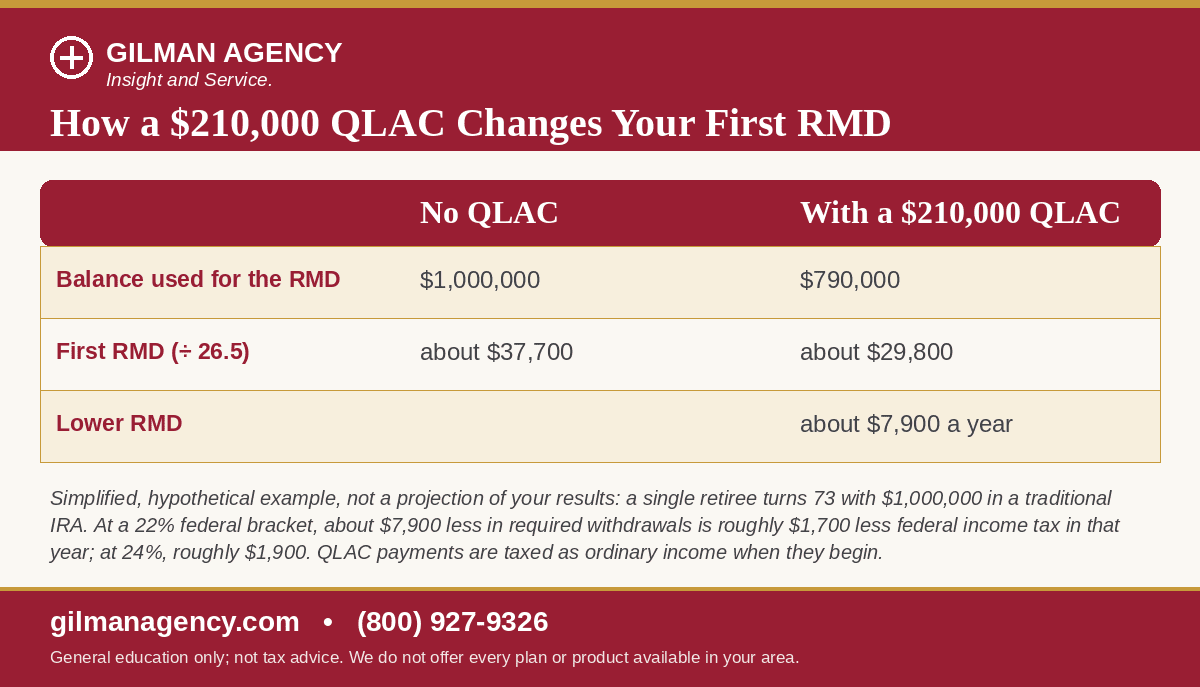
At a 22% federal bracket, about $7,900 less in required withdrawals is roughly $1,700 less federal income tax in that year. At 24% it is roughly $1,900. If the reduction holds for the 12 years from age 73 through 84, that is about $95,000 less income pushed into those years, before state taxes and before the account’s growth and later withdrawals change the math.
Two caveats matter:
-
The balance keeps changing. Real RMDs shift with account growth, withdrawals and the life-expectancy factor, which gets smaller each year.
-
The income comes back. QLAC payments are ordinary income when they begin, so this reshapes when income is taxed. It is not a permanent reduction.
How Much Could the QLAC Pay Later?
Payouts depend on your age at purchase, how long you defer, interest rates at the time, whether the contract is single or joint life, and any riders. In general, the later the income start date, the higher the guaranteed payment. One 2026 illustration from Q3 Advisors for a $210,000 premium bought at 65 estimated roughly $58,000 to $66,000 a year if payments start at 85, and the source describes these as estimates, not quotes. A Cardinal Guide example (March 2026) shows how much results vary: a 62-year-old buying a $210,000 joint-life QLAC with his 59-year-old wife, with income starting at 80, projected about $4,000 a month, or about $48,000 a year, for as long as either spouse is alive. Your actual numbers will differ, so ask for quotes from several insurers.
Where Does the Tax Benefit Show Up?
-
Federal income tax brackets. A smaller RMD can keep taxable income lower, and in some cases below a bracket line, though the Wall Street reporting we reviewed notes that a smaller RMD “will not always avoid a bracket transition.”
-
Medicare IRMAA. Medicare uses income from two years earlier to set Part B and Part D surcharges, and the thresholds act as cliffs. We cover that strategy in detail in Can a QLAC Help You Avoid Medicare’s IRMAA Surcharge?
-
Social Security taxation. Lower income can reduce how much of your benefit is taxable. How much depends on your total income.
-
Planning around the start date. When payments begin in your 80s, they add to income again. Some people plan for that by pairing a QLAC with other strategies, such as Roth conversions in lower-income years or qualified charitable distributions. Those are separate decisions with their own rules and costs.
What Are the Rules and Tradeoffs?
-
Limit. $210,000 per person in 2026, applied in total across all of your eligible accounts. Amounts above the limit lose QLAC status and stay in the RMD calculation. SECURE 2.0 removed the old rule limiting the premium to 25% of the account balance.
-
Start date. Payments must begin by the first of the month after your 85th birthday. You can choose an earlier date, but the start date generally can’t be changed after purchase.
-
Designation. A contract must be designated as a QLAC when it is purchased, and MassMutual notes an existing deferred income annuity can’t be converted later.
-
Funding. Moving money from an IRA or 401(k) into a QLAC is generally a tax-free transfer between custodians, according to Kiplinger’s contributing adviser. You can also split the limit across more than one QLAC with staggered start dates, for example payments beginning at 80 and 85.
-
Illiquidity. Once funded, the premium generally can’t be surrendered for cash.
-
Inflation. Fixed payments may lose purchasing power over a long deferral. Inflation features can cost more or lower the starting payment.
-
Death benefit. A return-of-premium rider can pay beneficiaries the premium minus payments already received, with no growth. A joint-life option can continue income to a surviving spouse. Both reduce the monthly payment.
-
Opportunity cost. The money is out of the market, so a strong market could outperform the contract’s fixed income.
-
Insurer strength. The guarantee depends on the claims-paying ability of the issuing insurer. State guaranty associations offer limited backup coverage.
-
Timing. Because RMDs are based on the prior year-end balance, the purchase generally needs to be completed before Dec. 31 to affect the following year’s RMD.
Who Tends to Consider a QLAC?
People who have large traditional IRA or 401(k) balances, expect RMDs larger than they need, have other income they can rely on in the meantime, and want income that begins later in retirement as protection against outliving their savings. A QLAC is not a good fit for money you may need access to.
Where Does Insurance Planning Fit In?
A QLAC is first an income product, and the RMD and tax effects are side benefits. Whether it helps depends on your balances, your tax bracket, your other income, your health and your timeline. We can run illustrations from several carriers, compare payout and rider options, and look at the numbers with your tax professional.
What To Do Next
If you’d like to see how a QLAC could affect your RMDs against your own numbers, we’re happy to walk through it with you.
Questions? Call (800) 927-9326 or email
Prefer we reach out to you instead? Complete our Permission to Contact form and a licensed Gilman Agency agent will follow up.
Sources: IRS Notice 2025-67 (2026 QLAC premium limit), as cited by Q3 Advisors, “What Is a QLAC? 2026 Rules and $210,000 Limit” (July 2026); Marc Guberti, “The QLAC Move That Defers $200,000 of 401(k) RMDs Past Age 85,” 24/7 Wall St. via Yahoo Finance (May 16, 2026); PlanEasy, “QLAC Guide: Rules, Limits and RMD Tax Benefits” (Feb. 26, 2026); MassMutual, “What Is a QLAC?” (updated July 28, 2026); Kiplinger (Ken Nuss, AnnuityAdvantage), “The Best Way to Defer RMDs (and Their Tax Bills): QLACs” (May 29, 2024); Cardinal Guide (Hans Scheil), “How a QLAC Can Reduce RMDs and Create Guaranteed Income Later in Retirement” (March 10, 2026); Tax Shark Inc., “How Much Can I Put Into a QLAC to Reduce RMDs?” (March 2026); IRS Uniform Lifetime Table.
This article is for general educational purposes and is not a recommendation to purchase any specific annuity product. The worked example is hypothetical and simplified, and it is not a projection or guarantee of any individual’s RMD, tax or income outcome. QLAC payments are taxed as ordinary income, and QLACs are generally irrevocable and illiquid. Annuity guarantees are backed by the claims-paying ability of the issuing insurance company and involve costs and limitations. Tax rules change. This is not tax, investment or legal advice, and this is not an offer of coverage. We do not offer every plan or product available in your area. Consult a licensed insurance professional and a tax advisor regarding your specific situation.


