By Marc Gilman
Questions?
Call (800) 927-9326 or email
Key Takeaways
-
Special needs plans have their own enrollment rules. Special needs plans (SNPs) are Medicare Advantage plans for specific groups, including people with both Medicare and Medicaid (D-SNPs) and people with certain chronic conditions (C-SNPs). Some people in these groups can enroll or switch outside the usual enrollment periods.
-
C-SNP: you can generally join anytime, but only once. Medicare.gov says people with a severe or disabling condition can join a matching Chronic Care SNP at any time, but only once, and the plan must verify the condition.
-
D-SNP: the dual and integrated care SEPs are monthly, but narrow. As of CMS’s 2025 guidance, the monthly SEPs cover standalone drug plans and integrated D-SNPs. They don’t let you move into a Medicare Advantage plan that isn’t a D-SNP.
-
If your eligibility ends, you may get time to adjust. A plan may continue your coverage for a limited period, and you may get a special enrollment period to choose another plan.
What Is a Special Needs Plan?
A special needs plan is a type of Medicare Advantage plan that limits enrollment to people who meet certain criteria. Dual Eligible SNPs (D-SNPs) serve people who have both Medicare and Medicaid. Chronic Condition SNPs (C-SNPs) serve people with qualifying chronic conditions. To join, you must meet the eligibility requirements for that specific plan, which is why SNPs have enrollment rules that differ from other Medicare Advantage plans.
How Does the C-SNP Special Enrollment Period Work?
Medicare.gov lists a Special Enrollment Period for people with “severe or disabling conditions” who match a Chronic Care SNP: you can join “anytime, but only once.”
Two details matter:
-
The condition has to be verified. Under federal rules, a C-SNP must verify your qualifying condition with a current health care provider, either before you enroll or through a pre-enrollment assessment. If verification isn’t obtained by the end of the second month, the plan must disenroll you.
-
Once means once. Medicare.gov describes the SEP as a one-time opportunity, so talk through the plan’s benefits and your doctors before using it.
What Special Enrollment Periods Are There for D-SNPs?
Since Jan. 1, 2025, CMS has had two monthly SEPs for people with Medicaid or Extra Help. The details below come from CMS’s job aid for those SEPs, which covers calendar year 2025, so confirm current rules and which states participate.
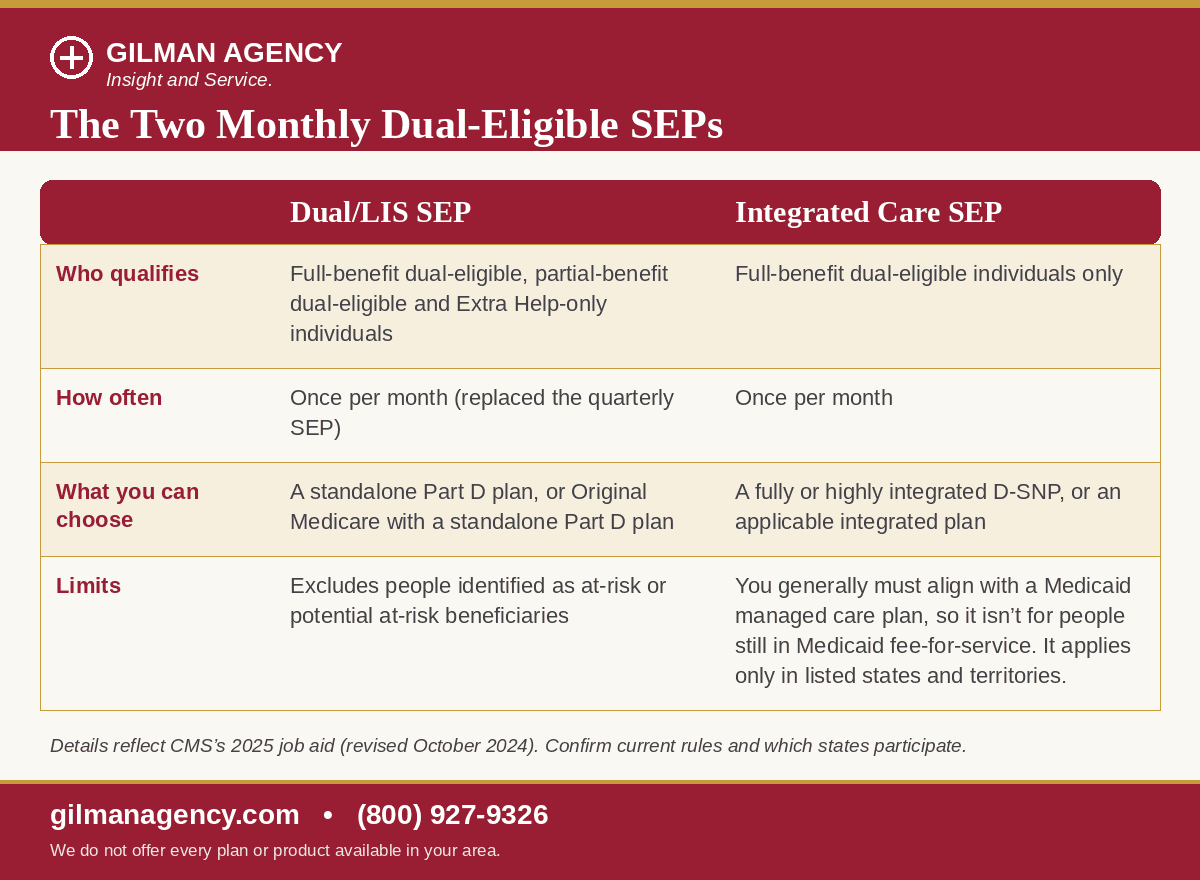
Neither SEP lets you move into a Medicare Advantage plan that isn’t a D-SNP. Dual-eligible and Extra Help members can still choose any Medicare Advantage plan during other periods, such as the Initial Enrollment Period or Annual Enrollment. If you want help understanding where D-SNPs fit when your doctor or hospital leaves a plan network, see What Happens When Your Doctor or Hospital Leaves Your Medicare Advantage Network?
What Happens If I Lose Medicaid or Extra Help?
Medicare.gov lists these separately:
-
Losing Medicaid eligibility, or being told you’re no longer eligible: 3 full months from the later of the loss or the notice.
-
Losing Extra Help eligibility: 3 full months from the later of the loss or the notice.
-
Losing special needs status: you can switch from the month you lose it until you join another plan or 3 calendar months after an involuntary disenrollment, whichever is earlier.
What Is “Deemed Continued Eligibility”?
If a special needs plan determines you no longer meet its eligibility criteria but you can reasonably be expected to meet them again within 6 months, federal rules let the plan keep you enrolled for a limited period. The rule says the period must be not less than 30 days and not more than 6 months (42 CFR § 422.52(d)).
CMS’s 2027 enrollment guidance revised the deeming rules for D-SNPs and added an explanation of when the deeming period starts. A summary by the compliance firm MHK says it begins on the first of the month after the month the information about the loss is available, and that a member whose deemed eligibility ends must get a special enrollment period to choose another Medicare Advantage or Part D plan. Your plan’s notices will tell you the dates that apply to you, so keep them.
Do I Still Have Annual Enrollment?
Yes. Annual Enrollment runs Oct. 15 to Dec. 7 and applies to anyone with Medicare. If you’re in a SNP, it is another time to compare plans, including SNP and non-SNP options, before changes start Jan. 1.*
*Some 2027 Medicare Advantage plans can set enrollment caps and may close to new members before Dec. 7, so starting early gives you more options.
What Should I Do?
-
Find out which situation applies. Are you changing because of Medicaid, Extra Help, a chronic condition or a notice you received?
-
Keep every notice. Dates in letters from your plan, your state Medicaid agency or Social Security can start or end your window.
-
Check your doctors, drugs and benefits. Compare plans using your own list, not just the premium.
-
Ask whether an integrated plan is available where you live. The integrated care SEP depends on your state and how your Medicaid is delivered.
-
Check before you use a one-time SEP. C-SNP enrollment through the SEP is once only.
Where Does Insurance Planning Fit In?
SNP rules are detailed, and the right plan can depend on whether you have full Medicaid, partial Medicaid or Extra Help. We can look at your situation, check your doctors and prescriptions against the plans available where you live, and explain which options are open to you now. If you receive a notice about your eligibility, bring it with you.
What To Do Next
If you have Medicare and Medicaid or Extra Help, or you have a chronic condition and are wondering about a special needs plan, we are happy to walk through your options.
Questions? Call (800) 927-9326 or email
Prefer we reach out to you instead? Complete our Permission to Contact form and a licensed Gilman Agency agent will follow up.
Sources: Medicare.gov, “Special Enrollment Periods” (Medicare Advantage and Part D); CMS, “Dual/LIS and Integrated Care Special Enrollment Periods” job aid (revised October 2024, effective Jan. 1, 2025); 42 CFR § 422.52 (eCFR, current as of Oct. 8, 2026); CMS, HPMS memo on the Contract Year 2027 Medicare Advantage and Part D Enrollment and Disenrollment Guidance (Aug. 25, 2026); MHK, “CMS Releases CY 2027 Medicare Advantage and Part D Enrollment and Disenrollment Guidance” (Sept. 23, 2026); Gilman Agency, “What Happens When Your Doctor or Hospital Leaves Your Medicare Advantage Network?” (Aug. 21, 2026).
Gilman Agency is not affiliated with or endorsed by Medicare or the federal government. This article is for general educational purposes and is not an offer of coverage or a recommendation of any specific plan. Eligibility for special enrollment periods and special needs plans depends on your individual circumstances, your state and your plan, and rules change. SNP availability varies by area. We do not offer every plan available in your area. For more information, contact Marc Gilman, licensed insurance agent, at (800) 927-9326, or call 1-800-MEDICARE for a full list of your options.