By Marc Gilman
Questions?
Call (800) 927-9326 or email
Key Takeaways
-
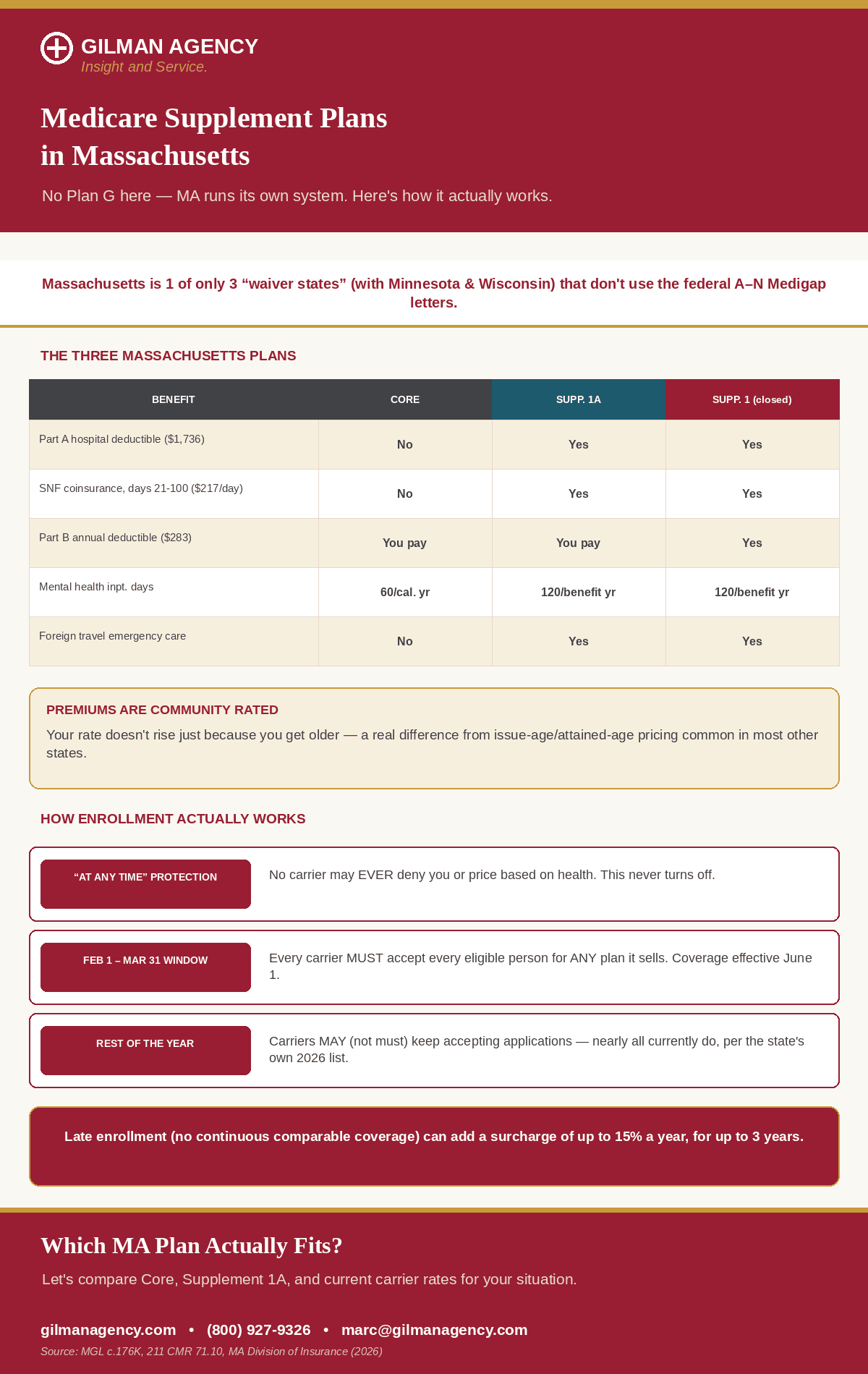
Massachusetts doesn’t use the national Medigap letters. Most of the country buys Medigap as Plans A through N, with benefits fixed by federal rule inside each letter. Massachusetts is one of only three “waiver states” (with Minnesota and Wisconsin) that standardize differently — you won’t find a Plan G here.
-
Massachusetts sells three plan types instead: Core, Supplement 1A, and Supplement 1. Supplement 1 — the most complete of the three — is closed to anyone who first became eligible for Medicare on or after January 1, 2020.
-
Premiums are community rated, meaning they don’t vary by your age or gender. Your rate doesn’t climb just because you get older, which is a real difference from the issue-age or attained-age pricing common in most other states.
-
No Massachusetts carrier may ever deny you a policy or price it based on your health — this protection is written into state law as applying “at any time,” not just during a specific window.
-
There’s still a real annual enrollment mechanic worth understanding precisely: a mandatory guaranteed-issue window every February 1–March 31, plus carrier-by-carrier voluntary continuous enrollment the rest of the year — which in practice means most people can switch plans or carriers essentially anytime, but it’s worth confirming with the specific carrier you’re considering.
Massachusetts Plays By Different Rules
If you’ve researched Medicare Supplement insurance anywhere else, you’ve probably seen it described by letter — Plan G, Plan N, and so on, with benefits standardized by federal law so a Plan G from one company covers exactly what a Plan G from another company covers. Massachusetts doesn’t work that way. It’s one of three states that received federal permission to standardize its Medigap market on its own terms, and the practical result is a shorter, differently named menu of choices.
The Three Massachusetts Plans
Core is the basic option — it covers a baseline set of Medicare’s gaps but leaves more cost-sharing to you, which makes it the lower-premium choice.
Supplement 1A is the more complete plan currently open to anyone newly eligible for Medicare. It’s the closest thing Massachusetts has to a national Plan G, with one specific gap: it does not cover the annual Part B deductible ($283 in 2026) — you pay that yourself each year.
Supplement 1 used to be the most complete plan on the market, because it also covered that Part B deductible. Federal law (the same MACRA provision that closed Plans C and F in lettered states) closed it to anyone who first became eligible for Medicare on or after January 1, 2020. If you became eligible before that date and simply haven’t enrolled yet, you can still buy it; if you already have it, you keep it.
Here’s how the three compare on the specific benefits that actually differ:
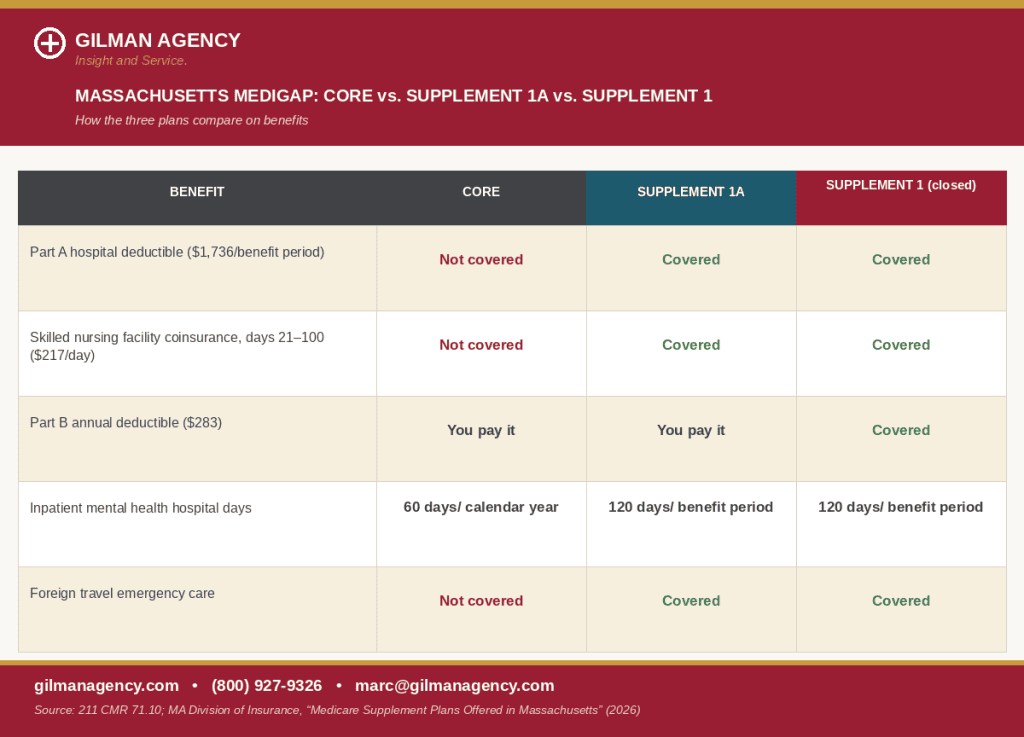
Every plan — including Core — covers the shared basics: Part A hospitalization copayments for days 61 and beyond, Part B’s roughly 20% coinsurance, and the first three pints of blood.
Why Your Premium Doesn’t Climb With Age
Massachusetts requires Medigap premiums to be community rated — they can’t vary based on your age or gender. In most other states, Medigap uses issue-age or attained-age pricing, where a low first-year quote can climb substantially over time. Here, your rate doesn’t rise simply because you had another birthday. Premiums still differ meaningfully from one carrier to another, so the insurer you choose is really the main price decision, not your age.
How Enrollment Actually Works
This is the part worth understanding precisely, because it’s more nuanced than it first appears — and getting it right matters if you’re timing a purchase or a switch.
The protection that never turns off: Massachusetts law states that no carrier may, “at any time,” deny you a policy or price it based on your age, health status, or medical condition. This is an absolute rule, not limited to a specific window.
The window every carrier must honor: Separately, state law requires every carrier to hold a mandatory annual open enrollment period each year from February 1 through March 31, with coverage effective June 1. During this window, every carrier must make all of its plans available to any eligible person — this is your one guaranteed chance to access a carrier’s full menu.
Outside that window: carriers are legally permitted, but not required, to keep accepting new applications the rest of the year. In practice, according to the state’s own current published carrier list, essentially every active Massachusetts Medigap carrier has voluntarily chosen continuous, year-round enrollment — so switching plans or carriers is a realistic option most of the year, not just during the spring window. But this is a current market condition, not a permanent guarantee for every carrier going forward, so it’s worth confirming directly with whichever carrier you’re considering if you’re planning to enroll outside the February–March window.
One more real cost to know about: applying after your initial 6-month Medicare enrollment window, without continuous comparable prior coverage, can add a surcharge of up to 15% a year, for up to three years.
Questions Worth Asking
-
Do you know which of the three plans — Core, Supplement 1A, or (if you’re eligible) Supplement 1 — actually fits your situation, or have you been comparing Massachusetts options against a national Plan G description that doesn’t apply here?
-
Have you priced the same plan type across multiple carriers? Since benefits are identical within each plan type, price and service are the real differences between companies.
-
If you’re considering a switch outside the February–March window, have you confirmed directly with that specific carrier whether it currently accepts applications year-round?
-
Do you have continuous comparable coverage to avoid the late-enrollment surcharge, or is that a cost you should be planning for?
What To Do Next
If you’re weighing Core against Supplement 1A, trying to understand whether you still qualify for Supplement 1, or just want to compare current carrier rates side by side, let’s go through your specific situation together.
Questions? Call (800) 927-9326 or email
Prefer we reach out to you instead? Complete our Permission to Contact form and a licensed Gilman Agency agent will follow up.
Sources: Massachusetts General Laws Chapter 176K, Section 3; 211 CMR 71.10 (Massachusetts Division of Insurance); Massachusetts Division of Insurance, “Medicare Supplement Plans Offered in Massachusetts” (2026, updated December 29, 2025); Centers for Medicare & Medicaid Services, “Medigap in Massachusetts” (medicare.gov).
This article is for general educational purposes and is not personalized insurance, financial, or legal advice. Plan availability, carrier participation, and enrollment practices can change. Confirm current details directly with the Massachusetts Division of Insurance, a specific carrier, or a licensed advisor before making a decision.