By Marc Gilman
Questions?
Call (800) 927-9326 or email
Key Takeaways
-
Bianco’s call is about bonds, not annuities. In an Oct. 5, 2026 outlook, Bianco Advisors said it moved its bond duration to 105% of its benchmark for the first time in six years. The post does not mention annuities, and it doesn’t make a recommendation for any insurance product.
-
He called it “a value call, not a call for lower yields.” His argument is that bonds are no longer expensive, not that yields are about to fall. He says they would become “cheap” only if yields rose above nominal GDP growth.
-
Higher yields can matter to annuity buyers. Insurers invest heavily in bonds, so the rates they credit or the income they pay on new fixed annuities generally follow the interest-rate environment, though not one-for-one.
-
A bond and an annuity are different tools. Bonds can lose value if you sell before maturity. Fixed annuities have no market price swings but come with surrender charges, insurer-backed guarantees and different tax treatment.
What Did Jim Bianco Actually Say?
Jim Bianco, president of Bianco Research and founder of Bianco Advisors, wrote that for three years his firm had been cautious to bearish on bonds because yields looked too low for the state of the U.S. economy. He says that changed over the past couple of weeks, when yields from the 5-year note through the 30-year bond all moved above 5% for the first time since mid-2007.
His reasoning is that bond yields should be compared with nominal GDP growth, which is real growth plus inflation. He points to economists’ expectations of a little over 2% real growth and core inflation of roughly 2.6% to 3.3% through mid-next year, and says nominal GDP grew 6.3% in the second quarter of 2026. On his view, most of the yield curve now sits inside the range where the economy says yields should be. That is why his firm moved to a longer-duration position.
He is also careful about what he is not saying. The post stresses that he is not calling bonds “cheap,” that inflation forecasts are still rising, and that yields have “little reason to fall far without a recession.” If yields rise further, he says bonds would become cheap and his firm would add to its position.
Bianco’s other published views, including his arguments about the Federal Reserve, are separate from this post. We’re only covering the bond-value argument here.
What Is His “Bond Math” Argument?
Bianco shows that the Bloomberg U.S. Aggregate Bond Index yield is now around 5.6%, and that yields could rise to about 6.5% over the next year before the index’s return turned negative. He says that cushion is the largest since 2009.
For a 10-year Treasury, he lays out three scenarios over the next 12 months:

These are Bianco’s illustrations for a specific bond, not forecasts and not a projection for any individual’s portfolio. Real results depend on when you buy, what you buy and whether you hold to maturity.
Why Do Bond Yields Matter for Annuities?
Insurance companies back their fixed-rate promises mostly with bonds and other fixed-income investments. When yields are higher, insurers can generally credit more interest on new fixed annuities, such as multi-year guaranteed annuities (MYGAs), and pay more income on new immediate annuities, than they could when yields were low. The same pattern can affect deferred income annuities and QLACs, whose payouts are priced off current rates and your age.
That link is general, not automatic:
-
Crediting rates and payouts vary by company, product, term and your age.
-
Insurers set rates based on their own portfolios, costs and competition, so they don’t move one-for-one with Treasury yields.
-
Rates for new contracts can change at any time, and a rate you see today may not be available next month.
We aren’t going to quote rates here, because they change frequently and depend on the product. If you want current numbers, we can pull them from the carriers we offer.
How Does a Fixed Annuity Differ From a Bond?
Both can pay interest, but the risks and rules are different.
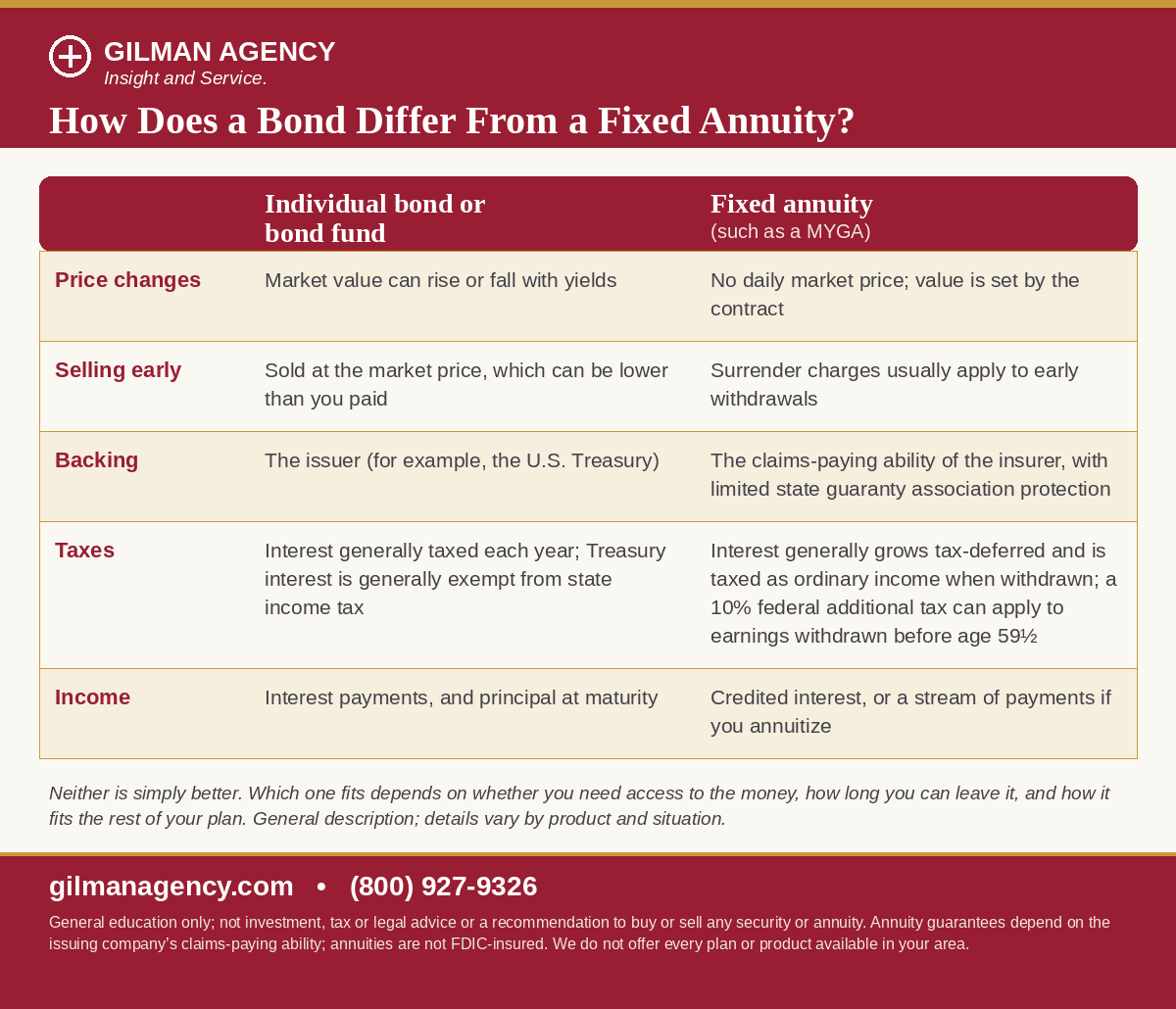
Neither is simply better. Which one fits depends on whether you need access to the money, how long you can leave it, how you feel about price swings and how the rest of your plan works.
If Yields Might Rise Again, Should I Wait?
Bianco’s own post is a reminder that nobody knows. He says yields have little reason to fall far without a recession and that he would add to bonds if they rose. Press coverage of his interviews also reports that he said the selloff may have further to run, and that he is adding exposure gradually rather than all at once. A buyer who waits may see better rates, or may see rates fall. Some people split a purchase across several terms or several dates so they aren’t relying on one rate. The right answer depends on your goals and your timeline, not on a market forecast, including this one.
Who Might Look at Fixed Annuities in This Environment?
People who tend to consider them include those who want a known rate for a set term on money they don’t expect to need, those building a floor of guaranteed income to go alongside Social Security, and those who like the idea of reducing exposure to market swings on part of their savings. Money you may need on short notice isn’t a good fit, since early withdrawals can be costly.
Where Does Insurance Planning Fit In?
A market commentator’s view on bonds isn’t a reason to buy an annuity, and it isn’t a reason to avoid one. What matters is how a product works against your income needs, taxes, other assets and time horizon. We start with those questions, then show you how the options we offer compare, then talk about what, if anything, fits. We can also work alongside your financial advisor and tax professional.
What To Do Next
If you’d like to see how current fixed annuity rates and payout options look against your own situation, we’re happy to walk through it with you.
Questions? Call (800) 927-9326 or email
Prefer we reach out to you instead? Complete our Permission to Contact form and a licensed Gilman Agency agent will follow up.
Sources: Jim Bianco, “Q4 Outlook: The Case For Bonds,” Bianco Advisors (Oct. 5, 2026), including the Bloomberg headline it cites, “Bond Veteran Jim Bianco Turns Bullish for First Time Since 2020.” Bond-return figures are Bianco’s illustrations from that post. Darryn Pollock, “Bond Bear Jim Bianco Turns Bullish as 5% Yields Hit Fair Value,” BeInCrypto (Oct. 8, 2026), a secondhand summary of Bianco’s Bloomberg and CNBC interviews.
Gilman Agency is not affiliated with or endorsed by Bianco Advisors, Bianco Research or Jim Bianco, and the commentary referenced here does not mention or endorse any insurance product. This article is for general educational purposes and is not investment, tax or legal advice, a recommendation to buy or sell any security or annuity, or an offer of coverage. Bond returns, yields and market views change. Annuity guarantees are backed by the claims-paying ability of the issuing insurance company and are subject to costs, surrender charges and limitations. Annuities are not FDIC-insured or bank guaranteed. Interest rates credited and income paid can change and vary by company and product. Tax rules change. We do not offer every plan or product available in your area. Consult a licensed insurance professional, financial advisor and tax advisor regarding your specific situation.