By Marc Gilman
Call (800) 927-9326 | Email marc@gilmanagency.com
Most people spend a long time choosing an annuity and about thirty seconds filling in the names on the application. Those names matter more than many people realize. How a non-qualified annuity is titled decides who controls it, who pays the tax, and what your family receives, and how fast, when someone dies. A titling mistake usually isn’t discovered until a death claim, when it’s too late to fix.
Here’s how the parties to an annuity work, the most common mistakes, and what your beneficiaries can do with the money.
Key Takeaways
-
Every annuity has three roles: the owner, the annuitant and the beneficiary. Each has different rights.
-
In most annuities, the owner’s death triggers the death benefit, not the annuitant’s, unless a trust or other entity owns the contract.
-
Changing the owner can be a taxable event. Moving ownership to a spouse or your own grantor trust generally isn’t; giving the annuity to anyone else generally is.
-
A named beneficiary usually avoids probate. With no beneficiary, the money goes to your estate and must be paid out within five years.
-
Beneficiaries have choices, from a lump sum to spreading payments over their life expectancy, and the choice can change how much tax they pay.
The Three Parties to an Annuity
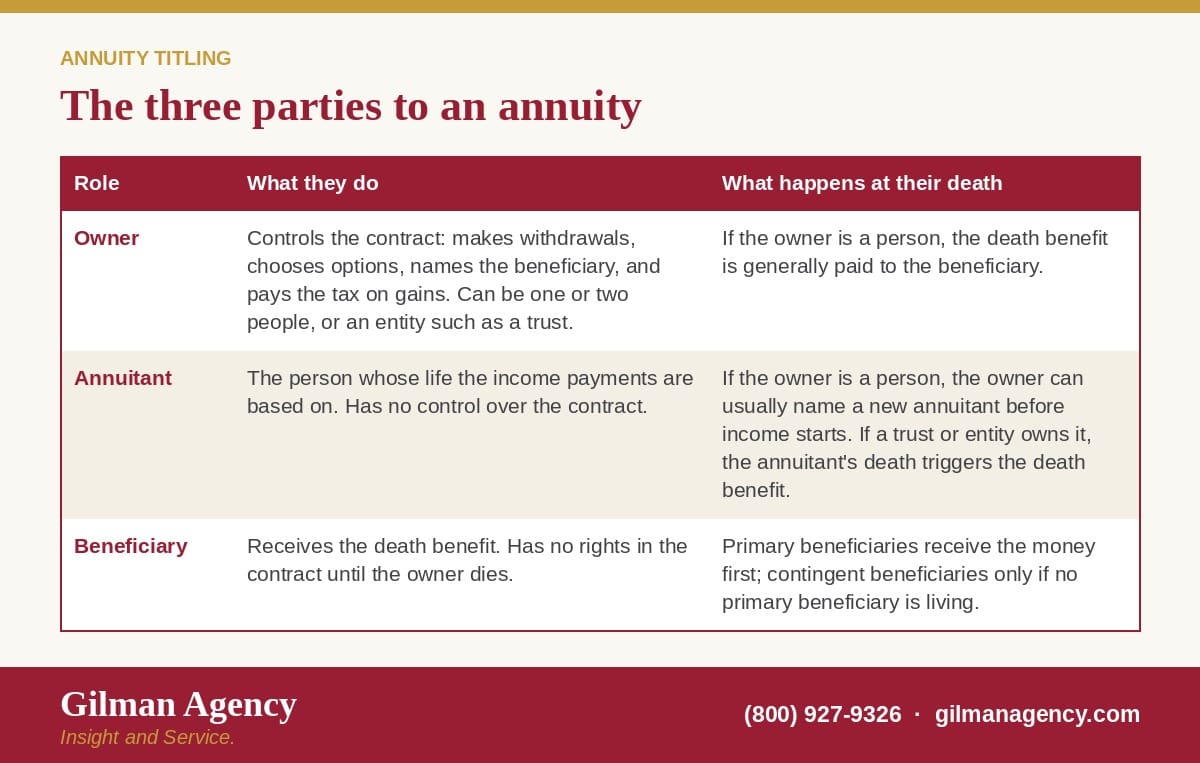
Often one person is both the owner and the annuitant, which keeps things simple. Problems tend to come up when the roles are split between different people, or when a trust is involved.
Owner-driven or annuitant-driven? Most annuities sold today are owner-driven: the owner’s death triggers the death benefit, and if the annuitant dies first, the owner simply names a new one. Some older or specialized contracts are annuitant-driven, where the annuitant’s death triggers the payout. If the owner and annuitant are different people, find out which kind you have. It decides whose death pays the claim. Even an annuitant-driven contract must pay out when the owner dies, because federal tax law (IRC § 72(s)) requires it. In some annuitant-driven contracts, the owner’s death pays the owner’s beneficiary only the surrender value, which can be less than the death benefit. The simplest safeguard is to name the same person as owner and annuitant.
Two Common Setups: An Example
Hypothetical example for illustration only. Tom, 62, and Linda, 60, are married with two adult children. Here are two ways they could title a non-qualified annuity, depending on their goals.
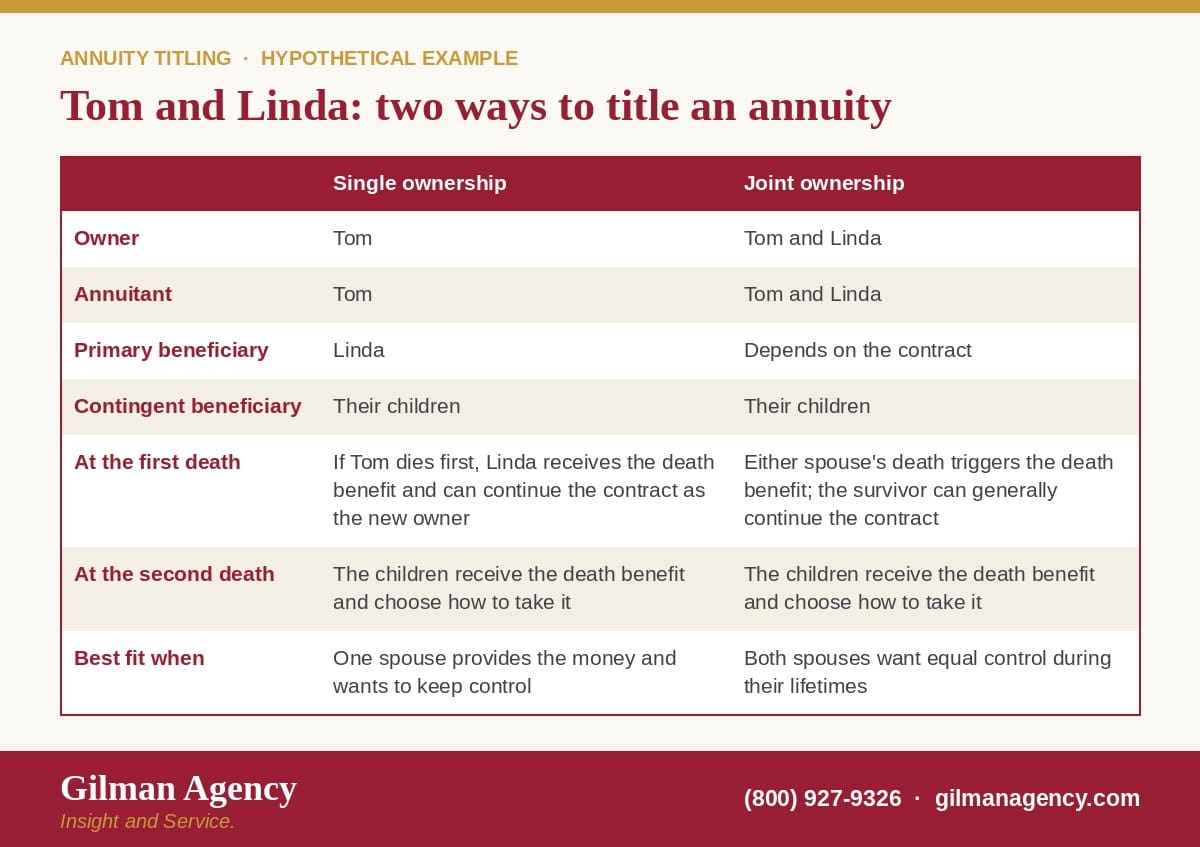
With joint ownership, insurers handle the surviving owner differently. Some contracts pay the surviving joint owner automatically; others pay whoever is listed as primary beneficiary. Check how your contract works, and name beneficiaries to match. Titling is one piece of a bigger question for couples: how the surviving spouse will be supported. For more, see protecting income for a surviving spouse.
Ways to Title an Annuity
Individual ownership. You’re the owner, and usually the annuitant. It’s the simplest setup: you control the contract, and your beneficiary receives the death benefit when you die.
Joint ownership. Two people, often spouses, own the contract together, and both must generally sign for changes. The death of either owner generally triggers the death benefit, because federal tax law treats the death of one joint owner as requiring a payout. Because contracts differ on whether the surviving owner is paid automatically, many advisors recommend naming each joint owner as the other’s primary beneficiary. Otherwise, if someone else is listed as primary beneficiary, the money could go to that person instead of the surviving owner.
Trust ownership. A trust can own an annuity, but the rules change. A trust keeps tax deferral only if it holds the annuity for the benefit of people (or is a grantor trust); otherwise gains are taxed every year even if nothing is withdrawn (IRC § 72(u)). With a trust owner, the annuitant’s death triggers the death benefit. Trust ownership can also cost your family options: some insurers warn that titling an annuity to a revocable living trust can mean losing spousal continuation and the non-qualified stretch, and often recommend individual ownership instead. Some insurers also require a trust that owns an annuity to be its beneficiary, which generally means the money must be paid out within five years of the annuitant’s death. Have your estate attorney weigh in before you title an annuity to any trust.
Joint ownership with a non-spouse. A parent and adult child, for example, can own an annuity jointly. The surviving owner usually inherits first, but there’s no spousal continuation, and the arrangement can create unintended gift or tax consequences. Insurers generally don’t recommend it.
Business ownership. Annuities owned by a corporation, partnership or most LLCs generally don’t get tax deferral; gains are taxed each year. The annuitant’s death triggers the payout, usually as a lump sum or under the 5-year rule. Single-member LLCs may be treated differently, so check with your tax advisor.
Can You Change the Owner, Annuitant or Beneficiary Later?
The owner: yes, but watch the taxes.
-
Usually not taxable: changing ownership to your spouse, to your own grantor trust, or to your spouse’s grantor trust. The new owner keeps your cost basis and the contract continues.
-
Usually taxable: changing ownership to anyone else, such as giving the annuity to a child. The IRS treats it as if you withdrew the gain. You owe income tax on the gain, possibly plus a 10% penalty if you’re under 59½, and the new owner’s cost basis becomes the contract value.
The annuitant: usually yes, if a person owns the contract and income payments haven’t started.
The beneficiary: yes, any time before the owner’s death, unless you named an irrevocable beneficiary.
Any change can affect the contract’s riders and death benefit, and some insurers have their own rules. Talk with your financial professional and tax advisor before you request one.
Six Common Titling Setups at a Glance
How the death benefit can be paid depends on who owns the annuity and who’s named as beneficiary. This summary assumes an owner-driven contract and a death before income payments start; your contract’s terms control.
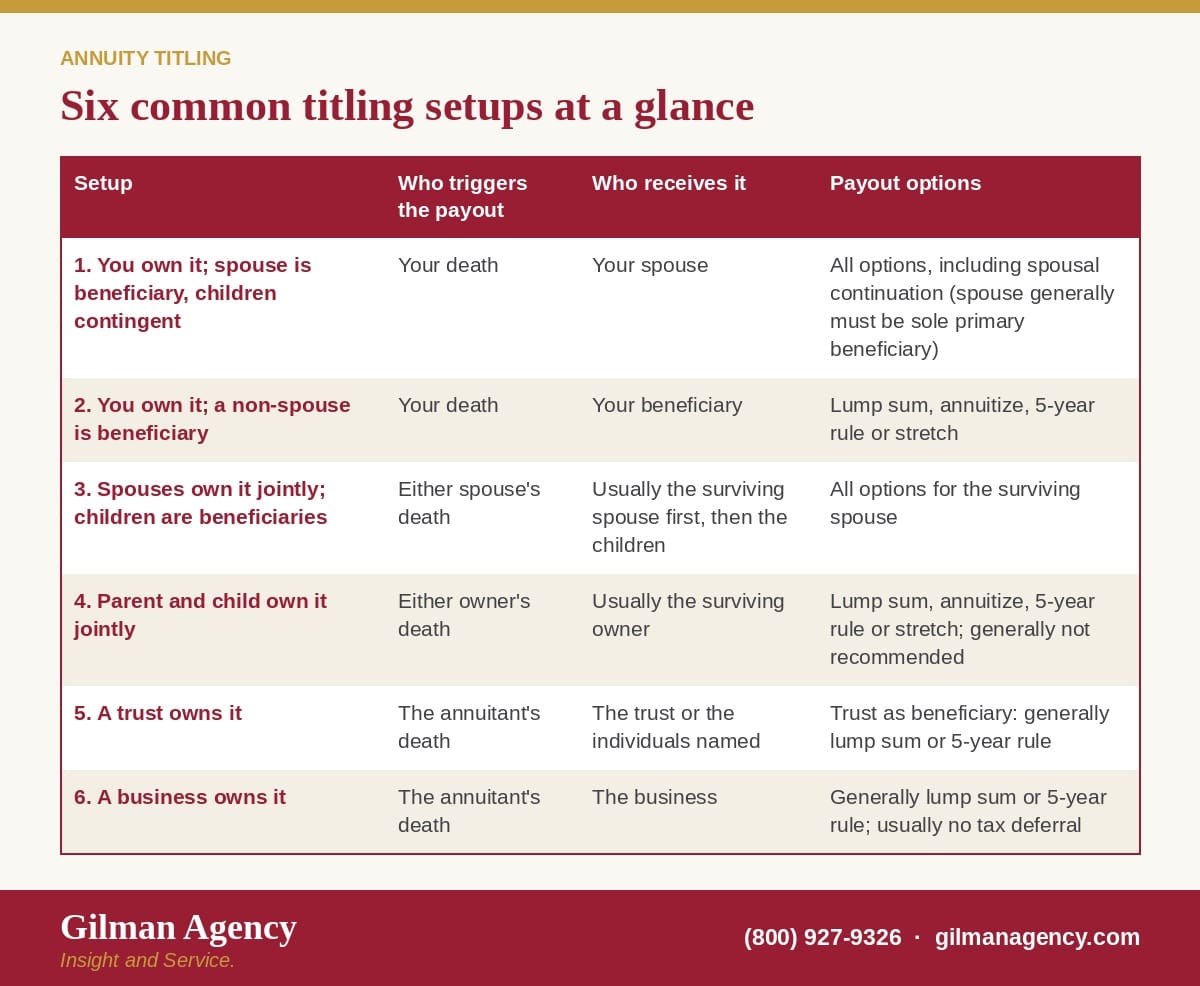
Based on insurer titling guides; rules vary by insurer and contract.
Common Titling Mistakes
-
No beneficiary named. The death benefit goes to your estate, may go through probate, and generally must be paid out within five years.
-
Joint owners whose beneficiary designations don’t match the contract. Depending on how the contract handles a surviving owner, the money may not go to the surviving spouse.
-
Your spouse isn’t the sole primary beneficiary. Splitting the primary designation can cost your spouse the right to continue the contract.
-
A trust as owner without checking the rules. The trust could lose tax deferral, and your family could lose spousal continuation or the stretch.
-
Joint ownership with a child. It can create unintended gift and tax consequences, and it doesn’t avoid the tax on the gain.
-
Different owner and annuitant without a plan. It can trigger a payout at the wrong death, or not trigger one when you expect, and in some contracts the owner’s death pays only the surrender value.
-
Gifting an annuity to a child or grandchild. It usually creates an immediate tax bill for you.
-
Outdated beneficiaries. A divorce, death or new grandchild can make your designation wrong. Review it whenever your family changes.
Moving an Annuity to Another Insurer: Keep the Names the Same
A Section 1035 exchange lets you move an annuity to a new annuity, or into a qualified long-term care policy, without paying tax on the gain. (A life insurance policy can also be exchanged into an annuity, but not the other way around.) One titling rule matters here: the owner and annuitant generally must be the same on the new contract as on the old one. Changing names during an exchange can turn a tax-free move into a taxable one. If you want different titling, talk with your advisor about the order and timing of changes. Any exchange should also be in your best interest, considering surrender charges and the benefits you’d give up.
What Can Your Beneficiaries Do With the Money?
When the owner dies, beneficiaries of a non-qualified annuity generally have several choices. The options available depend on the contract and the insurer.

Two limits to know: if no beneficiary is named, the money goes to the estate and the 5-year rule applies. If the beneficiary is a non-grantor trust or another entity, the choices are generally limited to a lump sum or the 5-year rule. A few more points: surrender charges generally don’t apply to death benefits paid at the owner’s death; if spouses die at the same time, the money goes to the contingent beneficiaries, without the spousal continuation option; a beneficiary who doesn’t want the money can file a qualified disclaimer within strict time limits, passing it to the next beneficiary in line; and if income payments had already started, the payout follows the income option chosen.
For large annuities, the stretch option can make a real difference. Spreading the gain over a beneficiary’s lifetime keeps more money growing tax-deferred and can keep the beneficiary in a lower tax bracket. Keep in mind that the gain in an inherited non-qualified annuity is taxed as ordinary income, and higher-income beneficiaries may also owe the 3.8% net investment income tax.
Your Annuity Titling Checklist
-
Confirm who is listed as owner, annuitant and beneficiary on each annuity you own.
-
If you have joint owners, make sure each is the other’s primary beneficiary.
-
Name contingent beneficiaries, and decide whether you want them to inherit “per stirpes” (a deceased beneficiary’s share passes to their children).
-
If a trust owns or is the beneficiary, have your attorney confirm the tax treatment.
-
Before changing an owner, check the tax consequences.
-
Review your designations after any marriage, divorce, death or birth in the family.
Annuity titling often connects to other retirement decisions. For more, see what Wharton research shows about deferred annuities, what a QLAC is and whether one is worth it, how a QLAC can reduce your RMDs and taxes, other ways to reduce your RMDs and the taxes on them, how Medicare’s IRMAA surcharge works and how Medicare and annuities work together.
Get a Second Look at Your Annuity
Gilman Agency reviews annuity ownership and beneficiary designations as part of retirement and estate planning, and works alongside your tax and legal advisors. Call (800) 927-9326 or email marc@gilmanagency.com.
Sources
Global Atlantic Financial Group, “Titling Considerations for Non-Qualified Annuity Contracts”; Pacific Life, “Titling Options for Your Nonqualified Deferred Annuity Contract”; Jackson National Life, “Annuity Titling Guide: Six Scenarios for Effective Annuity Titling”; Internal Revenue Code § 72(s) (required distributions at the owner’s death) and § 72(u) (annuities owned by non-natural persons); IRS Private Letter Ruling 201330016 (post-death 1035 exchange).
This article is general educational content and not tax, legal or investment advice. Annuity features, death benefit options and rules on ownership changes vary by contract and insurer. Consult your tax and legal advisors before changing an annuity’s owner, annuitant or beneficiary. Guarantees are backed by the claims-paying ability of the issuing insurer.