
By Marc Gilman
Questions? Call (800) 927-9326 or email
Key Takeaways
-
National call centers can process an enormous number of plans quickly, but speed and scale aren’t the same thing as local knowledge.
-
A plan that looks identical on paper can work very differently depending on which hospital network, which county, and which commute pattern you’re actually dealing with — details a national database doesn’t capture.
-
Call centers generally can’t guarantee you’ll speak to the same person twice, even when they emphasize consistent training across their team.
-
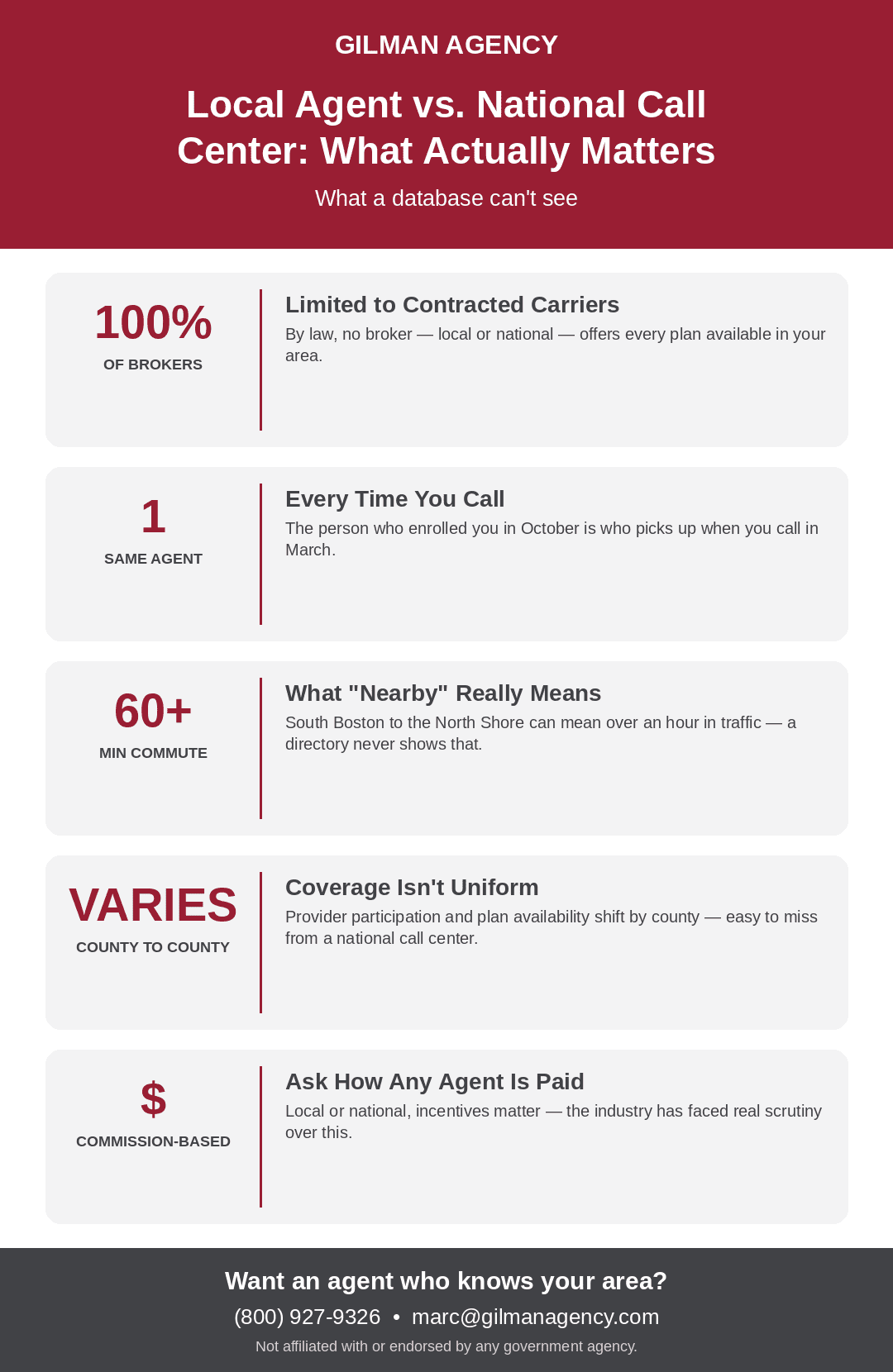
Every broker, local or national, works from a limited set of carrier contracts — “we compare everything” is a marketing claim worth reading carefully, not a guarantee.
-
The Medicare broker industry has faced real scrutiny over how commission structures can influence recommendations — a reason continuity and accountability matter, regardless of company size.
What’s the Real Difference Between a Local Agent and a National Call Center?
National platforms have built genuinely useful technology — the ability to search tens of thousands of plans quickly is a real advantage. But that technology answers a narrower question than people assume: it tells you what a plan covers on paper. It doesn’t tell you whether that plan actually works well for your doctors, your hospital, and your day-to-day reality of getting to appointments.
A local independent agent isn’t competing on database size. The value is in knowing the terrain a database can’t see.
Does “We Compare Every Plan” Actually Mean Every Plan?
National platforms often lead with a message like “we compare every option available.” Worth reading the fine print on that claim: every major broker, local or national, is contracted with a specific set of insurance carriers, and it’s highly unlikely that any of them offer every plan available in every area. That’s not a knock on any one company — it’s standard across the industry, and it’s exactly why federal marketing rules require agents to disclose it. The size of the claim doesn’t change the size of the actual carrier list behind it.
Will You Talk to the Same Person Twice?
This is worth asking directly before you commit to any service: if you call back in March with a question about a claim, will you reach the person who actually enrolled you — or whoever happens to be available that day? National call centers are generally built around consistent training so that any representative can help you, which is a reasonable operating model at scale. But it also means the relationship resets with every call.
A local agent’s whole value proposition runs the other direction: the person who enrolled you in October is the same person who picks up when you call in March, and they already know your coverage history without you re-explaining it.
What Local Knowledge Actually Looks Like
This is the part that’s hardest to see from outside the industry, and it’s where the real gap shows up:
-
Hospital and physician network awareness. Two plans can look identical in a national comparison tool while one includes your preferred hospital system and the other doesn’t — because network participation varies by region in ways a national database update cycle doesn’t always catch first.
-
Primary care accessibility. A plan’s directory might list a primary care provider as “accepting new patients” when the reality, known to anyone working the area regularly, is a six-month waitlist.
-
County-level differences. Coverage rules, provider participation, and even plan availability can shift from one county to the next — a distinction that’s easy to miss from a national call center answering calls from every state in the country.
-
Geography and commute patterns. A plan’s network might technically include a specialist “nearby” on paper, while the actual drive — say, from South Boston to the North Shore — realistically is a prohibitive travel time each way because of how the roads and traffic actually work. That’s the kind of detail that never shows up in a provider directory, but it’s exactly what determines whether someone actually uses their coverage or can easily access providers and medical facilities.
None of this shows up in a plan comparison spreadsheet. It shows up in years of actually working a specific area.
Why This Extends Beyond Just Choosing a Plan
The value of local knowledge doesn’t end at enrollment. When a claim gets denied, when a provider drops out of network mid-year, or when a client needs help understanding a bill, having an agent who already knows the local hospital systems and the client’s specific situation makes that conversation faster and more effective than starting from scratch with a new representative every time.
A Word on Incentives
Every Medicare agent, independent or affiliated with a national platform, is paid through carrier commissions — that’s how the entire industry is structured, and it isn’t inherently a conflict. But the Medicare broker industry has faced real, public scrutiny over how commission structures can influence which plans get recommended, particularly among large-scale operations processing enrollments at volume. That’s a reason to ask any agent — local or national — direct questions about how they’re compensated and whether they’re showing you every option that fits your needs, not just the ones that pay the most.
What To Do Next
A national call center’s technology is real, and for some people, that’s genuinely enough. But if you want an agent who knows which hospital network actually serves your town, which providers have real availability, and who’ll be on the other end of the phone next year when something comes up — that’s a different kind of value, and it’s the kind that’s hard to replicate at national scale.
If you’d like to talk through your specific situation with someone who actually knows the Massachusetts and New Hampshire healthcare landscape, reach out and let’s talk.
Questions? Call (800) 927-9326 or email


