
Category: Medicare Tags: CMS Final Rule 2027, Medicare Advantage Flex Cards, SSBCI, Supplemental Benefits, Point of Sale Verification, Medicare Advantage Transparency, AEP 2027, Medicare Regulation
New 2027 Rules for Medicare Advantage Flex Cards and Food/OTC Allowances
By Marc Gilman
Questions? Call (800) 927-9326 or email
Key Takeaways
-
CMS finalized the Contract Year 2027 Medicare Advantage and Part D Final Rule on April 2, 2026, introducing real changes to how flex cards, grocery allowances, and other Special Supplemental Benefits for the Chronically Ill (SSBCI) actually work.
-
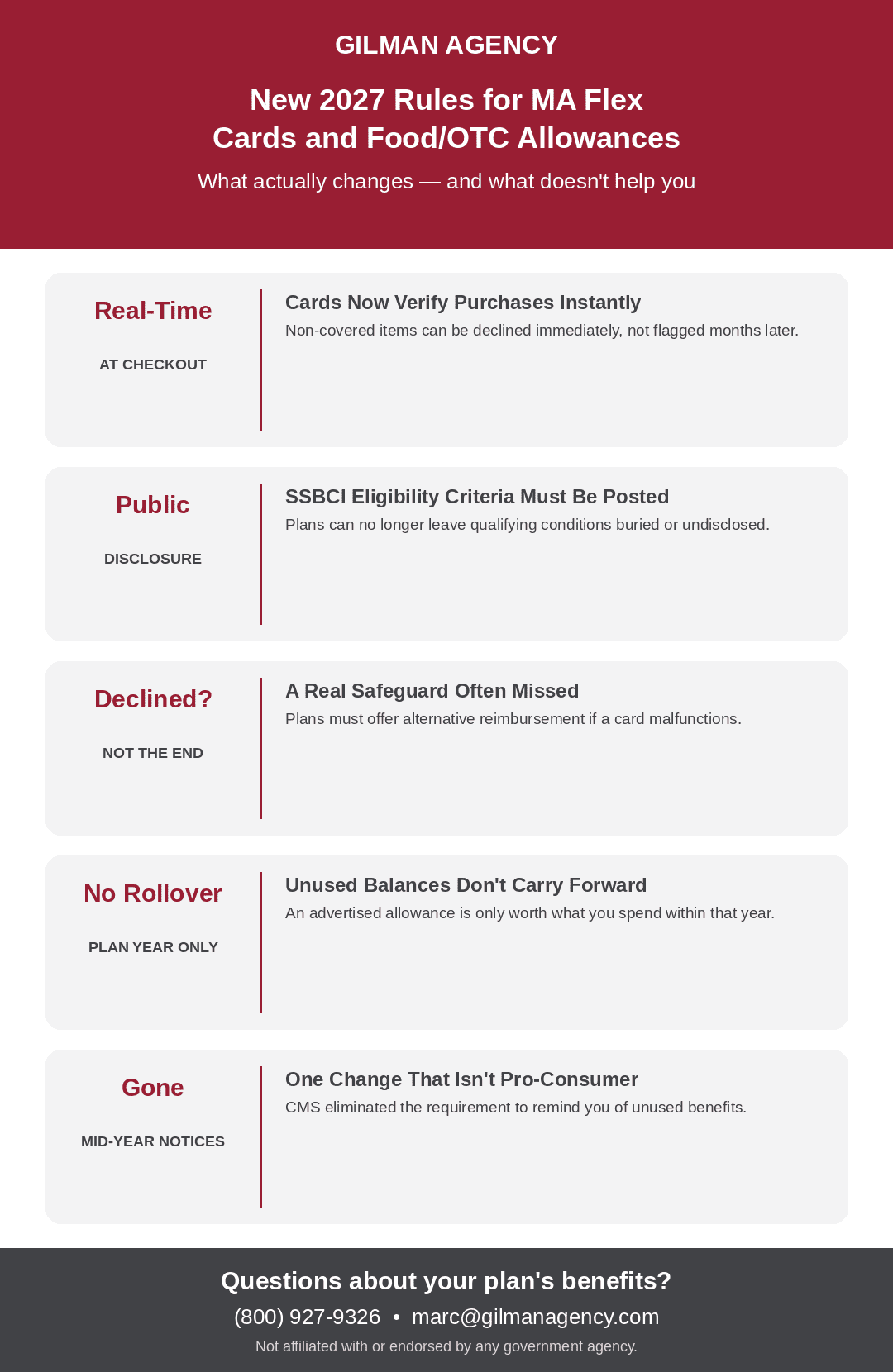
Flex and debit cards must now verify eligible purchases electronically at the point of sale — the card checks whether an item is actually covered in real time, rather than approving anything at an approved merchant and sorting it out later.
-
Plans must now publicly post their specific SSBCI eligibility criteria — a real transparency requirement, ending the practice of leaving beneficiaries to discover eligibility rules only after enrolling.
-
A genuine consumer protection often gets left out of coverage of this rule: if a card malfunctions or can’t process an eligible purchase, the plan is required to provide an alternative reimbursement process — a declined swipe isn’t necessarily the end of the story.
-
Not every change is consumer-favorable. CMS also rescinded the requirement that plans send mid-year notices about unused supplemental benefits, and debit/flex card balances are now restricted to the specific plan year — unused amounts don’t carry over into the next year.
What’s Actually Changing: Point-of-Sale Verification
The most significant operational change is how flex and debit cards confirm what you’re allowed to buy. Previously, many plans relied on merchant category codes — essentially checking where a purchase happened (a pharmacy, a grocery store) rather than what was actually purchased. Under the new rule, cards must be electronically linked to plan-covered items and services through a real-time identification mechanism, verifying at the register whether the specific product qualifies under your specific plan.
In practice, this means an item outside your plan’s approved categories can be declined immediately at checkout, rather than being flagged weeks or months later as an improper charge you’re asked to repay. For beneficiaries who’ve been surprised by a retroactive repayment demand, this is a genuine improvement — but it also means you’ll want a clearer sense of what’s actually covered before you’re standing at the register.
The Consumer Protection Worth Knowing About
This is the detail that gets skipped in a lot of coverage of this rule change, and it’s worth stating clearly: a declined card swipe doesn’t necessarily mean you’re out of luck. If the card malfunctions, or otherwise can’t be used for a purchase that should genuinely be covered, the plan is required to provide an alternative reimbursement process. If you run into a declined purchase you believe should have been covered, that’s worth raising directly with your plan rather than assuming the benefit simply doesn’t apply.
SSBCI Eligibility Must Now Be Public
Special Supplemental Benefits for the Chronically Ill were introduced in 2019 to address needs like food insecurity and other social determinants of health — but they were never available to every Medicare Advantage enrollee. They require a qualifying chronic condition determination, something that hasn’t always been made clear in plan marketing. Starting with contract year 2027, plans must publicly post their specific SSBCI eligibility criteria — a real, enforceable transparency requirement, rather than something buried in plan documents or left out of enrollment materials entirely.
If you’re comparing plans during the Annual Enrollment Period, this means you can — and should — ask directly which chronic conditions qualify for a given benefit, before you enroll based on an advertised grocery allowance or OTC card that you may not actually be eligible to use.
The Change That’s Not Purely Good News
It’s worth being balanced here, since much of the coverage of this rule frames it as uniformly pro-consumer. Two changes cut the other way:
-
CMS eliminated the requirement for plans to send mid-year notices about unused supplemental benefits. Previously, plans had to remind enrollees partway through the year if they hadn’t used benefits they were entitled to. That requirement is gone — meaning it’s now more on you to track your own remaining balance rather than expecting a reminder from your plan.
-
Debit and flex card balances are now limited to the specific plan year. An unused balance doesn’t roll over into the next contract year. If a plan advertises a large annual allowance, that figure is only meaningful in proportion to what you actually spend on covered items within that same year.
A Narrower Cannabis and Hemp Product Exclusion
One more specific, technical change worth knowing about: CMS refined the existing prohibition on cannabis as an SSBCI-eligible benefit, narrowing it specifically to products that violate applicable state or federal law. This preserves eligibility for certain lawful hemp-derived products that had previously fallen into a gray area, while keeping the broader prohibition intact for anything not legally permitted.
What This Means for You Before AEP
A few practical steps worth taking before the 2026 Annual Enrollment Period (October 15 – December 7) and before the new rules take effect:
-
Ask any plan you’re considering for its specific SSBCI eligibility criteria directly — which chronic conditions qualify, and how that determination is actually made.
-
Request an updated approved items list for any flex or OTC card benefit before relying on it for a specific purchase.
-
Track your own balance throughout the year, since you can no longer count on a mid-year reminder from your plan about what’s left unused.
-
Don’t assume an advertised dollar amount is what you’ll actually receive in value — a $1,200 annual allowance is only worth what you genuinely spend on covered items within that plan year, given it no longer carries forward.
What To Do Next
These changes are genuinely a mix — real transparency gains around eligibility and purchase verification, alongside real reductions in some of the guardrails that used to help beneficiaries track and use benefits they were already entitled to. Understanding both sides matters more than treating this as a simple win. If you want help sorting through what a specific plan’s supplemental benefits actually mean for your situation — this year or heading into 2027 — reach out and we’ll go through the real details together.
Questions? Call (800) 927-9326 or email
Sources: Centers for Medicare & Medicaid Services, “Contract Year 2027 Medicare Advantage and Part D Final Rule,” CMS Fact Sheet, April 2, 2026; Crowell & Moring LLP, “CMS Finalizes CY 2027 Medicare Advantage and Part D Rule: Key Implications for Plan Sponsors”; Bass, Berry & Sims PLC, “CMS Finalizes Contract Year 2027 Medicare Advantage and Part D Final Rule and Rate Announcement,” April 2026; 24/7 Wall St. and Yahoo Finance, “In 2027 the Flex Card Checks Your Cart at the Register,” August 2026.


