By Marc Gilman
Questions? Call (800) 927-9326 or email
Key Takeaways
-
SCAN Health Plan announced a Medicare Advantage partnership with Costco on August 18, 2026 — a co-branded plan aimed at reaching older adults where they already shop.
-
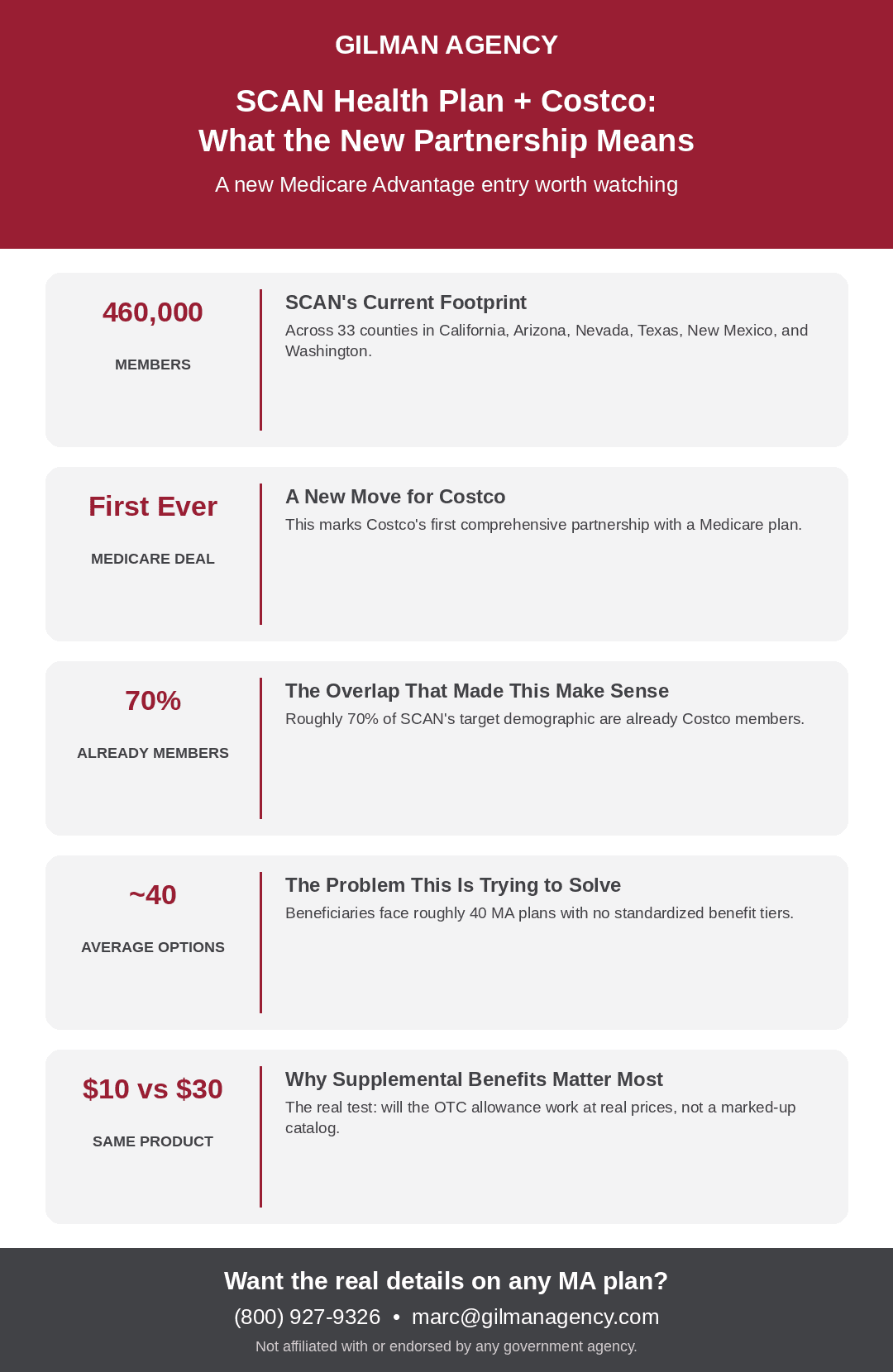
The overlap is real: according to a SCAN survey cited by CEO Sachin Jain, roughly 70% of SCAN’s target demographic are already Costco members.
-
This isn’t the first insurer-retailer pairing — similar arrangements already exist between plans and Kroger, Walmart, and USAA, and UnitedHealthcare has long marketed alongside AARP. What’s unusual here is a small nonprofit plan pairing with an exceptionally trusted consumer brand.
-
The real test is supplemental benefits. A frequently cited complaint about Medicare Advantage OTC allowances — a $200 quarterly card that only works through a marked-up third-party catalog — is exactly the kind of problem Costco’s own retail pricing could genuinely solve, or could just as easily fail to fix if benefits stay tied to a narrow catalog.
-
Plan details aren’t public yet. Bids haven’t been filed, so specific copays, networks, and covered benefits remain unconfirmed. The launch is planned for two MA states and one Medicare supplement state before any broader expansion.
What’s Actually Happening
SCAN Health Plan, a nonprofit Medicare Advantage insurer serving nearly 460,000 members across 33 counties in California, Arizona, Nevada, Texas, New Mexico, and Washington, announced an expanded partnership with Costco Wholesale on August 18, 2026 — marking Costco’s first-ever comprehensive partnership with a Medicare plan. As SCAN Group and SCAN Health Plan CEO Sachin Jain put it in the official announcement: “Older adults want healthcare that is easier to navigate, more responsive to their needs and rooted in organizations they trust.”
Costco CEO Ron Vachris framed the move as a natural extension of the retailer’s existing consumer relationship: “For more than 40 years, Costco has consistently listened to our Members and earned their trust delivering consistent value on essential goods and expanding our health service offerings… We have developed a shared understanding of what matters most to the seniors we serve.”
It’s worth noting Costco itself is treating this cautiously at the outset. Richard Stephens, Costco’s senior vice president for pharmacy, told the Wall Street Journal the company is approaching the Medicare effort as a pilot program — not a full-scale national rollout from day one. The initial target markets, spanning Medicare Advantage in two states and a Medicare supplement plan in a third, collectively cover roughly 5 million Medicare enrollees, according to WSJ reporting — though the companies have declined to name the specific states or launch timing, citing disclosure restrictions while the plans await regulatory approval from CMS.
The demographic logic behind the pairing is straightforward. Carrie Graham, a Georgetown University health policy researcher, pointed to both the demographic overlap and the depth of trust Costco carries specifically among older adults — describing it as “a really trusted brand… in terms of cost, in terms of quality.”
Why Costco Specifically
Jain framed the partnership as a genuine values match, not just a branding deal: “[Costco] talks about consumer value, [SCAN] talks about member obsession, and they’re basically 2 sides of the same coin.” This gets at something genuinely structural about the Medicare Advantage market too: insurers, as an industry, generally carry a trust deficit with consumers. Costco doesn’t. As Matthew Fiedler, a health economist at the Brookings Institution, put it: SCAN is likely “hoping that this will be seen as a Costco product and so be seen as carrying the… quality that consumers expect Costco products typically have.” He was careful to note there’s not yet real evidence of how large that “halo effect” will actually turn out to be in practice — this is a reasonable hypothesis, not a proven outcome.
This Isn’t the First Insurer-Retailer Partnership
It’s worth knowing this tactic has real precedent. Graham pointed to an MA plan operating in Colorado, Idaho, Nevada, and Utah that partnered with Kroger, another plan that partnered with Walmart, and a veteran-focused plan that partnered with USAA. UnitedHealthcare’s long-running marketing relationship with AARP is arguably the best-known example of this model generally.
What makes the SCAN-Costco pairing specifically unusual, according to Fiedler, is the combination: a comparatively small nonprofit insurer paired with an exceptionally trusted, broad-based consumer brand — a combination he noted isn’t easily replicated by other insurers looking to copy the approach.
The Real Test: Will Supplemental Benefits Actually Work Better
This is the part of the story most worth paying attention to as a consumer, since it gets at a genuine, well-documented pain point in Medicare Advantage shopping. Graham described exactly the kind of disappointment that often follows enrollment: a beneficiary expects an OTC allowance like $200 per quarter, only to discover “that plan only lets you shop through their own catalog… and then you realize that the Tylenol that you usually get at your CVS for $10 is $30 through this catalog.”
Costco’s existing pharmacy, optical, and hearing service infrastructure suggests a real possibility that this specific partnership could sidestep that problem — if the OTC benefit genuinely works at Costco’s own locations at Costco’s own everyday prices, rather than through a separate, marked-up catalog. Graham’s own assumption is that pricing would reflect normal Costco pricing, not an inflated third-party rate — but this is an assumption, not a confirmed plan detail, since specifics haven’t been released.
The companies’ own press materials give a general sense of direction, even without firm details: pending regulatory review, the partnership is expected to explore a reinvented pharmacy experience, “Medflex” over-the-counter benefits, vision, and audiology — categories directly aligned with services Costco already operates at scale through its warehouses. Jain has connected this effort to SCAN’s broader “Health Insurance is Broken” campaign, launched the prior year specifically to name the disjointed experience many seniors face accessing care — positioning this partnership as a practical step toward that stated goal, rather than a purely cosmetic rebrand.
The 40-Plan Problem This Is Trying to Solve
Part of the broader context here is just how difficult Medicare Advantage shopping already is. Graham noted that beneficiaries typically face an average of roughly 40 plan options, with no standardized benefit tiers to simplify comparison — nothing like a straightforward silver or gold package structure. Comparing supplemental benefits, network adequacy, and copays across that many options is genuinely arduous, and Graham observed that many beneficiaries simply stop shopping once enrolled rather than repeat that research every year.
A recognizable, trusted brand name is, in part, an attempt to cut through that fatigue — whether or not it actually results in a better-fitting plan for any individual beneficiary is a separate question from whether it feels more approachable to shop for.
The Access Concern Worth Watching
Graham raised a real, practical concern worth taking seriously: if OTC, dental, or vision benefits end up tied specifically to Costco’s own catalog or physical locations, beneficiaries in rural areas or without reliable transportation to a Costco location could face genuine access gaps. Her point was that beneficiaries need real options to shop around, both online and in person — being enrolled in a Costco-branded plan shouldn’t mean being functionally limited to Costco alone for using the benefit.
Fiedler raised a related, more structural concern: Costco has a retail reputation to protect, which gives it a real incentive to be careful about what it lends its name to — but the arrangement is also likely to be financially lucrative for Costco, which could just as easily motivate prioritizing enrollment volume over genuine fit for each beneficiary. Both dynamics are plausible; which one actually dominates in practice remains to be seen.
What We Don’t Know Yet
It’s worth being direct about the current state of information: bids haven’t been filed yet, meaning specific copays, provider networks, and exact covered benefits are still unconfirmed. SCAN has stated the partnership will launch in two Medicare Advantage states and one Medicare supplement state before any broader rollout, with Jain describing the near-term goal as building “the right operational chassis” before scaling further.
What This Means for You
If you’re currently shopping for Medicare coverage, this development is genuinely worth watching, but not worth waiting for — actual plan details, service areas, and pricing won’t be available until bids are filed and details are formally released, likely closer to the next Annual Enrollment Period. In the meantime, the underlying lesson from this story applies regardless of which specific plan you’re considering: read the fine print on supplemental benefits specifically. An attractive-sounding OTC allowance, dental benefit, or vision benefit is only as good as where and how you can actually use it — a trusted brand name attached to a plan doesn’t automatically resolve that question, and neither does a large advertised dollar figure.
What To Do Next
Whether the Costco partnership meaningfully improves how older adults evaluate Medicare coverage, or simply adds another familiar-sounding name to an already crowded field, is something we’ll only really know once actual plan details, networks, and enrollee experiences start to emerge. If you want help sorting through the real details of any Medicare Advantage plan — Costco-branded or otherwise — reach out and we’ll go through the actual fine print together, not just the marketing.
Questions? Call (800) 927-9326 or email
Sources: Sabrina McCrear, “FAQ: Why Costco? Experts Weigh In on SCAN Health’s New MA Plan,” The American Journal of Managed Care (AJMC), September 2026, featuring interviews with Sachin H. Jain, MD, MBA (CEO, SCAN Group and SCAN Health Plan), Carrie Graham, PhD (Georgetown University Center on Health Insurance Reform), and Matthew Fiedler, PhD (Brookings Institution); “SCAN and Costco Launch Landmark Partnership to Reimagine Healthcare for Older Adults,” SCAN Health Plan press release, August 18, 2026; Susan Morse, “Costco Enters the Medicare Advantage Market Through SCAN Partnership,” Healthcare Finance News, August 19, 2026; Marissa Plescia, “SCAN, Costco Launch Medicare Partnership,” MedCity News, August 20, 2026; PYMNTS, “Costco Seeks Regulatory Approval for Multiyear Medicare Plan Rollout,” August 2026; reporting via The Wall Street Journal as cited by Yahoo Finance, August 18, 2026.