By Marc Gilman
Questions? Call (800) 927-9326 or email
Key Takeaways
-
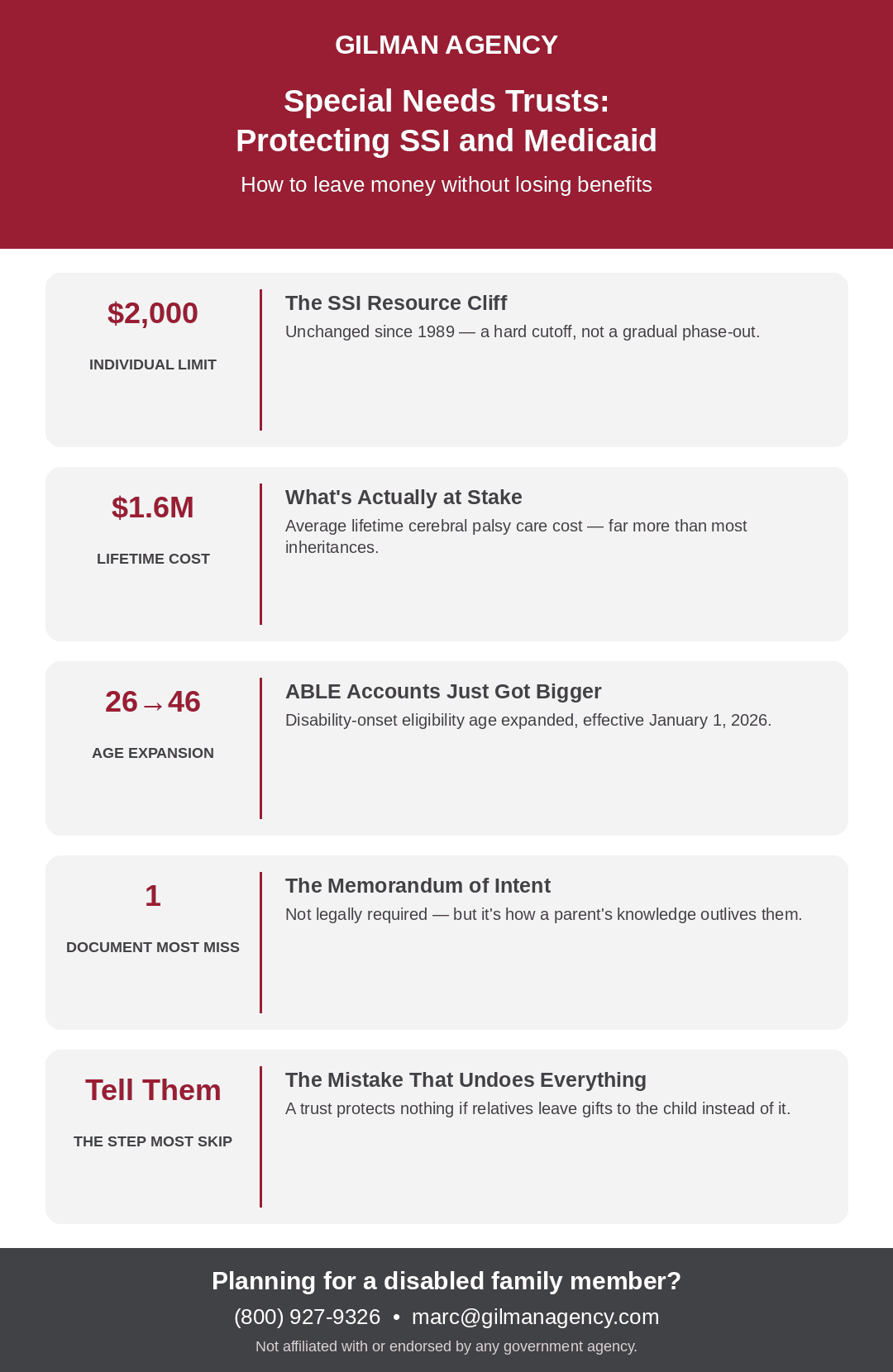
SSI and Medicaid are means-tested programs with strict, unforgiving asset limits. SSI’s resource limit is $2,000 for an individual, $3,000 for a couple — a figure that hasn’t changed since 1989, and it’s a hard cutoff with no gradual phase-out.
-
A direct inheritance or gift can immediately disqualify a disabled loved one from these benefits, often before they’ve had any real chance to use the money.
-
A properly structured special needs trust (SNT) holds assets for a disabled beneficiary without counting toward SSI or Medicaid resource limits — because the beneficiary doesn’t legally own the assets and can’t demand distributions on their own.
-
The distinction between a third-party and first-party SNT matters enormously. A third-party trust (funded by parents or other family) carries no Medicaid payback requirement. A first-party trust (funded with the beneficiary’s own assets) must reimburse Medicaid at death before anything passes to other heirs.
-
ABLE accounts recently got significantly more useful. As of January 1, 2026, the disability-onset eligibility age expanded from 26 to 46 — a change advocacy groups project could make millions more people newly eligible.
-
A Memorandum of Intent — not legally required, but genuinely important — preserves what the trust document can’t: the beneficiary’s routines, preferences, and history, for whichever trustee ends up making decisions after a parent no longer can.
Why This Requires Careful Planning
Parents of a disabled child, or anyone planning to leave money to a disabled family member, face a genuinely difficult problem: how do you provide for someone financially without accidentally disqualifying them from the benefits they depend on? Over 14 million children in the U.S. have a special healthcare need, according to a National Survey of Children’s Health data brief — and the costs involved are often substantial. The average cost of autism care runs roughly $60,000 a year through childhood, according to Autism Speaks, while the average lifetime cost of treatment and care for someone with cerebral palsy can top $1.6 million.
SSI provides monthly cash payments to disabled, blind, or elderly individuals with limited income and resources. Medicaid, for many disabled individuals, covers an enormous range of services — home health care, personal care aides, day programs, supported employment, residential placements, and long-term care — that could otherwise cost hundreds of thousands of dollars a year out of pocket. Protecting Medicaid eligibility is often worth far more than the inherited assets themselves.
The core problem is the resource limit. If a disabled person’s countable resources exceed $2,000 at the start of any month, they become ineligible for SSI that month — a hard cutoff, not a gradual reduction. A well-intentioned inheritance, left directly, can trigger exactly this outcome.
How a Special Needs Trust Actually Protects Benefits
A properly drafted special needs trust works through a specific legal structure, recognized directly under the Social Security Act (42 U.S.C. § 1396p(d)(4)) and the Social Security Administration’s own operating rules:
-
The beneficiary doesn’t own the assets — the trust does. Because the beneficiary has no legal ownership of trust funds, they don’t count as the beneficiary’s personal resources.
-
The beneficiary can’t demand distributions. The trustee holds discretion over when and how funds are distributed — the beneficiary has no enforceable right to receive money on demand.
-
The trust is “supplemental,” not a replacement. It’s designed to pay for things SSI and Medicaid don’t cover, not to duplicate or replace those benefits.
Third-Party vs. First-Party: The Distinction That Matters Most
There are two fundamentally different types of special needs trusts, and which one applies changes the outcome substantially:
-
Third-party SNT: funded with assets from parents, grandparents, or other relatives — never the beneficiary’s own money. No Medicaid payback provision is required, meaning the full remaining trust balance can pass to other family members (siblings, for example) after the beneficiary’s death. This is the standard structure for parents doing estate planning for a disabled child. It can also be set up two different ways: as a stand-alone trust, which gives the beneficiary access to assets during the grantor’s own lifetime, or as a testamentary trust, contained within a will and not funded until the grantor’s death. A third-party SNT can be structured as either revocable or irrevocable — the grantor decides which at the time it’s created.
-
First-party (self-settled) SNT: funded with the beneficiary’s own assets — a lawsuit settlement or a direct inheritance that was received without a trust in place. This structure requires a Medicaid payback provision: at the beneficiary’s death, remaining trust assets must first reimburse the state Medicaid program for benefits paid during their lifetime, before anything passes to other heirs. If Medicaid has covered decades of care, that payback obligation can consume the entire remaining balance. Unlike a third-party trust, a first-party SNT must be irrevocable — once created, it generally can’t be undone without court approval. One real benefit that comes with this structure: assets held in a first-party SNT are generally protected from creditors and from judgments in a lawsuit against the beneficiary.
One detail worth knowing: a first-party SNT was historically something only a parent, grandparent, legal guardian, or a court could establish on the beneficiary’s behalf — not the individual themselves. The 21st Century Cures Act of 2016 changed this, explicitly allowing a mentally capable individual with disabilities to establish their own first-party special needs trust directly, without needing a parent or court to set it up for them.
This is exactly why leaving assets directly to a disabled person receiving SSI or Medicaid is generally a serious mistake. A third-party trust, established in advance, avoids the payback requirement entirely.
What a Special Needs Trust Can — and Can’t — Safely Pay For
Trustees have to be genuinely careful here, since certain distributions can reduce SSI payments even when the trust itself is properly structured:
Generally safe: electronics, entertainment and recreation, travel, personal care items beyond what Medicaid covers, clothing, education and training, transportation, hobbies, dental and vision care, furniture, and pre-paid funeral arrangements.
Handle with real caution:
-
Cash paid directly to the beneficiary counts as unearned income and reduces SSI dollar-for-dollar, up to the full grant amount.
-
Food and shelter payments — rent, mortgage, utilities, groceries — count as “In-Kind Support and Maintenance” and can reduce SSI by up to one-third of the benefit plus $20.
This is one of the more counterintuitive parts of the whole system, and it trips up well-meaning trustees regularly. A trustee who pays a beneficiary’s rent directly, thinking they’re being helpful, can inadvertently cut into the very benefit the trust was designed to protect.
There’s a related principle worth understanding directly: the “sole benefit rule.” The Social Security Administration’s own guidance requires that trust distributions be for the sole benefit of the disabled beneficiary — not shared with, or incidentally benefiting, other people. This doesn’t mean every single dollar must be spent in complete isolation (a 2019 update to SSA’s guidance, for example, clarified that travel expenses for a trustee or caregiver overseeing the beneficiary’s well-being don’t violate the rule), but it does mean a trustee genuinely has to think through whether a given expense primarily benefits the beneficiary or someone else. As a practical rule of thumb, distributions should generally be paid directly to vendors and service providers — not funneled through the beneficiary as cash — both to satisfy the sole benefit rule and to avoid the direct-cash problem described above.
Pooled Special Needs Trusts: An Option for Smaller Amounts
Setting up and administering a standalone special needs trust isn’t always cost-effective for smaller amounts — often under roughly $100,000–$150,000. A pooled special needs trust, managed by a nonprofit organization, pools funds from many beneficiaries for investment purposes while keeping separate accounts for each individual. Pooled trusts offer lower administrative costs, professional trustee management experienced specifically in SSI and Medicaid rules, and availability regardless of the beneficiary’s age (unlike first-party trusts, which generally require the beneficiary to be under 65 when established). The tradeoff: some pooled trusts retain a portion of the remaining balance for their own charitable purposes at the beneficiary’s death, rather than passing the full amount to family.
ABLE Accounts: A Meaningfully Expanded Complementary Tool
ABLE (Achieving a Better Life Experience) accounts are tax-advantaged savings accounts for people with disabilities, and they work alongside — not instead of — a special needs trust. Up to $100,000 in an ABLE account is excluded from SSI’s resource count entirely; balances above that suspend (but don’t terminate) SSI eligibility. For 2026, the annual contribution limit is $19,000, matching the federal annual gift tax exclusion — plus, for working beneficiaries, an additional “ABLE to Work” contribution up to the lesser of their earnings or the one-person federal poverty level.
The most significant recent change: as of January 1, 2026, the disability-onset age requirement for opening an ABLE account expanded from 26 to 46 — a substantial increase from the original threshold. Disability advocacy organizations project this could make several million additional people newly eligible, including many adults who acquired a disability later than the previous cutoff allowed for. ABLE accounts are simpler to manage day-to-day than a trust and give the beneficiary more direct access to funds — many families use both together: an ABLE account for everyday expenses, a special needs trust for larger, longer-term planning. Note that ABLE account balances are subject to Medicaid payback at the beneficiary’s death, similar to a first-party trust.
Choosing a Trustee Matters as Much as the Trust Itself
The trustee manages investments, approves distributions, keeps records, and deals with government agencies when needed — and a wrong choice here can undermine even a well-drafted trust. Some families name a trusted relative who understands the beneficiary’s needs personally. Others use a professional or corporate trustee with actual experience administering special needs trusts and navigating benefit systems, especially when the trust is larger or the family situation is more complex. The right choice tends to depend on the size of the trust, how complex the beneficiary’s needs are, and whether there’s a family member genuinely equipped for the ongoing responsibility.
The Document Most Families Don’t Know They Need: A Memorandum of Intent
This is one of the more overlooked pieces of special needs planning. A Memorandum of Intent (MOI) — sometimes called a Letter of Intent — isn’t a legally required document anywhere, but it plays a genuinely important role alongside the trust itself. The trust document controls how money moves; the MOI captures everything the trust can’t express: the beneficiary’s routines, preferences, communication style, medical and developmental history, key relationships, and the family’s values and hopes for their care.
Here’s why this matters so much in practice: trustees change over time, caregivers come and go, and family members who know the beneficiary well may not always be available. Without something written down, a future trustee — possibly someone who never personally met the beneficiary — is left guessing at decisions that should reflect real, specific knowledge. An MOI typically covers:
-
Functional, educational, and communication abilities — how the beneficiary learns, interacts, and manages daily tasks.
-
Medical and developmental history — diagnoses, medications, therapies, and treatment plans.
-
Key relationships — siblings, extended family, caregivers, and community connections.
-
Personal preferences — favorite activities, sensory sensitivities, calming routines, and interests.
-
Family values — the cultural, moral, or spiritual context that should shape ongoing care decisions.
Many families describe the MOI as the emotional counterpart to the legal trust — it’s how a parent’s specific knowledge and intent get preserved for whoever ends up making decisions after they no longer can.
How a Special Needs Trust Actually Gets Set Up
Setting one up follows a fairly standard trust process, though it’s genuinely worth doing with an estate planning attorney rather than alone, given how easily a technical misstep can undermine the whole point:
-
Designate the beneficiary — your loved one with a disability, or whoever the trust is meant to support.
-
Choose a trustee. Often the person setting up the trust names themselves, though the beneficiary can sometimes serve as trustee too. For a pooled trust, the nonprofit organization managing the fund typically serves as trustee.
-
Draft and sign the trust documents. This is the step where working with an estate planning attorney matters most — they’ll make sure the trust actually meets your state’s specific requirements. Most states require witnesses and notarization.
-
Fund the trust — with cash, investments, real estate, or other assets, depending on what you’re providing for.
-
Tell your family it exists. This step gets overlooked constantly, and it can quietly undo everything the trust was set up to protect. Grandparents, aunts, uncles, and other relatives often want to leave something to a disabled family member in their own wills — and if they don’t know the trust exists, they may leave it directly, triggering exactly the disqualification problem the trust was built to avoid. Once the trust is in place, make sure extended family knows to direct any future gifts or bequests to the trust itself, not to the beneficiary personally.
What This Means for You
If you’re planning to leave money to a disabled family member, the single most important decision is making sure it doesn’t go to them directly. A third-party special needs trust, set up well in advance, is generally the right tool for parents and grandparents doing estate planning. If a disabled family member has already received a settlement or inheritance directly, a first-party trust — even with its Medicaid payback requirement — is still usually far better than no trust at all, since it at least preserves eligibility for future benefits.
What To Do Next
This is genuinely technical territory where the details matter enormously, and the rules vary by state. A properly structured special needs trust can be the difference between a disabled loved one keeping access to hundreds of thousands of dollars in Medicaid-covered services, or losing that access because of an otherwise well-intentioned inheritance. If you’re planning for a disabled family member’s future, reach out and we’ll talk through how a trust, an ABLE account, or both might fit your situation.
Questions? Call (800) 927-9326 or email
Sources: Social Security Act, 42 U.S.C. § 1396p(d)(4); Social Security Administration Program Operations Manual System (POMS), including SI 01120.201F.3.c (sole benefit rule); The Arc, “ABLE Accounts Expanded in 2026: New Eligibility Rules and How to Open One,” 2026; Disability Exchange, “The SSI Resource Limit in 2026,” June 2026; “What Is a Special Needs Trust?” MetLife, April 2026, citing the Special Needs Alliance, Medicaid.gov, and Cornell Law School’s Legal Information Institute; Daniel A. DeBruyckere, “Special Needs Trusts in Your New Hampshire Estate Plan,” Legacy Care Law Firm, December 2025; Jason Neufeld (Board-Certified Elder Law Attorney), “Special Needs Trust Distributions and the Sole Benefit Rule,” Elder Needs Law; “Financial Planning for Families with a Disabled Child,” U.S. Bank, citing the National Survey of Children’s Health Data Brief (June 2022), Autism Speaks, and Cerebral Palsy Guide; Julia Kagan, “Understanding a Special Needs Trust and Its Benefits,” Investopedia, updated May 2025.
This article is for general informational purposes only and does not constitute legal advice. SSI and Medicaid rules are complex, change frequently, and vary by state — consult a licensed special needs planning attorney before establishing or funding any trust intended to preserve government benefits.