By Marc Gilman
Questions? Call (800) 927-9326 or email
Key Takeaways
-
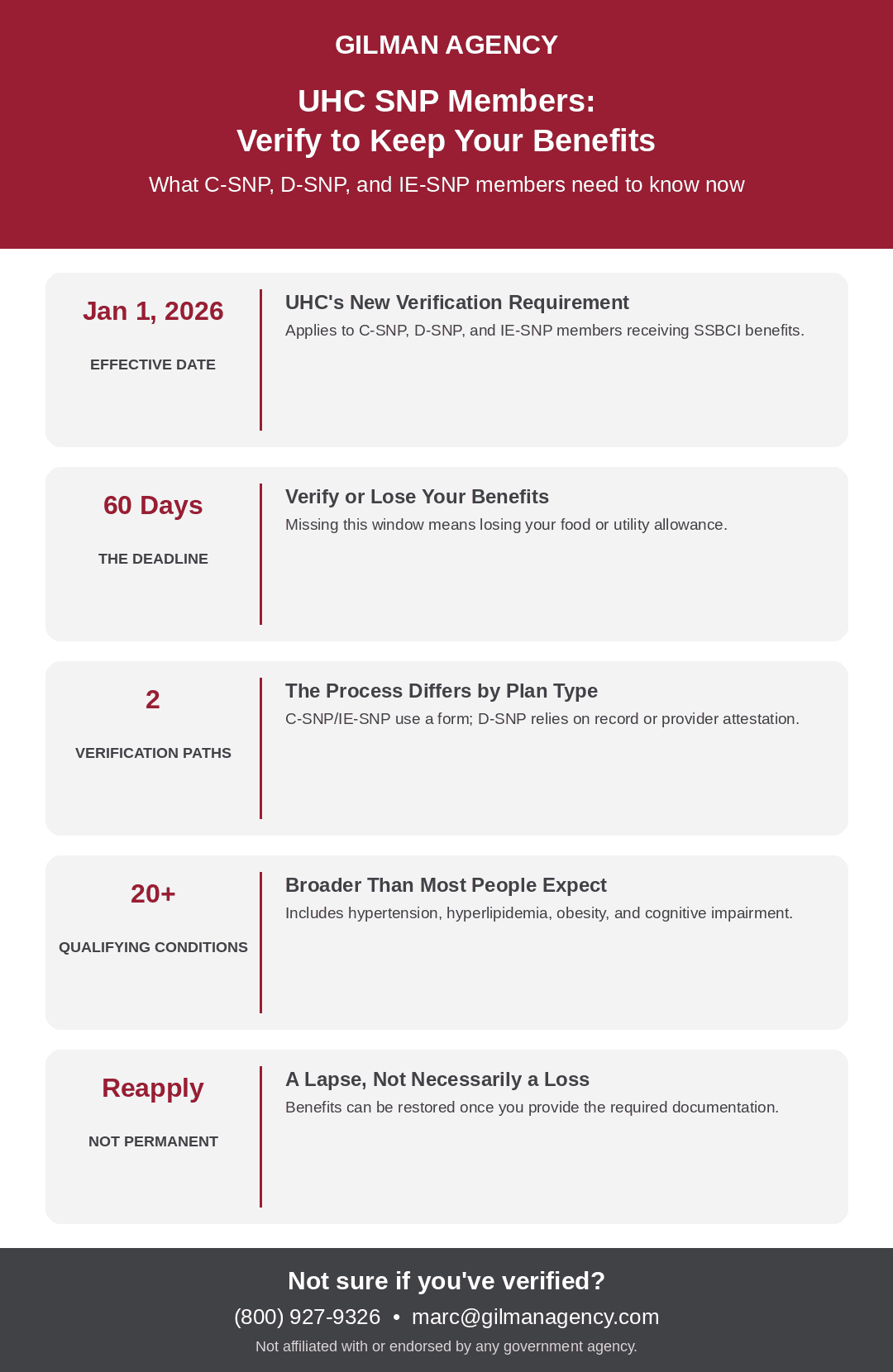
UnitedHealthcare implemented new verification requirements starting January 1, 2026 for members of its Special Needs Plans — Chronic Condition (C-SNP), Dual-Eligible (D-SNP), and Institutional Equivalent (IE-SNP) — in response to CMS regulatory changes.
-
If you have Special Supplemental Benefits for the Chronically Ill (SSBCI) — the benefit category covering healthy food allowances and utility assistance — your qualifying chronic condition now has to be formally verified and documented, not just assumed from your enrollment.
-
The verification process differs by plan type. C-SNP and IE-SNP members use a chronic condition verification form at plan registration. D-SNP members are verified through a record attestation of a qualifying diagnosis or a provider attestation — and UHC may call your provider’s office directly if your records don’t clearly confirm it.
-
There’s a real deadline with a real consequence. Failing to complete verification within 60 days results in loss of SSBCI benefits — though you can reapply once you provide the required documentation.
-
The list of qualifying conditions is broader than many people expect — it includes conditions like chronic hypertension, hyperlipidemia, obesity and metabolic syndrome, and specific cognitive impairment categories, alongside more commonly recognized conditions like diabetes and heart failure.
What’s Actually Changing
If you’re enrolled in a UnitedHealthcare Special Needs Plan and currently receive SSBCI benefits — most commonly a food or grocery allowance, or utility bill assistance — this affects you directly. UHC now requires your qualifying chronic condition to be actively verified and documented, rather than simply inferred from your plan enrollment. This is UHC’s specific implementation of broader CMS regulatory changes aimed at ensuring these benefits genuinely reach people who meet the eligibility requirements, rather than being extended based on assumption or incomplete records.
How Verification Actually Works
The process depends on which type of Special Needs Plan you’re enrolled in:
-
C-SNP and IE-SNP members: eligibility is established through a chronic condition verification form, completed as part of plan registration.
-
D-SNP members: verification happens through a record attestation of a qualifying diagnosis, or a provider attestation. If your existing records don’t clearly establish the diagnosis, UHC has stated it will contact your provider’s office directly to confirm eligibility.
The Deadline That Actually Matters
This is the detail worth taking seriously: failing to complete verification within 60 days results in the loss of your SSBCI benefits — the food allowance or utility assistance you may be relying on. The benefit isn’t necessarily gone forever; you can reapply once you provide the required documentation. But that means a real gap in benefits while verification is pending, which is exactly the kind of disruption worth avoiding by handling this proactively rather than waiting to be notified of a problem.
The Full List of Qualifying Conditions
It’s worth knowing the actual breadth of this list, since it includes more than the handful of conditions most people associate with chronic illness benefits:
Autoimmune disorders, cancer, cardiovascular disorders, chronic alcohol use disorder and other substance use disorders, chronic and disabling mental health conditions, chronic gastrointestinal disease, chronic heart failure, chronic hyperlipidemia, chronic hypertension, chronic kidney disease, chronic lung disorders, dementia, diabetes mellitus, HIV/AIDS, immunodeficiency and immunosuppressive disorders, myasthenia gravis and related myoneural disorders, neurologic disorders, overweight/obesity and metabolic syndrome, post-organ transplantation care, severe hematologic disorders, and stroke — along with two broader categories covering conditions associated with cognitive impairment (including Alzheimer’s disease, intellectual and developmental disabilities, and traumatic brain injury) and conditions involving functional challenges requiring similar services (including spinal cord injuries, paralysis, limb loss, and arthritis).
If you have one of these conditions and haven’t been receiving SSBCI benefits, or you’re unsure whether your specific condition qualifies, this is worth raising directly with your plan.
What This Means for You
If you’re a current UHC Special Needs Plan member receiving a food or utility benefit, the most important thing you can do is confirm your verification status now, rather than waiting to discover a lapse after the fact. If you’re a C-SNP or IE-SNP member, check whether your chronic condition verification form has been completed. If you’re a D-SNP member, confirm your provider’s records clearly document your qualifying condition — and if there’s any ambiguity, a conversation with your provider’s office now can prevent a benefits gap later.
What To Do Next
This kind of administrative requirement is exactly the sort of detail that’s easy to miss until a benefit unexpectedly stops — and by the time that happens, you’re already dealing with a gap rather than preventing one. If you’re a UHC Special Needs Plan member and want help confirming your verification status, or you’re not sure whether your specific condition qualifies for SSBCI benefits at all, reach out and we’ll help you sort it out.
Questions? Call (800) 927-9326 or email
Source: “Medicare SNP Members Must Verify Chronic Conditions to Retain Benefits,” Capline Healthcare Management newsletter, October 2025, reporting on UnitedHealthcare’s SNP chronic condition verification policy effective January 1, 2026. Full list of qualifying chronic conditions available at CMS.gov.