
By Marc Gilman
For additional information, please call: (800) 927-9326 or email:
Key Takeaways:
-
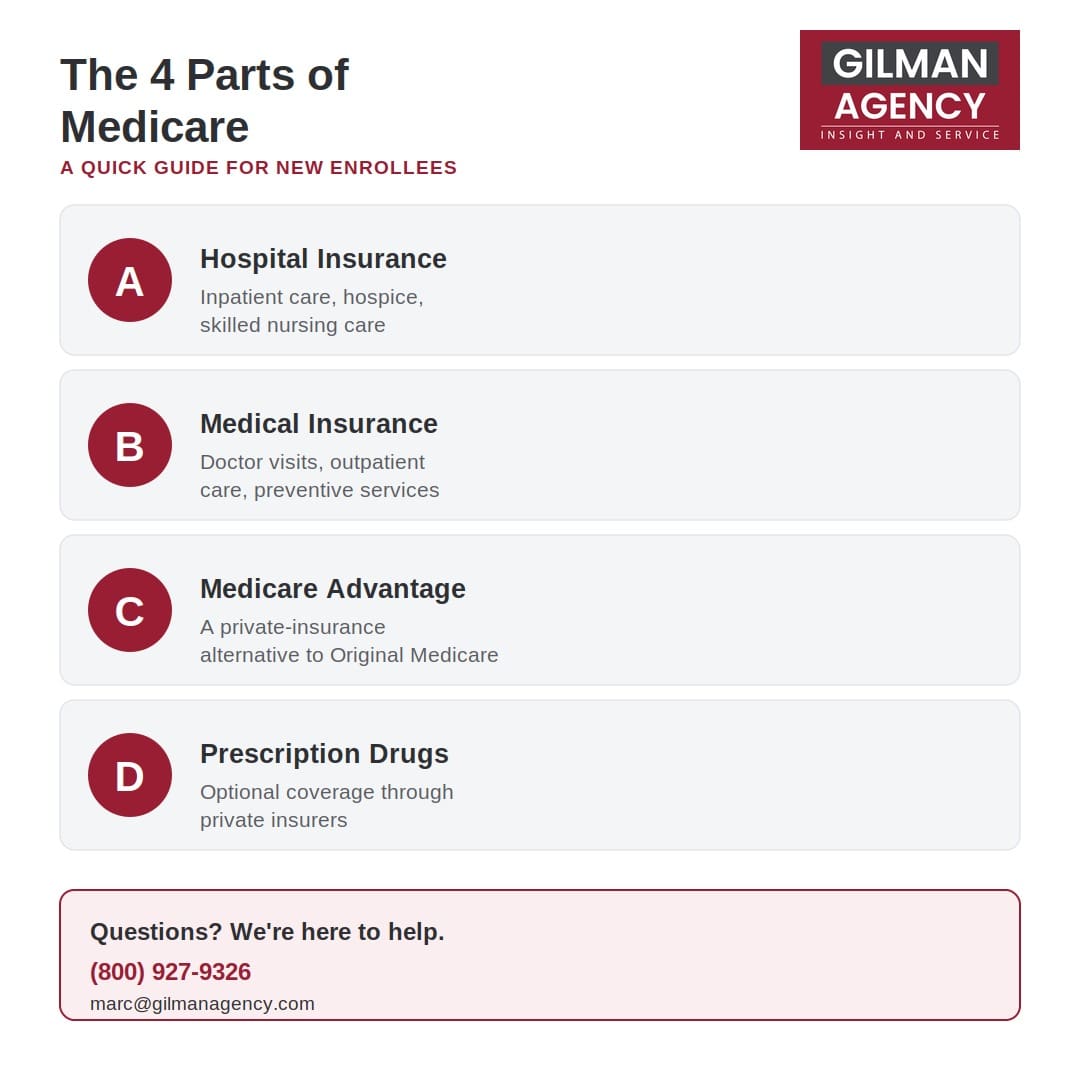
Part A covers hospital-related care and is premium-free for most people who’ve paid Medicare taxes for at least 10 years.
-
Part B covers non-hospital medical care — doctor visits, outpatient care, and preventive services — and requires a monthly premium ($202.90 standard, in 2026).
-
Parts A and B together are called “Original Medicare.”
-
Part C (Medicare Advantage) is a private-insurance alternative to Original Medicare — you need both Part A and Part B to enroll in it.
-
Part D covers prescription drugs and is optional, offered through private insurers — either as a standalone plan or bundled into a Medicare Advantage plan.
One of the more confusing things about Medicare for people newly approaching it is that it isn’t one single program — it’s split into four distinct parts, each covering something different. Here’s what each one actually does.
Part A: Hospital Insurance
Medicare Part A covers hospital-related expenses: inpatient hospital stays, hospice care, limited stays in a skilled nursing facility, and some home health care. There are real limits on this coverage — for example, in 2026 you’re responsible for a $1,736 deductible per benefit period, and coinsurance kicks in for extended hospital stays (currently $434/day for days 61–90).
Most people don’t pay a premium for Part A. If you or your spouse paid Medicare taxes for at least 10 years, it’s premium-free. If you don’t meet that threshold, you may still be able to enroll, but you’d pay a monthly premium for it.
Part B: Medical Insurance
Where Part A covers hospital care, Part B covers most things outside the hospital: doctor visits, outpatient procedures, preventive screenings, ambulance rides, durable medical equipment, and more. Unlike Part A, everyone pays a monthly premium for Part B — $202.90 in 2026 for most people, though it can be higher depending on income (see IRMAA). There’s also an annual deductible ($283 in 2026), after which you’re generally responsible for 20% coinsurance on covered services, with no annual cap on that coinsurance under Original Medicare alone.
Parts A and B together are what’s referred to as “Original Medicare.”
Part C: Medicare Advantage
Medicare Advantage (Part C) is a private-insurance alternative to Original Medicare. You need to already have both Part A and Part B to enroll in a Medicare Advantage plan. These plans are required to cover everything Original Medicare covers, but they typically work through provider networks, often include prescription drug coverage bundled in, and are required to cap your annual out-of-pocket costs — something Original Medicare alone does not do.
Part D: Prescription Drug Coverage
Part D covers prescription medications and is entirely optional, offered through private insurance companies. If you stay on Original Medicare, you’d add a standalone Part D plan separately; if you choose Medicare Advantage, drug coverage is often bundled directly into the plan. Part D coverage comes with its own premium, deductible (capped at $615 in 2026), and formulary — the specific list of drugs a given plan covers, organized into cost tiers.
What This Means When You’re Choosing Coverage
In practice, most people aren’t choosing between four separate things — they’re choosing between two overall paths: Original Medicare (Parts A + B), often paired with a standalone Part D plan and sometimes a Medicare Supplement policy, or Medicare Advantage (Part C), which typically bundles A, B, and D together under one plan. Understanding what each part actually covers is what makes that choice make sense in the first place.
What To Do Next
If you’re newly approaching Medicare eligibility, understanding these four parts is the foundation for every other decision that follows — including whether Medicare Advantage or Original Medicare with a Supplement plan makes more sense for you.
If you need further information about how these parts fit together for your specific situation, we’re here to help — no cost, no obligation.
For additional information, please call: (800) 927-9326 or email:


