By Marc Gilman
Questions? Call (800) 927-9326 or email
Key Takeaways
-
Long-term care insurance is the right first line of defense for anyone who’s still insurable and financially able to obtain coverage — it’s proactive risk transfer that can prevent a crisis before it ever happens.
-
But many people reach an LTC need without adequate coverage — some declined it earlier, some became uninsurable, others simply never got to it in time. When that happens, planning shifts from prevention to protecting what’s left.
-
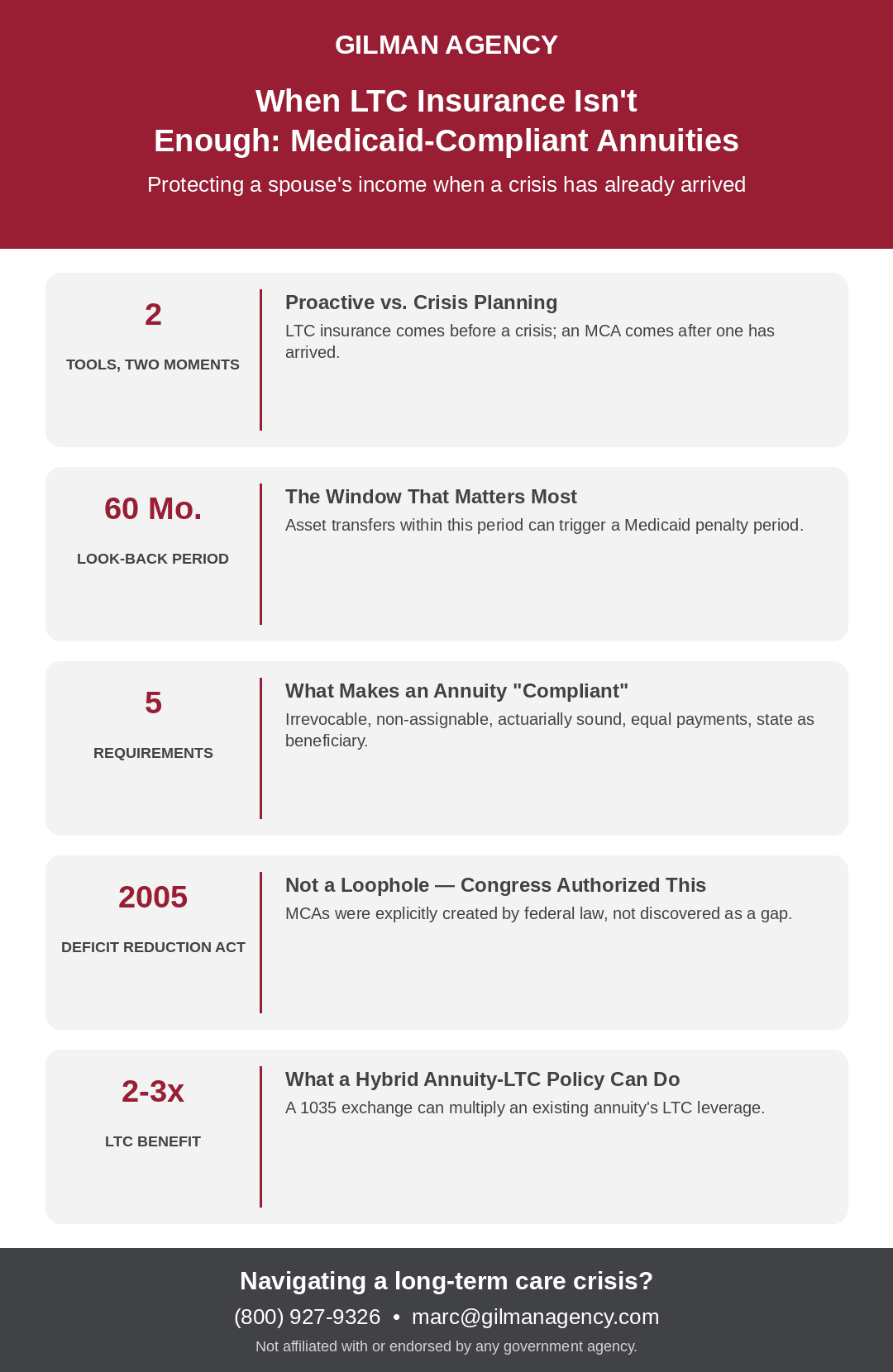
A Medicaid-Compliant Annuity (MCA) is a specific, federally authorized tool for exactly that situation — converting a married couple’s countable assets into an income stream for the spouse remaining at home, while the spouse needing care becomes eligible for Medicaid.
-
This isn’t a loophole. Congress explicitly authorized MCAs through the Deficit Reduction Act of 2005, with specific federal requirements an annuity must meet to qualify.
-
The rules are exacting, and small mistakes are costly. An MCA must be irrevocable, non-assignable, actuarially sound based on life expectancy, and structured with equal payments — miss any of these, and the entire purchase can be treated as a disqualifying transfer.
Two Different Tools for Two Different Moments
It’s worth being clear about the distinction here, since these two tools solve genuinely different problems at genuinely different points in time.
Long-term care insurance is what you use before a crisis — while you’re still healthy enough to qualify for coverage and while there’s time to plan ahead. Medicaid-Compliant Annuities are what come into play after — when a spouse already needs care, adequate LTC coverage either never existed or ran out, and the immediate priority becomes protecting the healthy spouse’s financial stability while pursuing Medicaid eligibility for the spouse who needs care.
Neither tool replaces the other. The honest goal is to use LTC insurance early enough that you never need an MCA at all — but when that window has closed, an MCA is a legitimate, federally sanctioned way to protect a family that’s now facing a genuine crisis.
Long-Term Care Insurance: The Proactive Option
If you’re still insurable, LTC coverage is generally the better starting point, and it comes in a few different structures worth understanding:
-
Traditional stand-alone LTC insurance provides a dedicated pool of LTC benefits, paid on a reimbursement or indemnity basis. It’s straightforward, but benefits are use-it-or-lose-it, and premiums can rise over time.
-
Hybrid life insurance policies combine a death benefit with the ability to accelerate that benefit for LTC needs. If care is never needed, your beneficiaries still receive a payout — addressing the “what if I never use it” objection that keeps a lot of people away from traditional LTC coverage.
-
Hybrid annuity-LTC policies pair a deferred annuity with an enhanced LTC benefit, sometimes multiplying your original premium two to three times over if care is actually needed. These can be especially useful if you already own an underperforming annuity, since a tax-free 1035 exchange can reposition those existing funds into a contract with meaningfully more LTC leverage.
Each of these has different underwriting requirements — traditional LTC insurance tends to have the strictest health requirements, while hybrid products sometimes offer more flexible pathways for older applicants or those with moderate health issues.
When LTC Insurance Wasn’t in Place: The Medicaid-Compliant Annuity
Here’s where the crisis-planning tool comes in. Medicaid is a means-tested program, and to qualify for long-term care benefits, an applicant generally has to meet strict income and asset limits. For a married couple, federal law includes real protections for the spouse who isn’t entering care — called the “community spouse” — through what’s known as the spousal impoverishment provisions, allowing that spouse to retain additional resources and income beyond what a single applicant could keep.
When a couple’s countable assets exceed Medicaid’s resource limits, one legitimate strategy is purchasing an MCA — converting a lump sum of countable assets into a protected income stream for the community spouse. Because Medicaid’s resource test for the community spouse focuses on assets, not income, this conversion can help the spouse needing care become eligible for benefits while preserving real financial stability for the spouse remaining at home.
The Specific Requirements — And Why They Matter
Federal law sets out exacting requirements an annuity must meet to actually qualify as Medicaid-compliant:
-
Irrevocable — once purchased, it can’t be undone.
-
Non-assignable — it can’t be transferred or sold to someone else.
-
Actuarially sound — the payment term must be equal to or less than the owner’s life expectancy, based on Social Security Administration life expectancy tables.
-
Equal payments, no deferral or balloon structure — the payment schedule can’t be front-loaded, back-loaded, or designed to manipulate the timing of eligibility.
-
The state Medicaid agency must be named as remainder beneficiary, up to the amount of benefits paid on the applicant’s behalf.
Missing any one of these requirements is a serious problem — an annuity that doesn’t meet the actuarial soundness test, or that allows assignment, can have its entire purchase amount treated as a disqualifying transfer under Medicaid’s look-back rules, rather than a protected conversion of assets.
The Look-Back Period Is Real, and It’s Long
Medicaid applies a 60-month look-back period in most states, examining asset transfers made for less than fair market value before an application. If a transfer during that window is found improper, it triggers a penalty period during which Medicaid won’t pay for care. This is exactly why MCA structuring has to be precise — an improperly structured annuity purchased during this window isn’t just ineffective, it can actively create a penalty that wouldn’t have existed otherwise.
It’s also worth understanding that this interacts with other estate planning tools. An irrevocable trust funded less than five years before a Medicaid application can complicate an MCA strategy, and depending on how the trust is structured, assets inside it may still be considered countable if the grantor retained certain powers or interests. This is genuinely complex territory where estate planning attorneys, elder law attorneys, and financial professionals need to be coordinating with each other, not working in isolation.
This Is Not a Loophole
It’s worth saying directly: Medicaid-Compliant Annuities are not a workaround or a trick. Congress specifically authorized their use within defined parameters through the Deficit Reduction Act of 2005. The rules exist precisely to distinguish legitimate resource conversion for a community spouse’s protection from an improper attempt to hide assets — and the specificity of the requirements (irrevocability, actuarial soundness, the state as remainder beneficiary) reflects that deliberate design, not a gap someone found and exploited.
What To Do Next
The best outcome is never needing an MCA at all — securing long-term care insurance while you’re still insurable, well before a health crisis forces a much narrower set of options. But if that window has already closed, or a care need has already arrived, a properly structured Medicaid-Compliant Annuity is a legitimate, federally authorized way to protect a spouse’s financial stability while pursuing Medicaid eligibility. Given how technical and state-specific these rules are, this isn’t something to structure without experienced guidance. If you’re facing this situation, or want to make sure your long-term care coverage is in place well before you’d ever need to consider this path, reach out and we’ll work through it together.
Questions? Call (800) 927-9326 or email
Source: Dale M. Krause, J.D., LL.M. (President and CEO, Krause Financial Services), “Integrating Long-Term Care Insurance and Medicaid-Compliant Annuities into Modern Estate Planning,” American Bar Association Real Property, Trust and Estate Law Section, July 2026. Statutory citations include 42 U.S.C. § 1396p(c)(1)(G), 42 U.S.C. § 1396r-5 (spousal impoverishment provisions), and the Deficit Reduction Act of 2005.
This article is for general informational purposes only and does not constitute legal advice. Medicaid rules vary by state and change frequently — consult a qualified elder law attorney before pursuing any Medicaid planning strategy.