
Meta description
The IRS set 2027 HSA limits at $4,500 self-only and $9,000 family. See the new HDHP rules, catch-up limits, and Medicare timing traps.
Category
Employee Benefits; Medicare
Tags
HSA, health savings account, HDHP, high-deductible health plan, 2027 contribution limits, Rev. Proc. 2026-24, catch-up contributions, Medicare Part A, six-month look-back, bronze plans, direct primary care, telehealth, open enrollment
By Marc Gilman
(800) 927-9326 | marc@gilmanagency.com
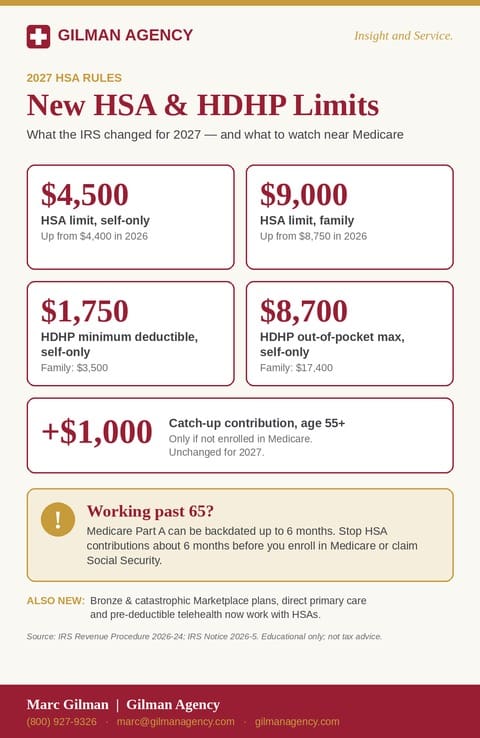
The IRS has released the 2027 limits for Health Savings Accounts (HSAs) and the high-deductible health plans (HDHPs) that go with them. Revenue Procedure 2026-24, announced May 29, 2026, raises the HSA contribution limit to $4,500 for self-only coverage and $9,000 for family coverage, starting January 1, 2027.
The new numbers matter for anyone choosing a health plan this fall. They matter even more if you are working past 65 or getting close to Medicare. Here is what changes in 2027, what stays the same, and where people most often get tripped up.
Key Takeaways
-
The 2027 HSA contribution limit is $4,500 for self-only coverage and $9,000 for family coverage, up from $4,400 and $8,750 in 2026.
-
To qualify, your HDHP must have a deductible of at least $1,750 (self-only) or $3,500 (family). Its out-of-pocket maximum can’t exceed $8,700 or $17,400.
-
If you are 55 or older and not on Medicare, you can still add a $1,000 catch-up contribution.
-
Once you enroll in any part of Medicare, you can no longer contribute to an HSA. Part A can be backdated up to six months, so plan your last contributions with care.
-
Starting in 2026, more plans work with HSAs: bronze and catastrophic Marketplace plans, certain direct primary care arrangements, and HDHPs that cover telehealth before the deductible.
What Are the 2027 HSA Contribution Limits?
For 2027, you can put up to $4,500 into an HSA with self-only HDHP coverage, or up to $9,000 with family coverage. That counts every dollar from every source: your own deposits, payroll deductions, and any employer contributions.
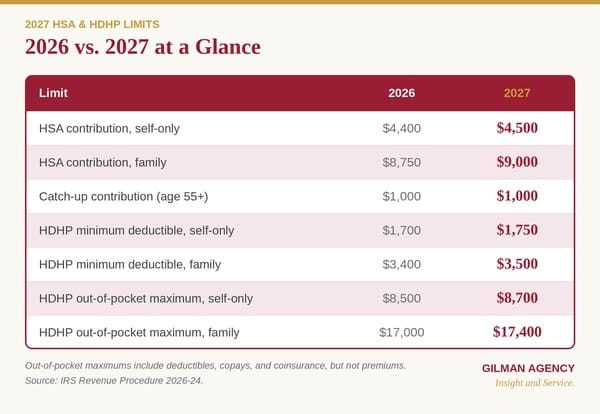
The out-of-pocket maximums include deductibles, copays, and coinsurance, but not premiums. The IRS also raised the excepted benefit HRA limit to $2,250 for plan years beginning in 2027, up from $2,200.
What Makes a Health Plan HSA-Eligible in 2027?
You can contribute to an HSA only for months when you are covered by a qualifying HDHP and have no other disqualifying coverage. In 2027, a qualifying HDHP must have a deductible of at least $1,750 for self-only coverage or $3,500 for family coverage. Its out-of-pocket maximum must be no more than $8,700 or $17,400.
You are not eligible to contribute if any of these apply:
-
You have other health coverage that is not an HDHP, such as a general-purpose health care FSA.
-
You are enrolled in Medicare, Medicaid, TRICARE, or CHIP.
-
Someone else can claim you as a dependent on their tax return.
Who Can Make a Catch-Up Contribution?
If you are 55 or older and not enrolled in Medicare, you can contribute an extra $1,000 a year. The catch-up amount is set by law and does not rise with inflation, so it stays at $1,000 for 2027.
If both spouses are 55 or older and eligible, each can make a $1,000 catch-up contribution. Each catch-up has to go into that spouse’s own HSA, so a couple using a single family account would need to open a second one.
How Does Medicare Affect Your HSA?
Once you enroll in any part of Medicare, you can no longer contribute to an HSA, and you lose the catch-up contribution too. This is where many people working past 65 run into trouble.
When you sign up for premium-free Part A after 65, your Part A coverage is generally backdated up to six months. Signing up for Social Security benefits after 65 enrolls you in Part A automatically, with the same look-back, and you can’t decline it. HSA contributions made during those backdated months count as excess contributions.
To avoid that, stop HSA contributions, including your employer’s, about six months before you apply for Medicare or Social Security. Coordinate the timing with your HR or benefits department so payroll deductions stop on time.
The good news is that the money you have already saved stays yours. After you enroll in Medicare, you can keep using HSA funds tax-free for qualified medical expenses. Those include premiums for Part A, Part B, Medicare Advantage (Part C), and Part D. Premiums for a Medicare Supplement (Medigap) policy do not qualify.
What Other HSA Rules Changed for 2026 and 2027?
The One Big Beautiful Bill Act, signed July 4, 2025, opened HSAs to more types of coverage. The IRS explained the changes in Notice 2026-5.
-
Bronze and catastrophic plans: Starting in 2026, individual bronze and catastrophic plans bought through the Health Insurance Marketplace count as HDHPs for HSA purposes. Those bought off-exchange also count if the same plan is offered on the Marketplace.
-
Direct primary care: Starting in 2026, a direct primary care arrangement no longer blocks HSA contributions, as long as monthly fees stay within the limit. For 2027, the limit is $150 per month for one person or $300 per month for more than one. You can use HSA funds to pay those fees.
-
Telehealth: An HDHP can cover telehealth before you meet the deductible without costing you HSA eligibility. This applies to plan years beginning after December 31, 2024.
What Deadlines and Penalties Should You Know?
You can make 2027 contributions until your tax filing deadline in 2028, usually around April 15. If you have HSA-eligible coverage for only part of the year, your limit is generally prorated by the number of months you were covered.
The main exception is the last-month rule. If you are eligible on December 1, you can contribute the full annual amount. You then have to stay eligible through December 31 of the following year, or the extra amount becomes taxable and faces an additional 10% tax.
Other penalties to watch:
-
Excess contributions face a 6% excise tax for each year they stay in the account uncorrected.
-
Withdrawals for non-medical expenses before age 65 are taxed as income, plus a 20% penalty.
-
After age 65, non-medical withdrawals are taxed as income, but with no penalty.
Where Does Insurance Planning Fit In?
An HSA works best when it is part of a coordinated plan, not a stand-alone decision. A higher HDHP deductible means more of a hospital stay or serious diagnosis comes out of pocket before coverage starts.
That is where supplemental coverage can help. A Hospital Indemnity Plan (HIP) pays a set cash benefit for a covered hospital stay. A Cancer, Heart Attack, and Stroke (CHAS) plan pays a lump sum when you are diagnosed with a covered condition. Either can help cover the gap between your deductible and your HSA balance. These plans do not count as health coverage that disqualifies you from an HSA, but check the plan details before you enroll.
Timing is the other piece. If you are working past 65, the decision about when to enroll in Medicare and the decision about when to stop HSA contributions need to be made together. A conversation a year ahead can prevent a surprise tax bill later.
What To Do Next
If you are choosing a plan this fall, or you are within a year or two of Medicare, now is a good time to review how your HSA fits your coverage.
-
Confirm your 2027 plan meets the new HDHP deductible and out-of-pocket limits.
-
Set your 2027 contribution, including any employer dollars and the $1,000 catch-up if you are 55 or older.
-
If you are working past 65, map out when you will enroll in Medicare and when your HSA contributions need to stop.
Call Gilman Agency at (800) 927-9326 or email marc@gilmanagency.com to schedule a review. If you would like us to contact you about your Medicare options, please complete our Permission to Contact form.
Sources
Figures in this post come from IRS Revenue Procedure 2026-24 and SHRM’s report “IRS Unveils 2027 HSA, HDHP Limits.” Eligibility, catch-up, deadline, and penalty rules come from Fidelity’s “HSA Contribution Limits” and “HSAs and Medicare.” Details on the 2026 rule changes come from WTW’s summary of IRS Notice 2026-5. The Part A look-back is described in Princeton University’s HSA and Medicare guidance, which cites Social Security Administration rules.
This article is for educational purposes only and is not tax, legal, or investment advice. HSA rules are set by the IRS and can change. Consult a qualified tax professional about your situation. Gilman Agency is not affiliated with or endorsed by the U.S. government or the federal Medicare program.


