By Marc Gilman
Call (800) 927-9326
Email marc@gilmanagency.com
Updated November 2026 with the 2027 Medicare amounts.
Key Takeaways
-
Plan G and Plan N cover nearly identical ground. Both work alongside Original Medicare, let you see any provider nationwide who accepts Medicare, and require no referrals. The real difference sits in just two areas: office and ER copays, and Part B excess charges.
-
The choice isn’t about which plan is “better.” It’s about how you pay. Plan G trades a higher monthly premium for almost no bills at the point of care. Plan N trades a lower premium for a handful of small, capped copays.
-
Neither plan covers the Part B deductible, which rises to $292 in 2027 (up from $283 in 2026), if you became eligible for Medicare on or after January 1, 2020. You pay it first under either plan.
-
Switching between Plan G and Plan N later isn’t guaranteed. Outside your one-time Medigap Open Enrollment Period or a qualifying guaranteed-issue event, changing plans typically means medical underwriting.
-
This is a math question, not a preference. The honest answer depends on how often you actually use healthcare.
What Plan G and Plan N Have in Common
Both are standardized Medicare Supplement plans, which means a Plan G policy covers the same core benefits no matter which company sells it, and the same holds for Plan N. What varies by insurer is the premium, not the coverage.
With either plan, you can see any doctor or hospital nationwide that accepts Medicare, with no referrals and no network. Both cover Medicare Part A hospital coinsurance (including extra hospital days beyond what Original Medicare covers), the Part A deductible, skilled nursing facility coinsurance, the first three pints of blood, and foreign travel emergencies up to plan limits. Neither includes prescription drug coverage, so you still need a separate Part D plan.
The 2027 Medicare Costs These Plans Help With
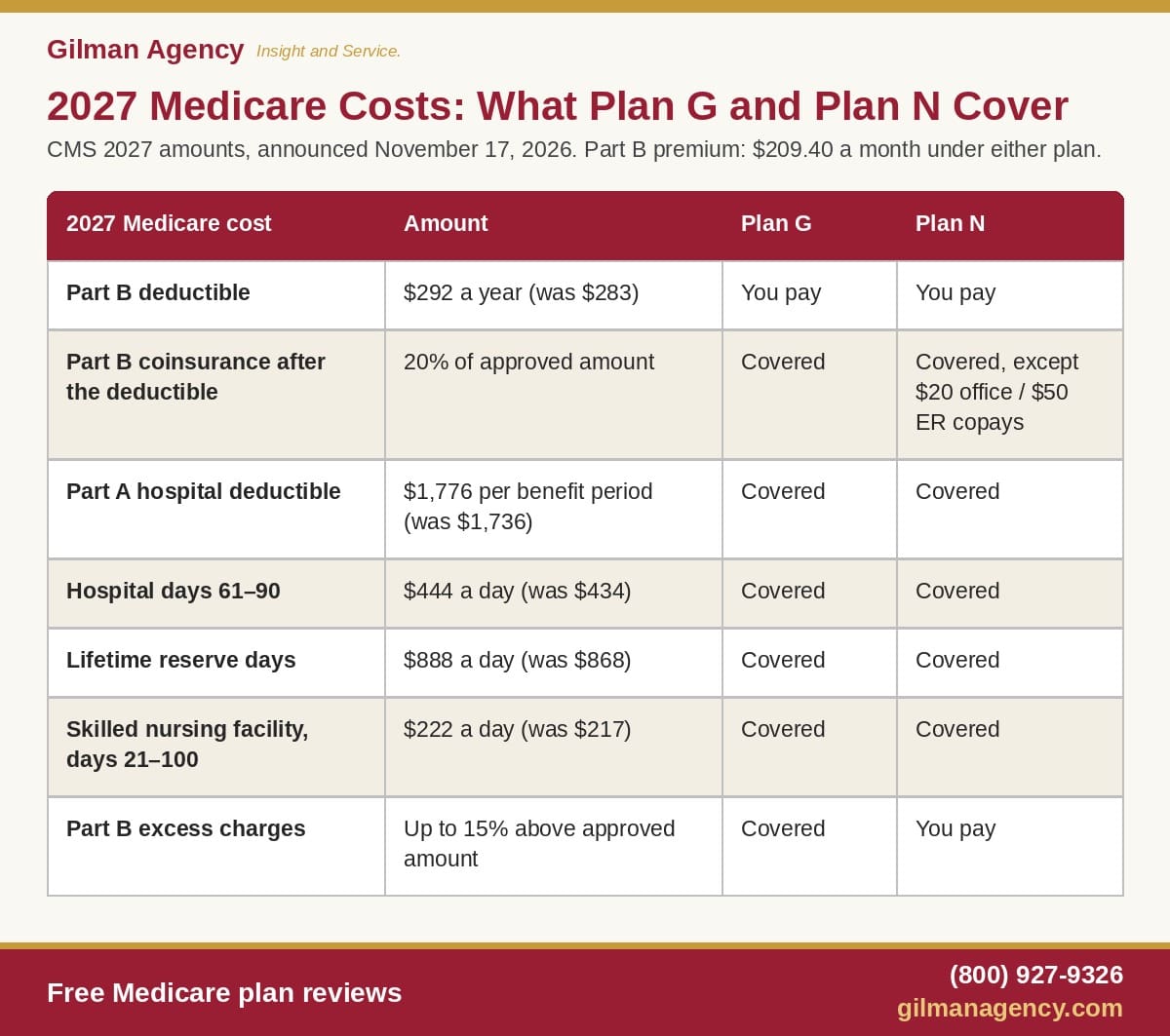
The standard Part B premium for 2027 is $209.40 a month (was $202.90). You pay it on top of your Medigap premium under either plan.
Where They Actually Diverge
Strip away everything identical, and the decision comes down to two things:
Office visit and ER copays. Plan G covers Part B coinsurance in full after you meet the annual deductible, so you generally won’t see a bill for a Medicare-covered service. Plan N has a copay of up to $20 for some office visits and up to $50 for an ER visit that doesn’t lead to an inpatient admission (waived if you’re admitted). These are maximums, not charges on every visit.
Part B excess charges. If a provider doesn’t accept Medicare assignment, they may bill up to 15% above the Medicare-approved amount in states that allow it. Plan G covers this difference. Plan N does not, so anyone considering Plan N should check whether their regular providers accept assignment.
Under both plans, you pay the $292 Part B deductible in 2027 before the plan’s Part B benefits begin.
A Simple Way to Think Through the Math
Rather than guessing, run your own rough numbers:
-
Find the actual premium gap between a Plan G and Plan N quote from the same insurer, in your area.
-
Multiply that monthly gap by 12 to get your annual premium savings with Plan N.
-
Estimate your annual copay exposure: office visits times up to $20, plus any ER visits times up to $50.
-
Compare the two numbers. If your expected copays are smaller than your premium savings, Plan N likely costs less. If you see specialists often, or aren’t sure your providers accept Medicare assignment, the math can flip the other way, or an excess charge Plan N doesn’t cover can erase the savings.
The $292 deductible doesn’t change this comparison, because you pay it under either plan.
Who Tends to Fit Each Plan
Plan G often fits if you:
-
Want the fewest possible surprises at the point of care
-
See specialists or need outpatient care fairly regularly
-
Sometimes see providers who may not accept Medicare assignment
-
Would rather budget one predictable premium than track copays
Plan N often fits if you:
-
Are generally healthy and don’t see the doctor often
-
Would notice and value the premium savings
-
Mostly see providers who accept Medicare assignment
-
Wouldn’t mind an occasional $20 or $50 bill
Switching Later Isn’t Automatic
Outside your Medigap Open Enrollment Period (the six months that start when you’re 65 or older and enrolled in Part B) or a qualifying guaranteed-issue event, moving from Plan N to Plan G, or back, generally requires answering health questions and passing medical underwriting in most states.
Some states have a “birthday rule” or a similar annual switching window, but the details vary by state. Confirm your own state’s rules before counting on switching later, because a change in your health can keep you from qualifying for the plan you want.
Questions Worth Asking Before You Decide
-
What is the actual premium gap between Plan G and Plan N from the same insurer in your area?
-
How many office visits and specialist appointments do you expect in a typical year?
-
Do your regular providers accept Medicare assignment, and have you confirmed it?
-
If your health changes, will you be comfortable with the plan you choose today?
What To Do Next
Let’s run your actual numbers together: your real premium quotes, your provider list and how often you use care.
Call (800) 927-9326 or email marc@gilmanagency.com.
Prefer we reach out to you? Complete our Permission to Contact form and a licensed Gilman Agency agent will follow up.
We do not offer every plan available in your area. Please contact Medicare.gov, 1-800-MEDICARE to get information on all of your options.
This article is for general education and describes standardized Medigap plan features nationally. Premiums, insurer availability, underwriting and state switching rules vary, including in Massachusetts, Minnesota and Wisconsin, which standardize Medigap differently. Confirm details with an insurer or your state insurance department. This is not a recommendation of any specific plan or insurer.