By Marc Gilman
Call (800) 927-9326
Email marc@gilmanagency.com
An annuity can be a smart way to protect savings or create income you can’t outlive. It’s also a long-term contract, often with years of surrender charges. That’s why New Hampshire doesn’t let an agent simply sell you one. In February 2024, the New Hampshire Insurance Department adopted the national Best Interest standard for annuities. Now any agent who recommends an annuity in New Hampshire must act in your best interest, and must be able to show it.
Here’s what that means for you, and what a good agent will do before you sign anything.
Key Takeaways
-
New Hampshire rule Ins 305 requires agents to act in your best interest when they recommend buying, exchanging or replacing an annuity.
-
Before recommending anything, your agent should ask about your income, expenses, savings, existing policies, goals, time horizon and how much access to your money you need.
-
You should receive a disclosure form explaining the agent’s role, which insurers they work with and how they’re paid.
-
You should also receive an annuity Buyer’s Guide and a disclosure document about the specific contract.
-
Your agent should explain surrender charges, fees, rider costs, caps and what is and isn’t guaranteed.
-
Replacing an existing annuity gets extra scrutiny: the new one should substantially benefit you over the life of the contract.
What Does “Best Interest” Mean for an Annuity?
The old standard was “suitability”: could this product reasonably work for you? The Best Interest rule goes further. The agent must be able to show that this particular annuity, in this amount, with these features, fits your needs, and that their own pay didn’t come ahead of yours.
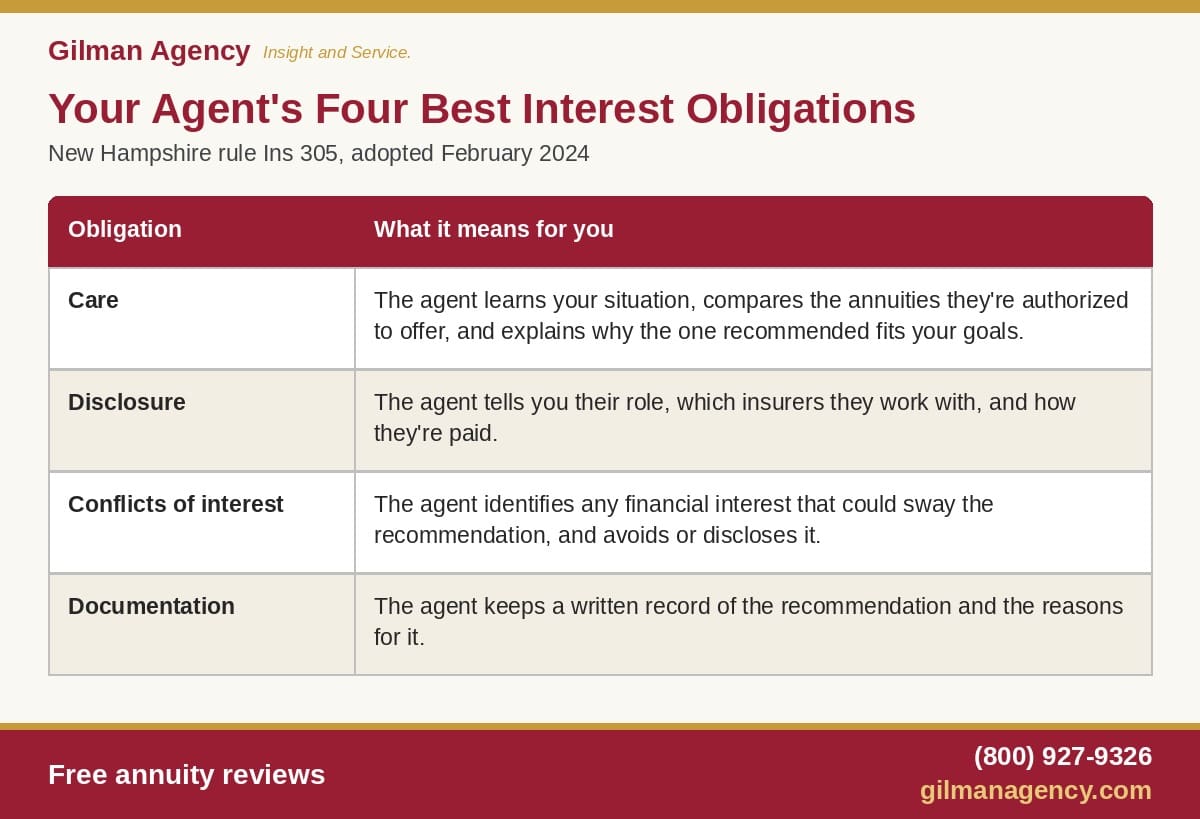
The rule rests on four obligations:
What Should Your Agent Ask You?
A good recommendation starts with good questions. Expect to be asked about:
-
Your age and where you are in retirement
-
Your income: Social Security, pension, work and investment income
-
Your expenses, debts and obligations
-
Your savings and other assets, including how much you can reach quickly in an emergency
-
Your existing annuities, life insurance and investments
-
Your goals: protecting principal, growing savings tax-deferred, guaranteed income, leaving money to family, or planning for long-term care
-
When you may need the money, and any large expenses ahead, such as medical or home costs
-
Your comfort with risk, and with having less access to your money
-
Where the money is coming from, such as a CD, savings, an IRA or 401(k), or another annuity
-
Tax status: whether the money is in a retirement account or not
These aren’t nosy questions. They’re how your agent shows the annuity won’t tie up money you’ll need, and that it fits the job you want it to do.
You can decline to answer. If you do, you’ll be asked to sign a statement saying you refused and understand that the agent may not be able to make a sound recommendation without the information. The state form warns that you may lose protections under New Hampshire’s insurance rules, and the same is true if you buy an annuity your agent didn’t recommend.
What Must Your Agent Tell You?
Who They Are and How They’re Paid
Before recommending an annuity, your agent must give you an Insurance Agent (Producer) Disclosure for Annuities form. It tells you:
-
The agent’s role and relationship with you
-
Which products they’re licensed to sell, such as fixed, fixed indexed or variable annuities, life insurance, or securities
-
Whether they work with one insurer, several, or mainly one, plus their National Producer Number, so you can confirm their New Hampshire license with the Insurance Department
-
How they’re paid: commission, fees or both
-
That you have the right to ask for more detail about their pay. If you ask, they must give you a reasonable estimate, which can be a range, and say whether it’s paid once or over time.
The Buyer’s Guide and Disclosure Document
New Hampshire also requires an annuity Buyer’s Guide and a disclosure document describing the specific contract. If you don’t receive them at or before the time you apply, you get at least 15 days after the contract arrives to return it without penalty.
What the Annuity Can and Can’t Do
Your agent should explain, in plain terms, the features that matter for your situation:
-
Surrender period and surrender charges: how long your money is committed and what it costs to leave early
-
Free withdrawals: how much you can take out each year without a charge
-
Taxes: including a possible IRS penalty on withdrawals before age 59½
-
Fees and rider costs: such as an income rider’s yearly charge
-
How interest is credited: caps, participation rates or spreads on indexed annuities
-
What’s guaranteed and what isn’t: and that non-guaranteed rates can change
-
Market risk: for variable annuities
Replacing an Annuity You Already Own
Moving money from one annuity to another gets extra attention, and it should. Your agent must consider whether the new annuity substantially benefits you over the life of the new contract, looking at:
-
Surrender charges you’d pay to leave the old annuity, and a new surrender period starting over
-
Guarantees, income riders or death benefits you’d give up
-
Any change in fees, access to your money and how interest is credited
-
Tax effects
-
Whether you’ve exchanged or replaced an annuity in the past 60 months
A replacement should be justified by a real benefit to you, not a new commission or a shiny feature.
Forms You Might Sign
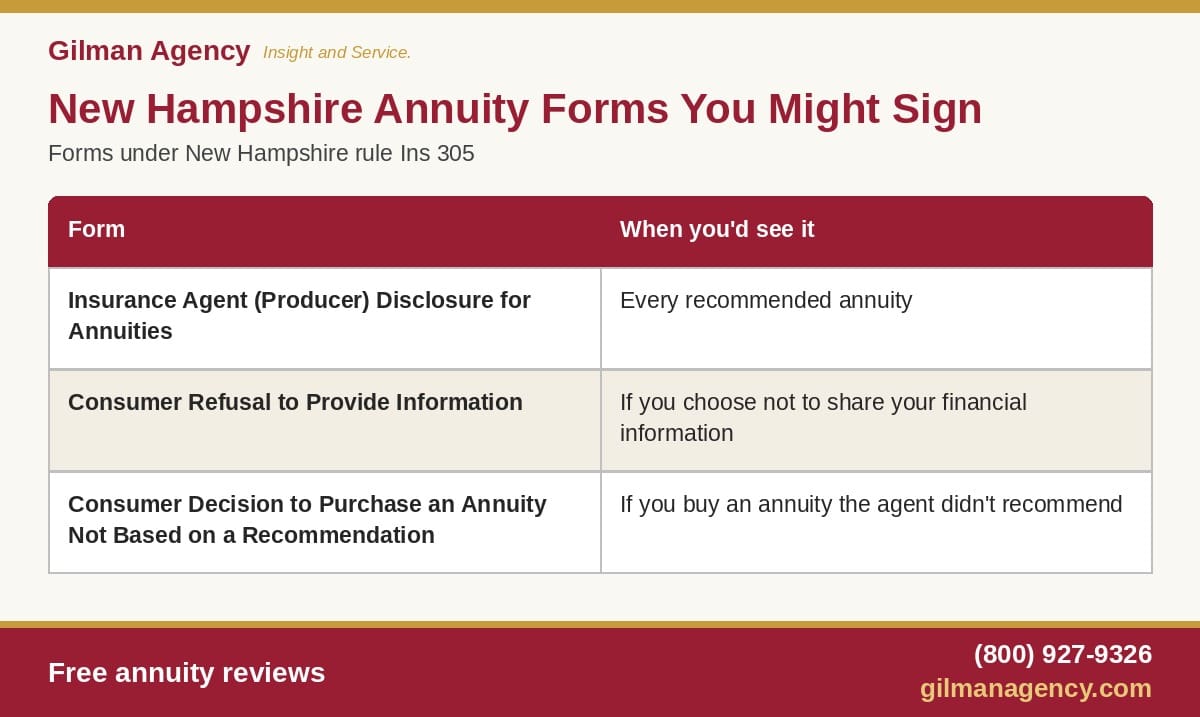
What the rule doesn’t cover: annuities inside most employer retirement plans, structured settlements for injury claims, prepaid funeral contracts, and direct-response sales where no one gathered your information.
What Else Protects You?
-
The insurer double-checks. Before issuing a recommended annuity, the insurance company must review whether it fits your situation. It may call or write to confirm your information, and it may ask you to complete its own client profile form. Records of your information, the disclosures you received and the basis for the recommendation must be kept for as long as the annuity is in force, plus five years.
-
No one may talk you out of your rights. An agent or insurer may not discourage you from answering the insurer’s confirmation questions truthfully, filing a complaint, or cooperating with an investigation. Insurers must also eliminate sales contests, quotas and bonuses tied to selling a specific annuity in a short period.
-
Trained agents only. Since February 2024, New Hampshire agents must complete Best Interest annuity training, plus the insurer’s product training, before selling annuities.
What the Rule Doesn’t Promise
-
It isn’t a fiduciary duty. The rule creates a regulatory standard, not a fiduciary relationship, and it doesn’t give you a right to sue under the rule itself.
-
It doesn’t require the cheapest option. The best annuity for you isn’t necessarily the one that pays the agent least.
-
Your agent compares what they’re licensed to sell. An insurance agent isn’t required to compare annuities with stocks, mutual funds or other products outside their license.
-
There’s no ongoing monitoring unless you sign a separate advisory or planning agreement. That’s why a periodic annuity review is worth asking for.
Questions to Ask Before You Sign
-
Why this annuity, and why this amount, for my goals?
-
What other options did you consider, and why aren’t they better for me?
-
How long is the surrender period, and what would it cost me to get out early?
-
How much can I withdraw each year without a charge?
-
What is guaranteed, and what can change?
-
What fees and rider costs will I pay each year?
-
How are you paid on this sale?
-
If I’m replacing an annuity, what will I give up, and what do I gain?
-
Did I receive the Buyer’s Guide and disclosure document, and how long is my free look period?
A good agent will welcome these questions and answer them in writing. One more tip: under New Hampshire law, your signed application is part of your annuity contract. Read it before you sign and make sure every answer on it is accurate.
Where Does Insurance Planning Fit In?
An annuity should fit inside your whole retirement picture: Social Security, savings you need to keep liquid, Medicare costs, and possible long-term care. We start there, not with a product.
What To Do Next
We help New Hampshire and Massachusetts retirees compare fixed, fixed indexed and income annuities from multiple insurers, and we document every recommendation the way the Best Interest rule requires. There’s no fee and no obligation. Call (800) 927-9326, text (603) 493-1394 or email marc@gilmanagency.com.
This article is for general education and isn’t legal, tax or investment advice. Annuities are insurance contracts issued by insurance companies. They are not deposits, are not FDIC insured, and are not investments in bonds or the stock market. Guarantees are backed by the claims-paying ability of the issuing insurer. Surrender charges may apply.