
By Marc Gilman
Questions? Call (800) 927-9326 or email
Key Takeaways
-
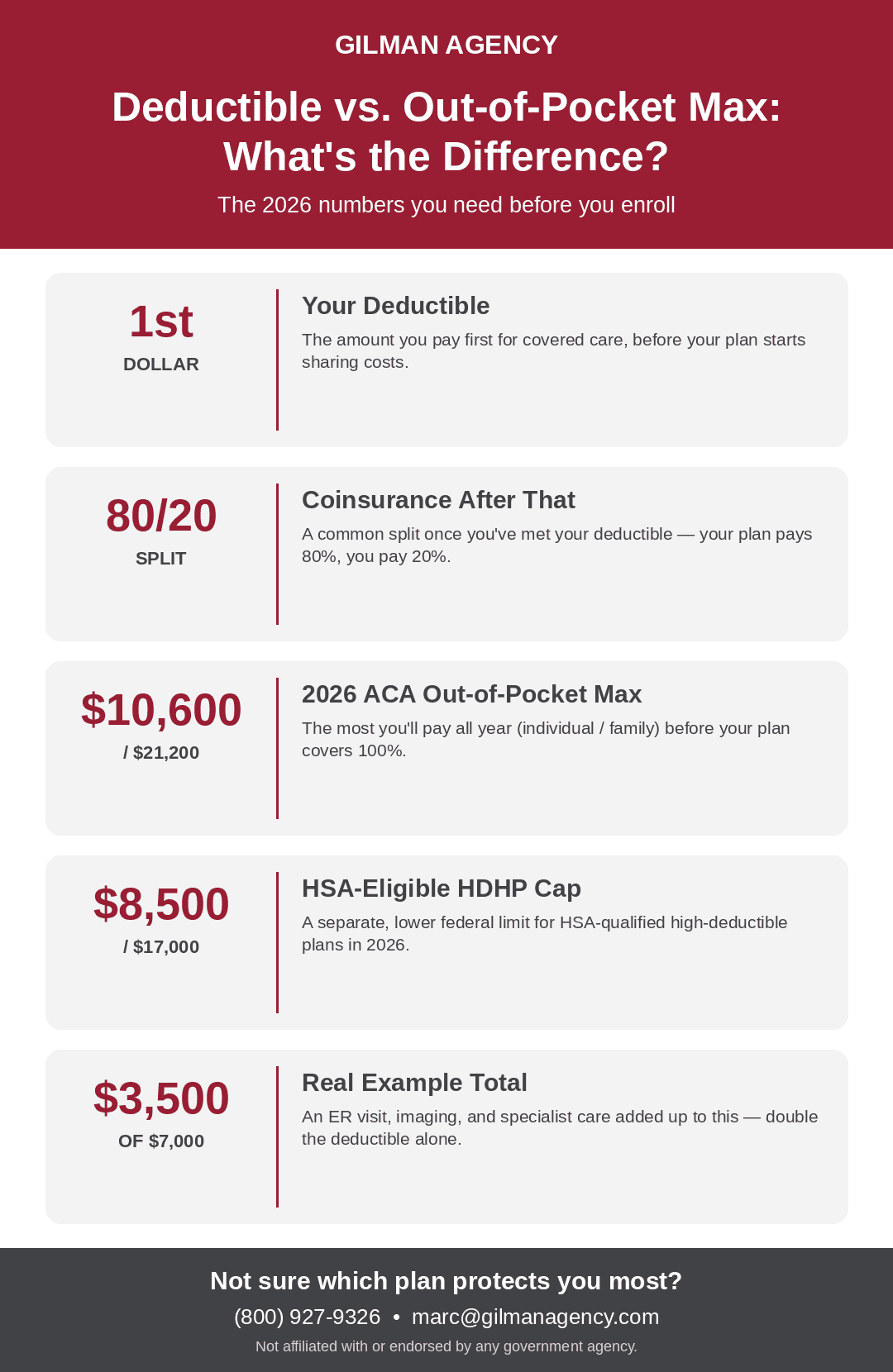
Your deductible is what you pay first, before your plan starts sharing costs. Your out-of-pocket maximum is the absolute ceiling on what you’ll pay in a year — and it’s almost always a much bigger number.
-
Hitting your deductible doesn’t mean you’re done paying. It usually means you’ve moved into coinsurance, where you and your insurer split the bill.
-
For 2026, ACA Marketplace plans can set an out-of-pocket max no higher than $10,600 for an individual and $21,200 for a family.
-
HSA-eligible high-deductible plans work under a separate, lower cap: $8,500 individual / $17,000 family in 2026 — but they also require a minimum deductible of $1,700 individual / $3,400 family to qualify.
-
Premiums, out-of-network care, and non-covered services generally don’t count toward either number — which is exactly where people get surprised.
What Is a Deductible, Really?
Your deductible is the amount you pay for covered care before your insurance starts sharing the cost. If your deductible is $2,000, you’re responsible for the first $2,000 of covered services each year — full price, no help from your plan.
Once you’ve met it, you don’t automatically get free care. You typically move into one of two arrangements:
-
Coinsurance — you and your insurer split the bill by percentage (a common split is 80/20, where your plan pays 80% and you pay 20%)
-
Copays — a flat fee per visit or service, regardless of the actual cost
Either way, meeting your deductible is the start of cost-sharing, not the end of it.
So What Is the Out-of-Pocket Maximum?
Your out-of-pocket maximum (often shortened to OOP max or MOOP) is the most you’ll pay in a plan year for covered, in-network care. Once you hit it, your plan picks up 100% of covered costs for the rest of the year.
The OOP max includes your deductible, plus everything you’ve paid in copays and coinsurance along the way. What it generally does not include:
-
Your monthly premium
-
Out-of-network care, in most plans
-
Non-covered services, like cosmetic procedures
-
Balance billing, when a provider charges more than your plan’s allowed amount
That last one catches people off guard the most — an out-of-network surprise bill can keep piling up well past the point where you thought you were “maxed out.”
What Are the Actual 2026 Limits?
The federal government sets a ceiling on how high an ACA-compliant plan’s out-of-pocket max can go, and it moves most years. For 2026:
-
Standard ACA Marketplace plans: up to $10,600 for an individual, $21,200 for a family
-
HSA-eligible high-deductible health plans (HDHPs): capped lower, at $8,500 individual / $17,000 family, under IRS rules
-
HDHP minimum deductible to qualify for an HSA: $1,700 individual / $3,400 family
Employer plans are allowed to set their own limits, as long as they don’t exceed these federal caps — so your actual number could be lower depending on where you get coverage.
A Real Example: How the Numbers Actually Add Up
Picture a fall on the ice that leads to an ER visit, imaging, and a few weeks of follow-up with an orthopedist. The plan in this example has a $2,000 deductible, 20% coinsurance after that, and a $7,000 out-of-pocket max.
Here’s how the costs would actually break down:
-
ER visit, billed at $3,500: you pay the first $2,000 (your deductible), then 20% of the remaining $1,500 — $300. Total so far: $2,300
-
Imaging, billed at $2,000: deductible already met, so you pay 20% coinsurance — $400. Running total: $2,700
-
Specialist visits and rehab, billed at $4,000: 20% coinsurance — $800. Running total: $3,500
Total out-of-pocket for the year: $3,500 — well under the $7,000 max, but nearly double the $2,000 deductible alone. That gap is exactly what catches people off guard when they assume “meeting the deductible” means the bills stop.
Why This Difference Actually Matters
Understanding both numbers changes how you should shop for a plan — not just how you brace for a bill. A few places it shows up directly:
-
Comparing a low-premium, high-deductible plan against a higher-premium plan with richer coverage. The lower monthly cost can disappear fast if you hit even a moderate claim.
-
Deciding whether an HSA-eligible plan makes sense for you. The tax advantages are real, but only if the higher minimum deductible fits your actual health needs and savings cushion.
-
Understanding your true worst-case cost for the year — which is your out-of-pocket max, not your deductible, and it’s the number you should actually be budgeting around if something serious happens.
What Should I Ask Before I Enroll?
Before picking a plan, it’s worth getting clear, specific answers to:
-
What services count toward my deductible, and are any (like preventive care) covered before I meet it?
-
What’s my coinsurance percentage once the deductible is met, and does it apply to everything or just certain services?
-
What’s excluded from my out-of-pocket max? Out-of-network care and balance billing are the two that most often surprise people.
What To Do Next
Your deductible tells you where cost-sharing starts. Your out-of-pocket max tells you where it stops — and that second number is the one that actually protects you from a financial worst-case scenario. The right plan depends on your health needs, your budget, and how much risk you’re comfortable carrying month to month.
If you’re comparing plans and want to see how a real claim would play out under each one, reach out and we’ll run the numbers together before you commit.
Questions? Call (800) 927-9326 or email


