By Marc Gilman
Questions? Call (800) 927-9326 or email
Key Takeaways
-
A fixed index annuity (FIA) combines a traditional fixed annuity with the potential for additional interest linked to a market index — without directly investing your premium in that index.
-
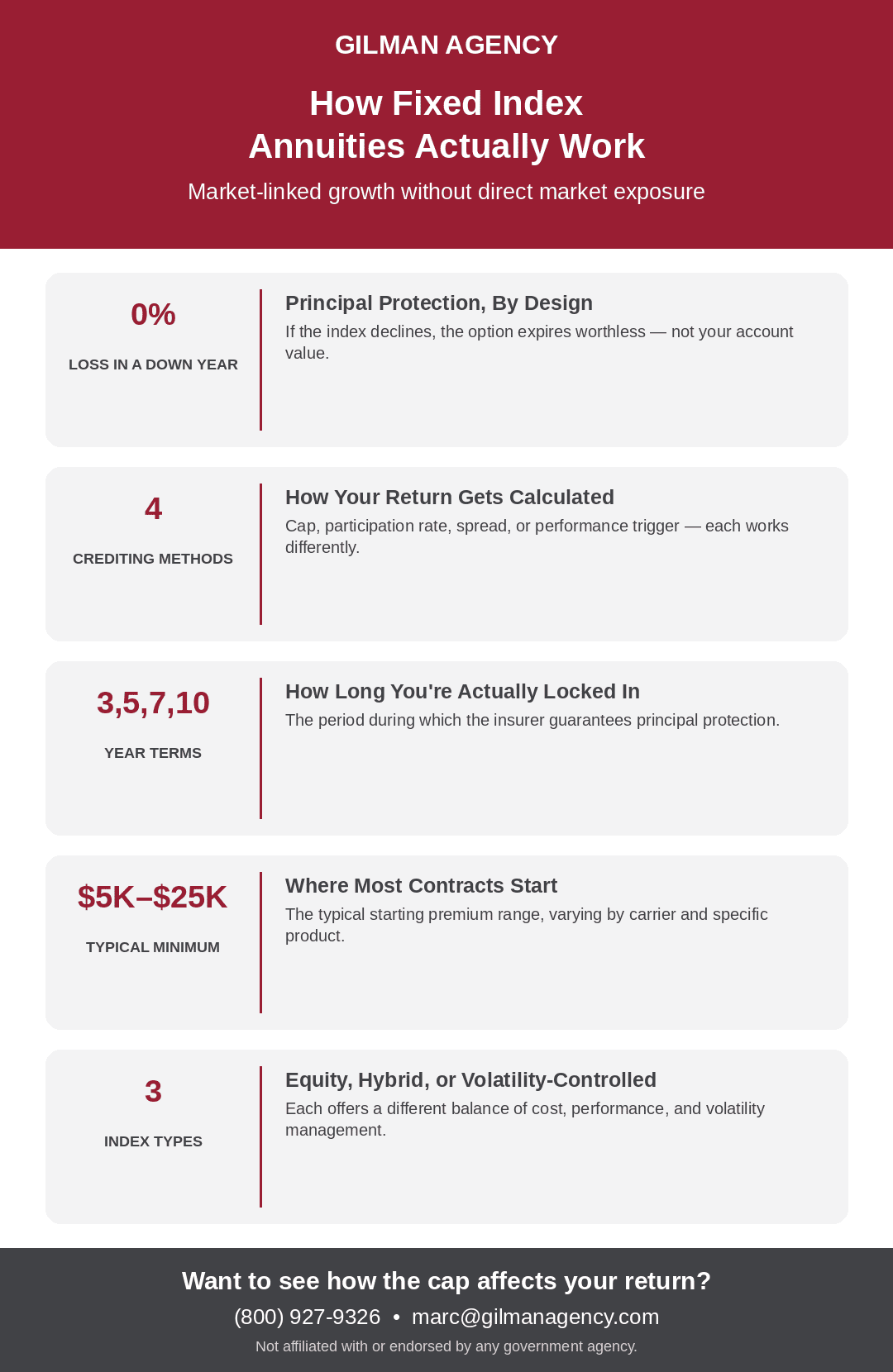
Your principal is protected from market losses. If the index declines, your account value doesn’t fall — the insurer absorbs that cost, not you.
-
The trade-off is a cap on your upside. In exchange for downside protection, you generally won’t capture the market’s full return in a strong year.
-
How much interest you’re credited depends on the crediting method your contract uses — a cap, a participation rate, a spread, or a performance trigger — each calculating your credited interest differently from the same index performance.
-
FIAs sit in the middle of the risk spectrum — more protected than variable annuities or stocks, but with more growth potential than a CD or a purely fixed annuity.
What an FIA Actually Is
A fixed index annuity is a long-term, tax-deferred contract that blends two things: the safety of a traditional fixed annuity, and the potential for additional interest tied to how a market index performs. It’s important to understand what that actually means mechanically — you are not investing directly in the index. Your premium isn’t buying shares of the S&P 500 or any other benchmark. Instead, the insurer uses your premium to generate a return that’s linked to index performance, while keeping your principal protected from market declines.
How the Insurer Actually Does This
Here’s the mechanism, in plain terms: the insurance company takes your premium and invests the bulk of it conservatively — generally in bonds — to protect your principal. It then uses the yield generated from those conservative investments to purchase call options on a market index, like the S&P 500.
If the index goes up, those options gain value, and you’re credited a portion of that gain based on your contract’s specific crediting method. If the index goes down, the options simply expire worthless — the insurer absorbs that cost, and your account value doesn’t decline. This is the entire basis of an FIA’s principal protection: you’re not directly exposed to the index’s downside, because you were never directly invested in it to begin with.
Where FIAs Sit on the Risk Spectrum
It helps to see this positioned against other common options, from least to most risk and potential reward:
CDs → Fixed annuities → Fixed index annuities → Registered index-linked annuities (RILAs) → Variable annuities → Bonds/Stocks
-
CDs and fixed annuities offer guaranteed returns over a set period, with no risk of principal loss from market downturns.
-
Fixed index annuities offer greater potential returns tied to index performance, with no return — but also no loss — when the index is negative.
-
RILAs (registered index-linked annuities) offer even greater potential returns, in exchange for accepting some downside exposure when the index is negative — a meaningfully different risk profile from an FIA.
-
Variable annuities and direct market investments (stocks, stock mutual funds) offer full market participation, with full exposure to market downturns.
The Four Crediting Methods, Explained With Real Math
This is the part that determines how much interest you actually earn, and it’s worth understanding precisely rather than taking “linked to the market” at face value:
-
Cap: the insurer sets a maximum return you can earn during the crediting period. If your cap is 6% and the index gains 8% that year, you’re credited 6% — not the full 8%.
-
Participation rate: this passes through a percentage of the index’s gain. If your participation rate is 80% and the index gains 10%, you’re credited 8%.
-
Interest rate spread: the index must outperform a set hurdle before you earn anything. If the spread is 2% and the index rises 7%, you’re credited 5% (7% minus the 2% spread).
-
Performance trigger: a flat rate is credited whenever the index ends the period flat or positive — the actual size of the gain doesn’t matter, only whether it was zero or above.
Which method your contract uses meaningfully changes your actual return in a given year, even against the identical underlying index performance — this is worth confirming precisely rather than assuming “index-linked” means the same thing across every contract.
How Contracts Are Actually Structured
-
Contract term length: FIAs are commonly issued with terms of 3, 5, 7, or 10 years — the period during which the insurer guarantees principal protection. Shorter terms offer more flexibility; longer terms reduce the risk of needing to make a decision during a market downturn, since the insurer has more time to reset caps and strategies as conditions change.
-
Minimum premium: typically starts somewhere between $5,000 and $25,000, depending on the carrier and product.
-
Index selection: most contracts let you choose from two or more indexes, and some allow splitting your premium across multiple indexes and strategies within a single contract.
-
Crediting period: the interval over which index performance is measured — monthly, annually, or multi-year. An annual “point-to-point” measurement, locking in gains at each contract anniversary, is one of the most common structures.
The Three Types of Indexes You’ll Actually See
-
Equity indexes — familiar benchmarks like the S&P 500, Nasdaq-100, Russell 2000, or MSCI-EAFE, typically using their “price-return” version (excluding dividends), which makes the underlying options less expensive than dividend-inclusive versions.
-
Multi-asset (hybrid) indexes — blend at least three asset classes, often stocks, bonds, and something like commodities or gold, designed for broader diversification.
-
Volatility-controlled indexes — dynamically shift allocation between stocks and cash based on current market volatility, aiming to smooth returns over time rather than chase raw performance.
Some FIA contracts even use indexes co-developed by well-known academic researchers — including a benchmark tied to work by Yale’s Robert Shiller (a Nobel laureate in economics) and another developed with Yale professor emeritus Roger Ibbotson — built specifically around consistency of returns and managing downside risk, rather than simply chasing the highest possible number.
A Simple Illustration of the Trade-Off
Consider two hypothetical retirees, each with a portion of their portfolio in an FIA with an 6% cap, tracking the same index over the same year:
-
If the index gains 4%, both are credited the full 4% — the cap didn’t come into play at all.
-
If the index gains 11%, both are credited only 6% — the cap limits the upside, but they still earned a solid return with zero risk of loss.
-
If the index drops 15%, both are credited 0% — not a loss, just no gain that year. Their principal remains exactly where it started.
That last scenario is the actual value proposition of an FIA: in a genuinely bad market year, the alternative to “0% growth” isn’t “still made money” — it’s comparing against what a directly invested portfolio would have lost instead.
What To Do Next
A fixed index annuity isn’t a way to capture full stock market returns with none of the risk — the cap, participation rate, or spread exists specifically because the insurer is buying you real protection, and protection has a cost built into the structure. The right question isn’t whether an FIA beats the stock market in a great year (it generally won’t) — it’s whether the protection against a bad year fits where you are in your retirement timeline. If you want to look at how an FIA’s specific crediting method and term length would fit into your broader portfolio, reach out and we’ll work through it together.
Questions? Call (800) 927-9326 or email
Sources: Spencer Look, Morningstar Center for Retirement & Policy Studies, “Under the Microscope: Fixed-Indexed Annuities With Guaranteed Lifetime Withdrawal Benefits,” June 2023; Susan Rupe, InsuranceNewsNet, “Anatomy of an FIA: 6 Benefits to Investors,” August 2024; Kerry Pechter, Retirement Income Journal, “The Derivatives That Power Index Annuities,” June 2019; Jennifer Schell, Annuity.org, “Point-to-Point Indexing Method” and “How to Use Fixed Index Annuities to Avoid Common Investing Mistakes,” 2025; John Forcucci, InsuranceNewsNet, “The Evolution of Indexed Products,” October 2024; Sara Pollock, S&P Dow Jones Indices, “Demystifying Volatility-Controlled Indices,” March 2024.