By Marc Gilman
Questions? Call (800) 927-9326 or email
Key Takeaways
-
The length of retirement has nearly tripled — from roughly 7 years historically to about 20 years today, according to research from Age Wave founder Ken Dychtwald, Ph.D. That’s not a minor shift; it’s a fundamentally different planning problem than previous generations faced.
-
Good health, not wealth, is what people actually say drives a happy retirement. In a Bank of America Merrill Lynch/Age Wave survey, 81% cited good health as the key to a happy retirement, compared to 58% for financial security.
-
People misjudge what they’ll actually miss in retirement. Pre-retirees predict they’ll miss reliable income most (38%). Actual retirees report missing social connections most (34%) — a real gap between expectation and experience worth planning around.
-
Healthcare and long-term care costs are the top financial worry for both retirees (58%) and pre-retirees (66%), outranking inflation, market downturns, and outliving savings.
-
People increasingly prefer a blended approach to retirement income — nearly half (49.5%) favor a mix of investments and guaranteed lifetime income, rather than relying purely on an investment account or a traditional pension alone.
The Scale of the Shift
It’s worth starting with just how large this change actually is. Life expectancy at birth sat around 30 years for most of recorded history, only reaching 47 by 1900. By 2020, it had climbed to 78. That trajectory alone reshaped how long a working life needs to fund a retired one.
But the more striking number, for planning purposes, is this: the expected length of retirement has nearly tripled, from roughly 7 years to roughly 20 years, as the gap between average retirement age and life expectancy at 65 has widened dramatically. A 20-year retirement isn’t a brief coda to a career anymore — it’s close to a third of an entire adult life, and it needs to be planned for with that scale in mind.
Retirement Isn’t What It Used to Be — And People Know It
When Age Wave and Edward Jones asked retirees how they actually think about this life stage, the answers reflect a real shift in framing: 55% described retirement as “a new chapter in life,” compared to just 22% who called it “a time for rest and relaxation.” Only 8% saw it as “the beginning of the end.” Retirement, for most people living it now, isn’t winding down — it’s a genuinely active phase of life, often including some form of continued work: in the same research, 39% of pre-retirees said they wanted part-time work in retirement, and 24% wanted to cycle between work and leisure, versus only 29% who wanted to never work again.
What People Predict They’ll Miss vs. What They Actually Miss
This is one of the more useful findings for planning purposes, because it reveals a genuine blind spot. When pre-retirees were asked what they expected to miss most about working, 38% said reliable income — by far the top answer, well ahead of social connections (17%), mental stimulation (16%), or a sense of purpose (16%).
But when actual retirees were asked the same question retrospectively, the answer changed: 34% said they missed social connections most, more than reliable income (29%). People consistently underestimate how much the social structure of work matters until they’ve actually left it. This doesn’t diminish the importance of income planning — it’s still the second-most-missed thing — but it’s a real argument for thinking about retirement holistically, not just as a financial spreadsheet problem.
Health Matters More Than Money — But They’re Connected
Asked directly what the number one key to a happy retirement is, 81% of people said good health, compared to 58% for financial security, 36% for family and friends, and 20% for a sense of purpose. Health outranks money by a wide margin as the thing people say actually determines whether retirement goes well.
This is exactly why health and financial planning can’t really be separated. The same research found the U.S. lags behind many other countries in healthspan — the number of years lived in good health — even where overall life expectancy is comparable. The gap between how long Americans live and how long they live well is a real, documented problem, not just an abstraction, and it directly explains the next finding.
The Real Financial Worry: Healthcare, Not the Market
When retirees and pre-retirees were asked about their greatest financial worries, healthcare costs, including long-term care, topped the list for both groups — 58% of retirees and 66% of pre-retirees cited it as their top concern, ahead of unexpected expenses, a market downturn, outliving savings, inflation, and tax increases. This lines up directly with the healthspan gap above: people are worried about healthcare costs specifically because a meaningful share of their retirement years are statistically likely to involve managing declining health, not just enjoying leisure time.
What People Actually Want From Their Retirement Income
Given all of this, it’s worth looking at how people say they want their retirement funded. Research from the Alliance for Lifetime Income’s Retirement Income Institute found that 49.5% prefer a mix of investments and lifetime income products — not purely an investment account (26.5%) and not purely a traditional monthly pension (24%). People increasingly want both growth potential and a guaranteed income floor, rather than betting entirely on one or the other.
This preference tracks with a broader finding from the same body of research: 77% agree that people with pensions are more likely to have a secure retirement, and the same share agrees that the disappearance of traditional pensions has made retirement security harder to achieve. With fewer employers offering pensions than in previous generations, that guaranteed-income function increasingly has to be built deliberately, rather than assumed as part of a career.
Our Systems Still Think We Die at 65
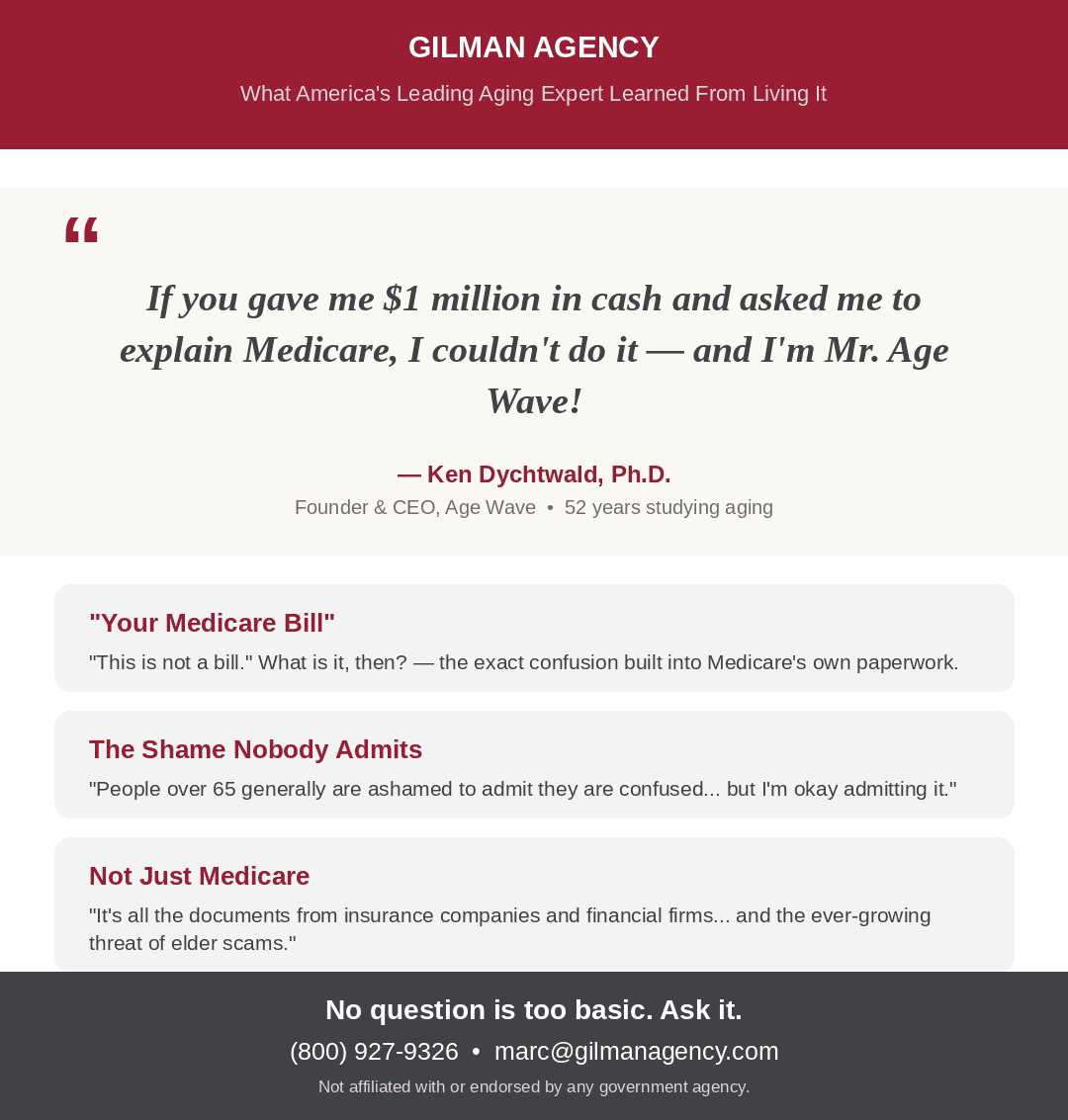
Dychtwald has made this point even more directly in subsequent commentary: most of the systems people rely on — Medicare, financial planning models, even workplace norms — were built for a world where far fewer people lived past 65, and haven’t caught up to the fact that tens of millions of people now reasonably expect to live into their 80s and 90s. As he’s put it plainly, “Medicare was created to pay doctors, not to keep older adults healthy.”
This shows up in concrete ways. Medical schools require every student to rotate through pediatrics, but far fewer require a dedicated geriatrics rotation — even though older adults are the fastest-growing and most medically complex patient population. The same misalignment exists in financial planning: many people are still asked “are you looking forward to winding down and retiring?” when a more accurate question, given a 20-year runway, might be “what are your new dreams?”
Dychtwald has coined a term for this newly common life stage: “time affluence” — decades of relatively healthy life with no clear script for how to use them. Astronaut-turned-senator John Glenn captured this when he returned to space at 77: “Just because I’ll be 77 doesn’t mean I still don’t have dreams.” Maybe someone takes up an instrument at 80, or starts a business at 67 — the tools built around retirement haven’t fully caught up to that reality yet.
Why This Is Directly a Finance Question
This matters for exactly the reasons this whole piece has been building toward. Dychtwald has specifically named where he sees the biggest opportunity in financial planning for the longevity era: solutions that prioritize guaranteed income, rising healthcare and long-term care costs, and peace of mind over aggressive growth — especially for women, who live longer and are increasingly the household’s financial decision-maker.
That’s not a generic observation — it lines up precisely with the data already covered here: healthcare and long-term care as the top financial worry, the documented preference for blended guaranteed-income approaches, and the fact that women disproportionately end up managing retirement finances later in life as surviving spouses. The planning priorities aren’t abstract; they’re the direct financial answer to a demographic shift that’s already happened.
Common Misconceptions Worth Correcting Directly
A few beliefs that consistently derail otherwise reasonable retirement plans:
-
“I won’t live that long.” This is the single most common planning error — underestimating your own longevity leads directly to underfunding it. Planning for a longer horizon than feels intuitive is usually the safer assumption.
-
“Medicare covers long-term care.” It generally doesn’t. Medicare pays for acute medical care, not extended custodial care — the kind of help with daily living that becomes more likely with age.
-
“Annuitizing wastes money I could leave to heirs.” Many modern annuity structures include survivor benefits, period-certain payouts, or return-of-premium features that preserve some legacy value while still addressing income risk — it’s not automatically an all-or-nothing tradeoff.
What This Means for How You Plan
Putting these findings together points toward a few concrete priorities:
-
Plan for a 20-year retirement, not a 7-year one. The math genuinely changed across generations, and assuming shorter timelines than reality is one of the most common planning errors.
-
Take healthcare and long-term care costs seriously as a top-tier financial risk, not a secondary concern — the data says most people already sense this, even if their planning doesn’t always reflect it.
-
Don’t underestimate the social and purpose dimensions of retirement. A financial plan that fully funds your income but ignores what retirees say they actually miss most is solving only part of the real problem.
-
Consider a blended income approach — combining growth-oriented investments with guaranteed lifetime income — matching what a growing majority of people say they actually want, rather than an all-or-nothing structure.
What To Do Next
Meeting the longevity challenge genuinely requires health planning, life insurance, and retirement income planning working together, not as three separate conversations. A 20-year retirement with a real chance of extended healthcare needs, funded by a mix of investments and guaranteed income, is a fundamentally different planning problem than what previous generations faced — and it’s worth approaching it that way. If you want to build a plan that actually accounts for the length of modern retirement and the healthcare costs that come with it, reach out and we’ll work through it together.
Questions? Call (800) 927-9326 or email
Sources: Ken Dychtwald, Ph.D. (Founder and CEO, Age Wave), “The New Retirement in the Age of Longevity,” presented via the National Institute on Retirement Security, March 2025; Ken Dychtwald, “The longevity revolution is here. Our systems still think we die at 65,” Fortune, April 2026; “Planning for Longevity: Risks and Solutions,” FinHelp, September 2025. Underlying research cited in the Dychtwald/Age Wave materials includes: U.S. Census Bureau; World Health Organization Global Health Observatory; Bank of America Merrill Lynch/Age Wave, “Americans’ Perspectives on New Retirement Realities and the Longevity Bonus”; Edward Jones/Age Wave, “The Four Pillars of the New Retirement” (2020–2021); National Institute on Retirement Security, “Retirement Insecurity 2024: Americans’ Views of Retirement”; Alliance for Lifetime Income, Retirement Income Institute Research Paper, 2021.