
By Marc Gilman
Questions? Call (800) 927-9326 or email
Key Takeaways
-
MassHealth’s Personal Care Attendant (PCA) Program pays for in-home personal care and lets you choose who provides it, including many family members.
-
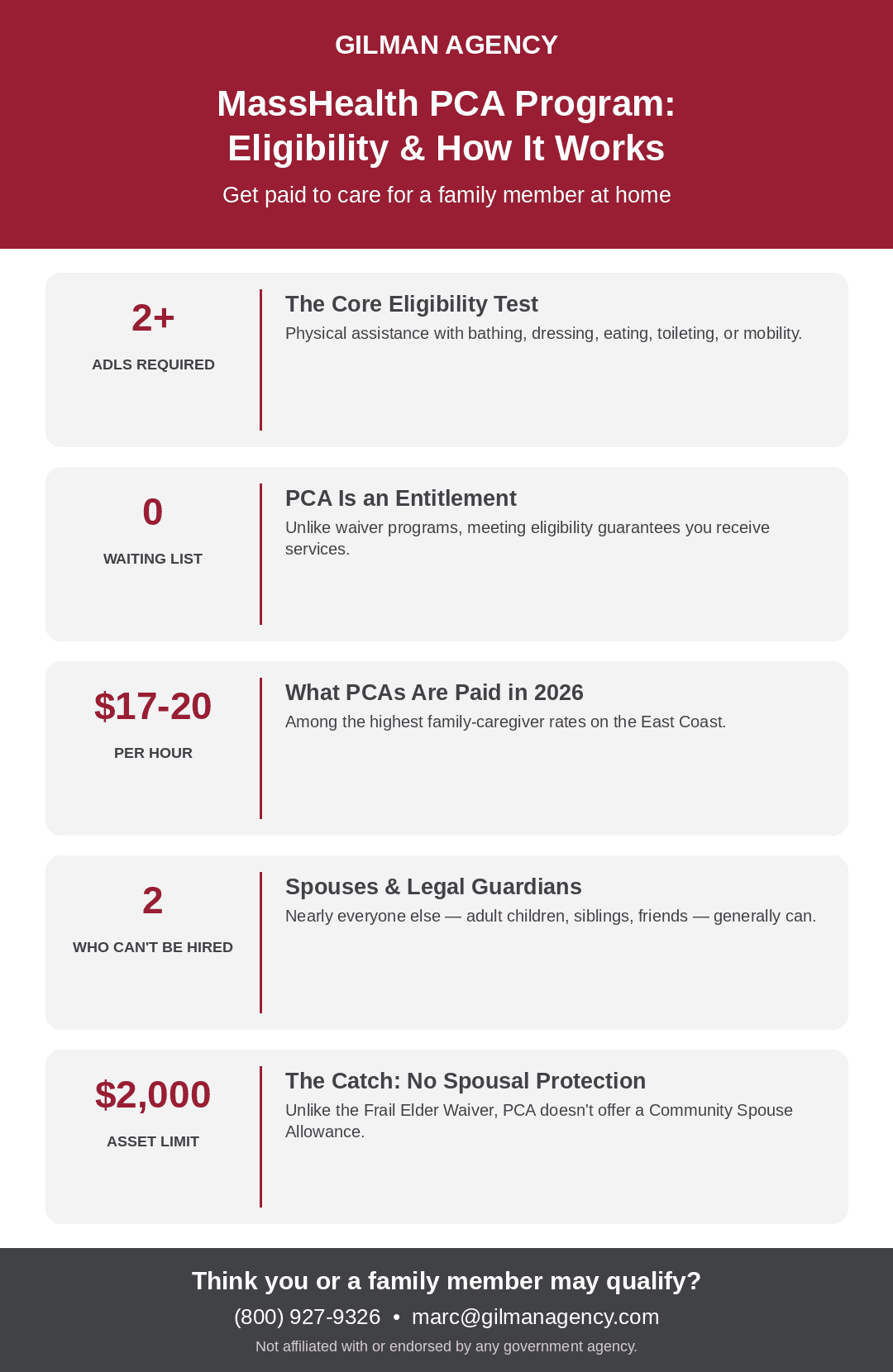
To qualify, you generally need MassHealth Standard, CommonHealth, or enrollment in a Senior Care Option or 1Care plan, a permanent or chronic disability, and physical assistance needs with at least two Activities of Daily Living.
-
Unlike some MassHealth programs, the PCA Program is an entitlement: there’s no waiting list for anyone who qualifies.
-
You must be able to direct your own care, or have a surrogate or administrative proxy who can direct it for you.
-
Adult children, friends, and neighbors can generally be hired and paid as a PCA. Spouses and legal guardians generally cannot.
What Is the MassHealth PCA Program?
The Personal Care Attendant Program is a MassHealth benefit that pays for help with personal care at home, with one feature that sets it apart from a typical home care agency: you’re the employer. Rather than an agency assigning a rotating aide, you or your surrogate hires, trains, schedules, and if necessary lets go of your own personal care attendant, and MassHealth pays that attendant directly for covered services.
This self-direction is the core of the program. It means the person providing your care can be someone you already know and trust, subject to a few restrictions covered below, rather than an unfamiliar aide assigned by an agency.
Who Qualifies for a PCA?
To be eligible for the PCA Program, you generally need to meet several conditions at the same time:
Health coverage. You need to be enrolled in MassHealth Standard or CommonHealth, or enrolled through a Senior Care Option or 1Care plan.
Disability status. You need a permanent or chronic disability that impairs your physical functioning.
Assistance need. You need physical assistance with at least two Activities of Daily Living. These generally include bathing, dressing, eating, toileting, and mobility or transferring. It’s worth noting that PCA services are for physical assistance specifically. Supervision, cueing, or verbal reminders alone generally don’t qualify someone for PCA-covered ADL assistance, even though they can matter for other kinds of care planning.
Ability to direct care. You need to be able to manage your own PCA services — hiring, training, scheduling — or have a Surrogate or Administrative Proxy who can do it on your behalf if you can’t manage it yourself.
A Detail Worth Knowing: The PCA Program Doesn’t Protect a Spouse’s Assets the Way Other Programs Do
If you’re comparing the PCA Program against MassHealth’s Frail Elder Waiver, there’s a meaningful difference in how each treats a married couple. The Frail Elder Waiver allows a non-applicant spouse to keep a larger share of the couple’s income and assets through a Community Spouse Resource Allowance. The PCA Program does not offer that same protection. For 2026, the underlying MassHealth asset limit is $2,000 for a single applicant and $3,000 for a married couple, regardless of whether one or both spouses are applying. If spousal asset protection is a significant concern, it’s worth discussing both programs before deciding which path to pursue.
One upside: because the PCA Program is part of MassHealth’s regular State Plan rather than a Medicaid waiver, the standard 60-month look-back rule that applies to Nursing Home Medicaid and most Home and Community-Based Services waivers isn’t relevant to PCA eligibility specifically.
How to Apply
Step 1: Establish your MassHealth eligibility. If you’re not already enrolled, you’ll need to apply for MassHealth Standard or CommonHealth — for seniors, this is done through the Application for Health Coverage for Seniors and People Needing Long-Term Care Services, which can be mailed, faxed, or dropped off at a MassHealth Enrollment Center. You can also call MassHealth directly at 888-665-9993 (TTY: 888-665-9997) to start the process.
Step 2: Connect with a Personal Care Management (PCM) agency. Once you have active MassHealth coverage, you’ll work with a PCM agency, which coordinates your PCA evaluation. You can find your local PCM agency by calling MassHealth Customer Service at 800-841-2900 or 800-896-2200.
Step 3: Complete your PCA evaluation. Your doctor or nurse practitioner will need to complete supporting forms, and your PCM agency will conduct a detailed assessment — typically including a home visit from a nurse and an occupational therapist — to determine your approved hours and covered tasks.
Step 4: Hire and manage your PCA. Once approved, you’re the employer. You can hire through word of mouth, help-wanted postings, or the Mass PCA Directory (888-627-7722), which connects consumers looking for a PCA with people looking for PCA work.
Who Can — and Can’t — Be Hired as Your PCA
This is one of the most practically important details of the program. Massachusetts allows a genuinely wide circle of people to be hired and paid as a PCA:
-
Generally eligible: adult children, siblings, grandchildren, in-laws, parents (of an adult consumer), nieces, nephews, friends, and neighbors
-
Generally not eligible: spouses and legal guardians — Massachusetts excludes both, on the reasoning that a spousal relationship already carries a legal expectation of mutual care, and a guardian’s role already involves directing decisions for the person they protect
If a spouse is your primary caregiver and compensation is a priority, it’s worth exploring VA Veteran Directed Care (if the consumer is an eligible veteran) or structuring the arrangement so another qualifying relative serves as the paid PCA while the spouse provides supplemental, unpaid support.
No formal medical training, CNA, or HHA license is required to work as a PCA — the program is intentionally consumer-directed, meaning you train your own PCA on your specific routines and needs.
What PCAs Are Paid in 2026
As of 2026, Massachusetts pays PCAs between $17 and $20 per hour, among the higher rates on the East Coast, set through a collective bargaining agreement with 1199SEIU. Standard authorized hours run up to 50 hours per week; with proper authorization, a consumer can request up to 66 hours per week in certain circumstances.
New for 2026: a complex care add-on provides a $3.25/hour pay differential for PCAs performing certain complex tasks (such as digital rectal stimulation or enteral tube feeding), once a Primary Care Provider Summary Form documents the clinical need and the task is added to the consumer’s approved PCA assessment.
A tax note worth knowing: payments to a PCA who lives in the same home as the consumer may qualify as “difficulty of care payments,” which can be excluded from federal and state income tax. PCAs pursuing this need to file an application through Tempus Unlimited, MassHealth’s fiscal intermediary.
What To Do Next
The PCA Program is one of the more flexible MassHealth benefits available for people who want to remain at home and choose who helps them get there — but between the MassHealth eligibility application, the PCM evaluation process, and the rules around who can be hired, it involves more moving pieces than it first appears. If you or a family member is exploring this option, reach out and we’ll help you work through the process.
Questions? Call (800) 927-9326 or email
Key contacts: MassHealth PCA Program — 800-896-2200 or 800-841-2900 · Tempus Unlimited (Fiscal Intermediary) — 800-323-0563 · Mass PCA Directory — 888-627-7722 · MassOptions/ASAP — 800-243-4636


