
By Marc Gilman
Call (800) 927-9326 | Email marc@gilmanagency.com
This is the next post in our series on retirement income and Medicare costs. Earlier posts covered what a QLAC is, how a QLAC reduces your RMDs and your taxes, the full set of ways to reduce RMDs and the taxes on them, how Medicare’s IRMAA surcharge works in 2026, and whether a QLAC can help you avoid IRMAA. The question we hear next is simpler: is a QLAC worth it for me?
The answer depends on six things you can check before you buy. A QLAC adds the most value when several of them line up. When only one or two do, other strategies often make more sense.
Key Takeaways
-
The RMD reduction is predictable: A $210,000 QLAC lowers your RMD by about $7,925 at age 73, rising to about $9,545 at 78, whatever your IRA’s size.
-
The Medicare savings are not: They show up only if that reduction moves your income under an IRMAA line. Then it’s $1,148 a year per person at the first tier in 2026.
-
Six criteria decide the value: Your distance from an IRMAA or tax bracket line, your age, your health and family longevity, your money outside the QLAC, your need for income after 85, and your spouse and heirs.
-
It’s a deferral, not a tax cut: QLAC payments are taxed as ordinary income when they start, no later than age 85.
-
Check flexible options first: Qualified charitable distributions and Roth conversions can be stopped or adjusted. A QLAC can’t be undone.
What Does a QLAC Actually Do?
A qualifying longevity annuity contract is a fixed deferred income annuity bought with money from a traditional IRA or workplace plan. In 2026 you can put up to $210,000 per person into one. The IRS leaves that amount out of the balance used to figure your required minimum distributions until payments begin, no later than the first of the month after you turn 85.
So a QLAC does two jobs at once. It shrinks your RMDs, and the taxable income they create, for up to 12 years. And it guarantees income for life starting at the age you choose, which protects you if you live well into your 90s. Our QLAC overview covers the rules in more detail.
That longevity protection is the core value. Research from Wharton suggests that turning part of a retirement account into deferred lifetime income can improve retirement outcomes for many retirees, as we covered in what the Wharton research actually shows. Lower RMDs and Medicare savings are a bonus when the numbers line up.
What Are the 6 Criteria That Decide Whether a QLAC Is Worth It?
Use this scorecard as a first check. The more rows where you fit the left column, the stronger the case for a QLAC.
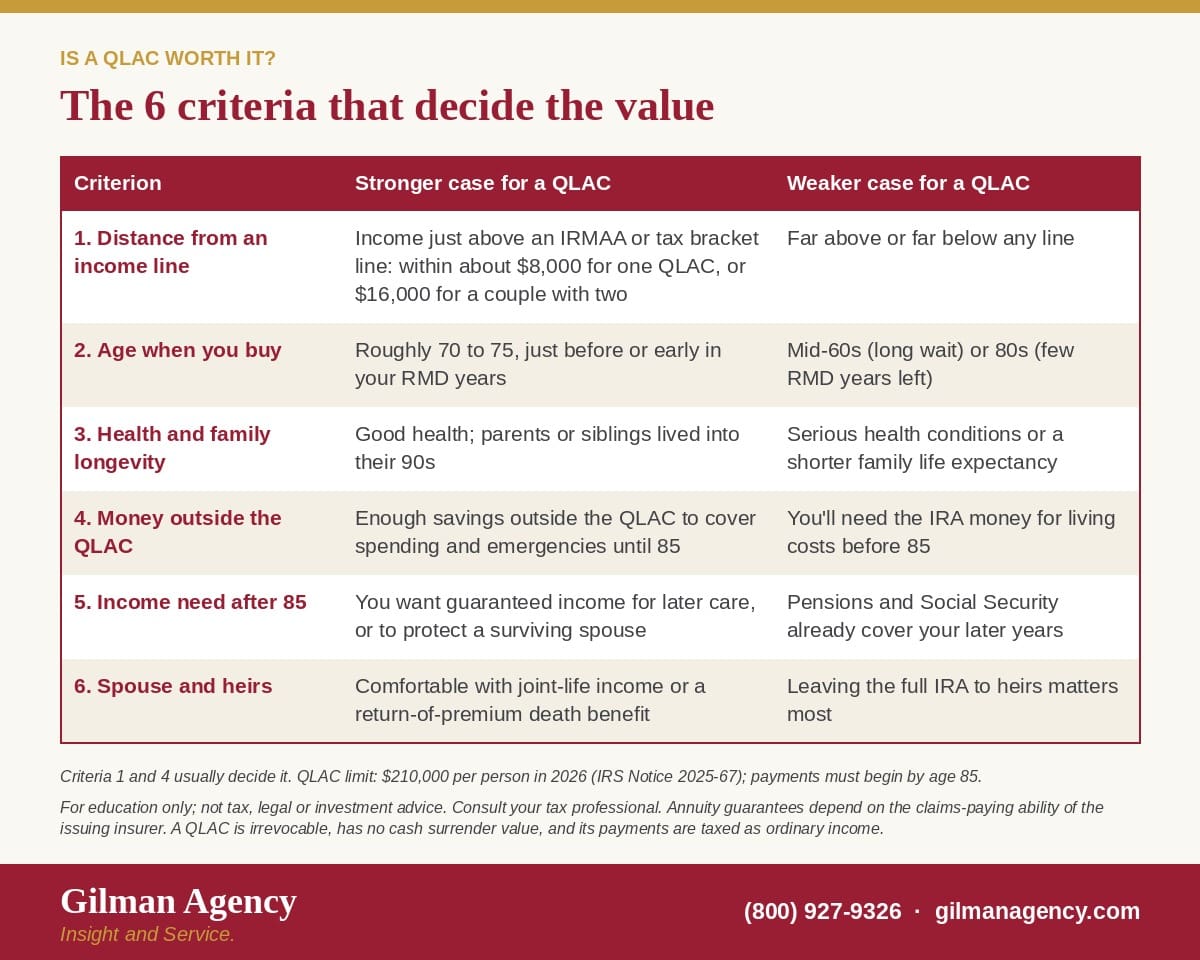
Criteria 1 and 4 usually decide it. If your income isn’t near a line, the RMD reduction mostly defers taxes rather than saving them. If you’d need the money before 85, a QLAC isn’t the right tool, however good the other numbers look.
How Much Can a QLAC Lower Your RMD?
The reduction depends only on how much you put in and your age, not on the size of your IRA. Each year, the IRS divides your IRA balance by a factor from its Uniform Lifetime Table. The QLAC amount comes out before that division, and the factor gets smaller as you age, so the reduction grows each year.
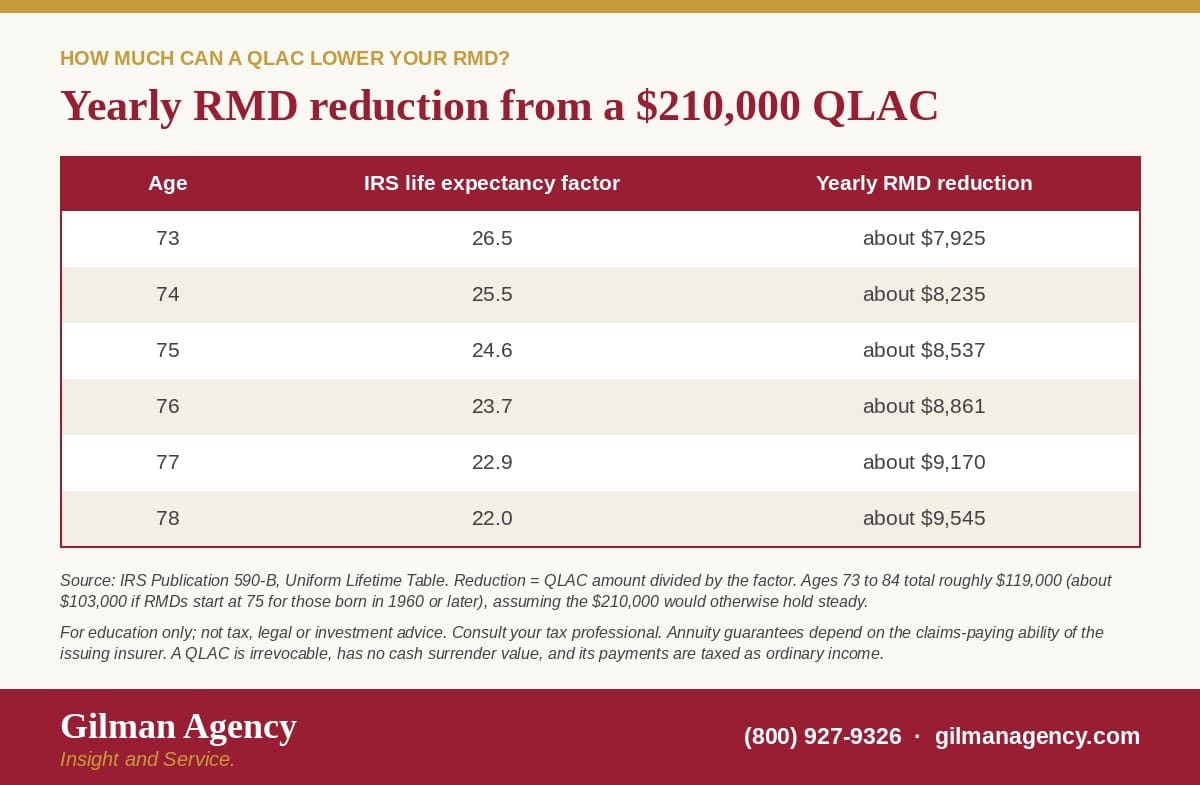
From 73 through 84, that adds up to roughly $119,000 less in required withdrawals, assuming the excluded $210,000 would otherwise have held steady. If you were born in 1960 or later, your RMDs start at 75 instead of 73, so you get two fewer years of reduction, about $103,000 in total.
A couple can each buy a QLAC from their own accounts. At 73, two $210,000 QLACs lower the household’s combined RMDs by about $15,850 a year.
When Does That Change Your Medicare Premium?
Only when it moves your income across an IRMAA line. Medicare charges a surcharge on Part B and Part D premiums once your modified adjusted gross income (MAGI) passes $109,000 for single filers or $218,000 for joint filers in 2026. It’s a cliff: going $1 over costs the full first-tier surcharge of $1,148 a year per person. Our IRMAA guide lists every tier.
Compare two single retirees, both 73 with a $1.6 million traditional IRA and a $210,000 QLAC. The only difference is their other income.
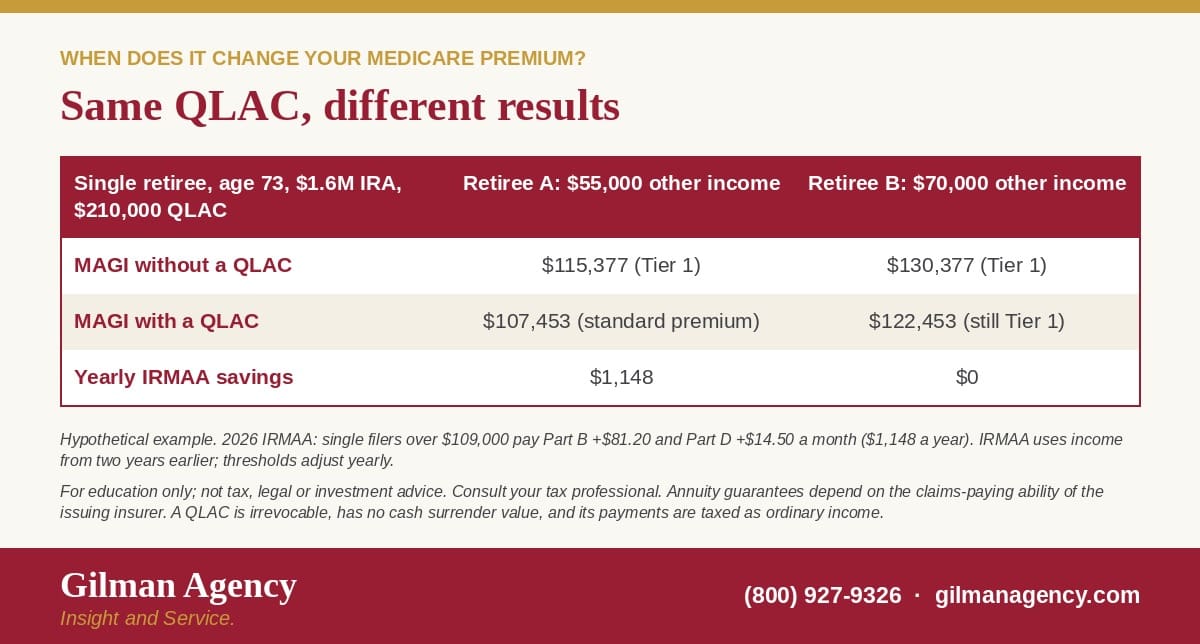
The QLAC lowered both retirees’ RMDs by the same $7,925. Only Retiree A crossed the line. For Retiree B, the QLAC still defers some income tax, but it doesn’t change the Medicare bill.
Timing matters too. IRMAA uses your tax return from two years earlier, so an RMD reduction in 2027 affects your 2029 premiums. The thresholds are adjusted for inflation each year, so the line you’re aiming for moves a little over time.
What Does a QLAC Cost You?
Every benefit above comes with a trade-off. Weigh these before you decide.
-
It’s irrevocable: After a 90-day free-look period, the money is locked up until payments begin. There’s no cash surrender value and no loans.
-
The income comes back later: Payments are taxed as ordinary income and count toward IRMAA once they start. Large payments at 85, on top of your remaining RMDs, could put you in a higher bracket then.
-
Inflation erodes fixed payments: Most QLACs pay a set amount. Over 10 to 15 years of waiting, rising prices can cut what that payment buys. Some contracts offer inflation adjustments, at the cost of a lower starting payment.
-
Protecting heirs costs income: A return-of-premium death benefit or joint-life payout protects your family but lowers the income you receive.
-
You rely on the insurer: Payments depend on the issuing company’s claims-paying ability, so its financial strength rating matters.
-
You give up growth: Money in a QLAC doesn’t share in market gains. Its value is guaranteed income, not investment return.
How Does a QLAC Compare With QCDs and Roth Conversions?
A QLAC is one of three common ways to lower RMD income. The other two are easier to change, so look at them first.
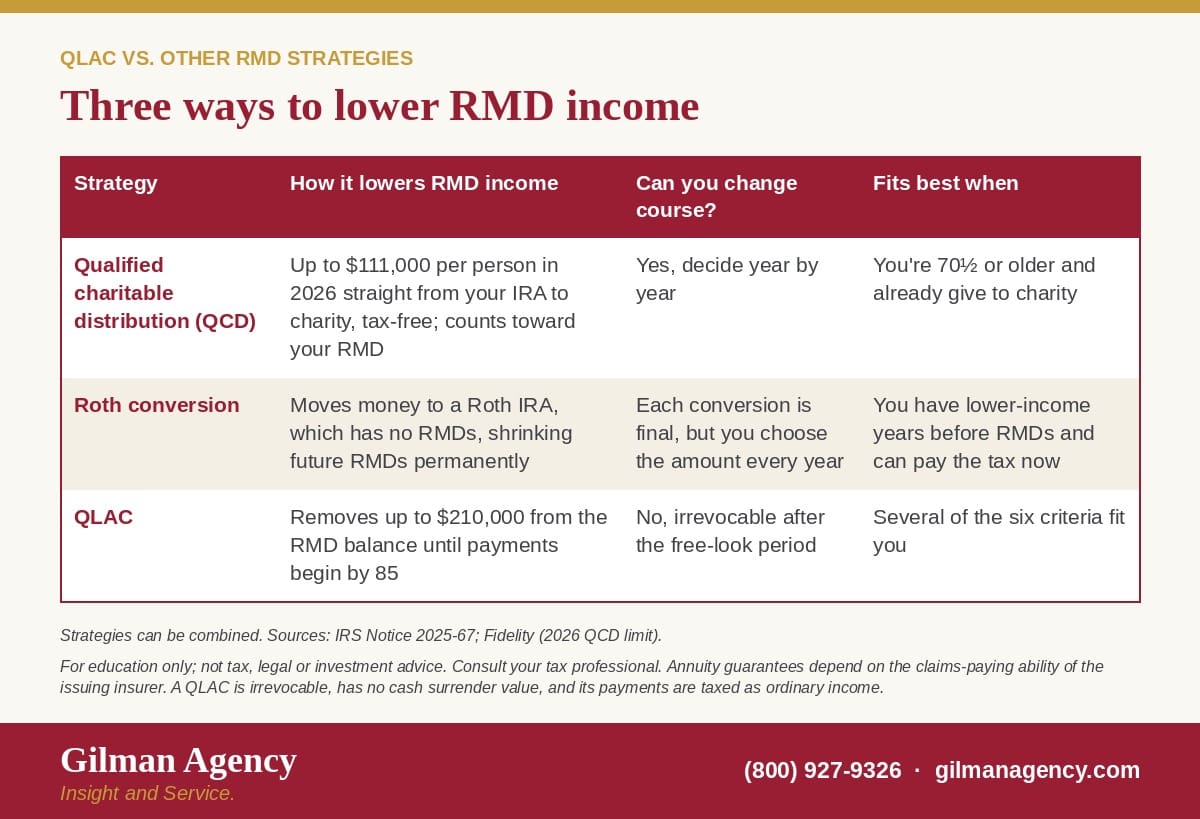
These strategies can work together. You can buy a QLAC and make QCDs from the rest of your IRA in the same year. Our RMD strategies post covers each one in more depth.
Where Does Insurance Planning Fit In?
A QLAC sits where your retirement income and your Medicare costs meet. Annuity income can lower some costs and raise others, as we explained in how Medicare and annuities work together, and where they can work against each other. The right answer comes from modeling both sides together: your RMDs and taxes now, and your income and IRMAA exposure at 85.
We start by learning your goals and income, then show you the numbers side by side, and only then make a recommendation. For tax decisions, we work alongside your tax professional.
What To Do Next
If you’re 70 to 75 with a sizable traditional IRA and your income sits near an IRMAA line, it’s worth running your own numbers. In a free, no-obligation review, we’ll check which IRMAA bracket you’re in, how close you are to the next line, and how a QLAC compares with QCDs or Roth conversions for you.
-
Call: (800) 927-9326
-
Email: marc@gilmanagency.com
Bring your most recent tax return, your IRA statements, and your Social Security benefit letter.
Sources: IRS, Instructions for Form 1098-Q (QLAC requirements); IRS Notice 2025-67 (2026 QLAC limit of $210,000) via Ascensus; IRS Publication 590-B, Uniform Lifetime Table; 2026 Medicare Part B and Part D IRMAA amounts; Fidelity, qualified charitable distributions (2026 limit of $111,000).
This article is for general educational purposes only and is not tax, legal, or investment advice. Examples are hypothetical and for illustration; your results will differ. Consult your tax professional before making decisions about RMDs, QLACs, QCDs, or Roth conversions. Annuity guarantees are backed by the financial strength and claims-paying ability of the issuing insurance company. A QLAC is irrevocable, has no cash surrender value, and its income payments are taxed as ordinary income. IRMAA thresholds and amounts shown are for 2026 and are adjusted each year.


