By Marc Gilman
Questions?
Call (800) 927-9326 or email
Key Takeaways
-
Losing employer coverage can open a Special Enrollment Period (SEP). If you or your spouse were still working and covered by an employer group health plan after you became eligible for Medicare, you can generally sign up for Part B without waiting for the general enrollment period and, in most cases, without a late enrollment penalty.
-
Part B and Part D follow different clocks. The Part B SEP lasts 8 months. Medicare.gov says the window to join a Medicare Advantage or drug plan after leaving employer or union coverage lasts 2 full months after the month your coverage ends.
-
COBRA does not extend the Part B window. The 8 months run from when your employment or active employer coverage ends, whichever comes first, not from when COBRA ends. Waiting on COBRA can cost you the SEP.
-
Retirement, retiree plans and ACA plans are different. The Part B SEP is tied to coverage from current employment. Retiree coverage and individual Marketplace plans generally don’t qualify.
-
Medigap protections have their own deadlines. Don’t let a Part B decision run past the point where you can still buy a Medigap plan without health questions.
Who Qualifies for This Special Enrollment Period?
The Part B SEP is for people who delayed Part B because they, or their spouse, had group health coverage through current employment. Many people in this situation are working past 65 and keep their employer plan instead of enrolling in Part B. Medicare.gov describes this as job-based coverage that is available to everyone at the company, as opposed to self-employment or retiree coverage. Employer size also matters: under the usual coordination rules, a plan from an employer with 20 or more employees is generally primary to Medicare, while with smaller employers Medicare may pay first. Confirm how your plan coordinates with Medicare before you rely on it, because delaying Part B only works without a penalty when your employer plan is the one that counts.
If your employer has fewer than 20 employees, the picture is different. AARP explains that Medicare is usually primary in that case and the employer plan is secondary, so if you skip Part A and Part B you may have no primary coverage. For people at small employers, AARP’s guidance is that enrolling in Medicare is “almost always” the answer. Check with your benefits office and Social Security before you delay.
The SEP generally does not apply to:
-
Retiree coverage. A plan you have through a former employer after retiring is not current-employment coverage. Medicare.gov notes that retiree coverage may not pay for services unless you have both Part A and Part B, so ask your benefits administrator whether you or your family could lose retiree coverage before you join a Medicare plan.
-
COBRA. COBRA continues your old coverage for a time, but it isn’t coverage from current employment for Part B purposes. Medicare.gov says plainly that “COBRA coverage doesn’t extend your limited time to sign up for Medicare.”
-
Individual or Marketplace plans. If you have ACA coverage with a subsidy, AARP notes that enrolling in Medicare generally ends your eligibility for the subsidy, so plan the end of the Marketplace plan to avoid overlap.
-
VA or Tricare coverage. Relying on VA care while delaying Part B isn’t based on current employment and can lead to lifelong Part B penalties, according to AARP. Military retirees who don’t enroll in Part B at 65 can lose Tricare benefits, so ask Tricare before you delay.
What About Part A?
Most people qualify for premium-free Part A after about ten years of Medicare-covered work, and there is no late enrollment penalty for premium-free Part A. Kiplinger notes that Part A coverage can be retroactive up to six months, but not before age 65. If you have to pay a premium for Part A, different rules apply, so check with Social Security.
How Long Do I Have to Enroll in Part B?
You have an 8-month SEP to sign up for Part B. It starts the month after your employment ends or the month after your group coverage ends, whichever happens first. Because “whichever comes first” can catch people off guard, get the exact end date from your employer’s benefits office in writing. For example, if you stop working and your health coverage continues through the end of the following month, your 8 months still count from the earlier event.
If you miss the window, you may have to wait for the General Enrollment Period (Jan. 1 to Mar. 31), your coverage would start later, and you may face a Part B late enrollment penalty of 10% for each full 12-month period you could have had Part B but didn’t. The penalty is added to your premium for as long as you have Part B. For reference, the standard 2026 Part B premium is $202.90 a month, and the 2027 amount is set by CMS later this year.
What Forms Do I Need?
Social Security handles Part B enrollment. If you already have Part A and want Part B during this SEP, SSA says to submit:
-
Form CMS-40B, Application for Enrollment in Part B.
-
Form CMS-L564, Request for Employment Information, which your employer completes to confirm your coverage dates.
You can apply online (you’ll e-sign, so you need an email address) or fax or mail the forms to your local Social Security office. SSA also asks for one document proving group health plan coverage within the last 8 months through you or your spouse’s current employment, such as pay stubs showing premium deductions, W-2s with pre-tax medical contributions, a health insurance card with a policy effective date, or explanations of benefits. In the remarks section you can write the month you want Part B to begin. Incomplete forms can cause delays, so if your employer is slow to complete its part, ask SSA what other proof it will accept rather than waiting.
What About COBRA?
COBRA is the most common trap. People assume it’s a bridge to Medicare, and it can be, but only if you understand how it interacts with the clock:
-
For Part B, the 8-month window runs from the end of employment or active employer coverage, not from the end of COBRA. If you choose COBRA and later try to enroll in Part B, you could be outside the SEP and face the General Enrollment Period and a penalty.
-
For Medicare Advantage and Part D, Medicare.gov says leaving employer or union coverage, including COBRA, gives you 2 full months after the month your coverage ends to join one of those plans.
-
COBRA can also overlap awkwardly with Medicare. Medicare.gov says COBRA typically ends once you enroll in Medicare, and if you take COBRA after you already have Medicare, COBRA pays second (with an exception for End-Stage Renal Disease). Ask the plan administrator before you choose.
What Happens With Part D and Medicare Advantage?
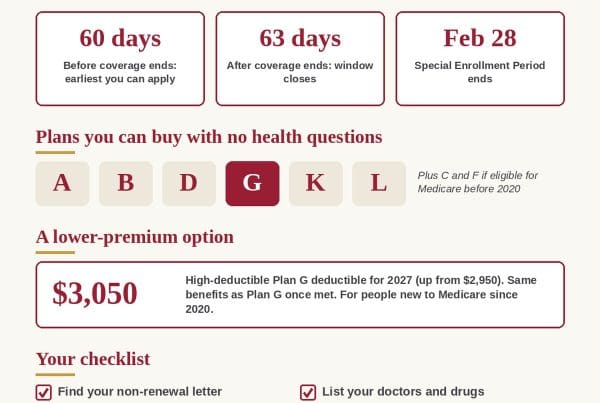
Losing employer coverage opens a separate window for a Medicare Advantage plan or Part D drug plan. Medicare.gov lists it as lasting 2 full months after the month your coverage ends. You may see “63 days” in other places, which refers to something different: if you go 63 days or more without creditable drug coverage after your Part D eligibility ends, you can face a permanent late enrollment penalty, which is 1% of the national base beneficiary premium for each full month without coverage (the 2026 base premium is $38.99, per Kiplinger).
Your plan must tell you whether its drug coverage is creditable, and Medicare.gov says to keep those notices but not to send them to Medicare. If you don’t have one, ask your former employer or plan for it. It can matter if a Part D enrollment question comes up later.
Timing also helps. If your coverage ends in the fall, the Annual Enrollment Period (Oct. 15 to Dec. 7) can be a second chance to choose a plan for Jan. 1.*
When Can I Buy a Medigap Plan Without Health Questions?
Medigap (Medicare Supplement) has two protections that people sometimes mix up:
-
Medigap Open Enrollment: a six-month window that starts the month you are 65 or older and enrolled in Part B. During it, insurers must sell you a policy at the best available rate, regardless of health.
-
Guaranteed-issue rights: typically a 63-day window after you lose certain coverage. You may qualify if you lost a group health plan through no fault of your own and that plan covered your Medicare cost-sharing, meaning it paid after Medicare.
For many people who work past 65, the Medigap Open Enrollment window is the main protection and it begins when Part B starts, which is one reason the Part B date matters. Rules and rights vary by state and by your situation, so confirm which applies to you before the window closes. Keep letters, notices and other documents showing when your coverage ended.
Should I Stop Contributing to My HSA?
If you have a Health Savings Account, Medicare.gov says you and your employer should stop contributions six months before you retire or apply for Social Security or Railroad Retirement benefits, to avoid a tax penalty. Kiplinger adds that once any part of Medicare starts you can no longer contribute to an HSA, so the six-month lead time matters if you plan to keep contributing until you enroll. Check the details with your tax professional.
What Should I Do, Step by Step?
-
Confirm your end dates. Get the date employment ends and the date employer coverage ends in writing.
-
Check what kind of coverage you have. Active employer coverage, retiree coverage, COBRA and Marketplace plans are treated differently.
-
Start the Part B paperwork early. Ask your employer for the CMS-L564 and complete the CMS-40B. SSA’s online process is usually the quickest.
-
Pick a Part B start date. Aim for no gap between your employer coverage and Medicare.
-
Decide on drug coverage. Join a Part D plan or a Medicare Advantage plan with drug coverage within your window.
-
Plan your Medigap timing. If you want Original Medicare with a supplement, line up quotes before your protected window ends.
-
Keep your records. Save termination notices, creditable coverage letters and confirmation of your Part B request.
*Some 2027 Medicare Advantage plans can set enrollment caps and may close to new members before Dec. 7, so starting early gives you more options.
Where Does Insurance Planning Fit In?
This is a deadline-driven decision, and the right answer depends on your employer’s plan, your spouse’s coverage, your health and your budget. We can look at your dates, explain how COBRA or retiree coverage would interact with Medicare, compare Medicare Advantage, Original Medicare with Medigap and Part D options available in your area, and help you avoid a gap in coverage. For more on timing, see our guide to Medicare Advantage vs. Original Medicare.
What To Do Next
If your employer coverage is ending, or you’ve just left a job, bring your dates and a list of your doctors and medications and we’ll walk through the next steps with you before any window closes.
Questions? Call (800) 927-9326 or email
Prefer we reach out to you instead? Complete our Permission to Contact form and a licensed Gilman Agency agent will follow up.
Sources: Medicare.gov, “Special Enrollment Periods” (leaving employer or union coverage, including COBRA: 2 full months to join a Medicare Advantage or drug plan); Kathryn Pomroy, “Working Past 65? Here’s How Medicare Works If You Have Employer Health Insurance,” Kiplinger via Yahoo Health (Oct. 8, 2026); Medicare.gov, “Working Past 65” (8-month Part B SEP, COBRA, retiree coverage, creditable drug coverage notices, 63-day rule, HSA contributions); Social Security Administration, “Sign up for Medicare Part B Online, by Fax, or by Mail” (Oct. 17, 2024) (CMS-40B, CMS-L564, proof of coverage, 8-month window); Kimberly Lankford, “Is Medicare Mandatory at 65 If You’re Still Working?” AARP (updated Oct. 2, 2026); Medicare Interactive (Medicare Rights Center), “Protected Times to Buy a Medigap” (Medigap Open Enrollment and guaranteed-issue rights); Medicare Agents Hub, “Am I eligible for a Special Enrollment Period if I lose employer coverage?” (agent answers, which varied on the Part D and Medicare Advantage window and were checked against Medicare.gov); CMS, Application for Enrollment in Part B (CMS-40B).
Gilman Agency is not affiliated with or endorsed by Medicare, the Social Security Administration or the federal government. This article is for general educational purposes and is not an offer of coverage or a recommendation of any specific plan. Enrollment rules, eligibility and deadlines depend on your individual situation, and Social Security and CMS make final determinations. Confirm your dates with Social Security, your employer and your plan. This is not legal or tax advice. We do not offer every plan available in your area. For more information, contact Marc Gilman, licensed insurance agent, at (800) 927-9326, or call 1-800-MEDICARE for a full list of your options.