
By Marc Gilman
For additional information, please call: (800) 927-9326 or email:
Key Takeaways:
-
The Bridge Program uses three different sets of eligibility criteria based on your BMI (Body Mass Index) — knowing your number is the first step.
-
You must have Medicare Part D coverage to participate — either through a Medicare Advantage plan that includes Part D, or Original Medicare/Medigap paired with a standalone Part D plan.
-
Your primary care doctor must submit a prior authorization (PA) before you can fill a prescription under the program.
-
The program prescription comes with a $50 copay, and the pharmacist must use a specific billing code to process it under the Bridge Program.
-
Mark your calendar for October 1–14 to review your 2027 coverage options, since plan availability and GLP-1 access can change year to year.
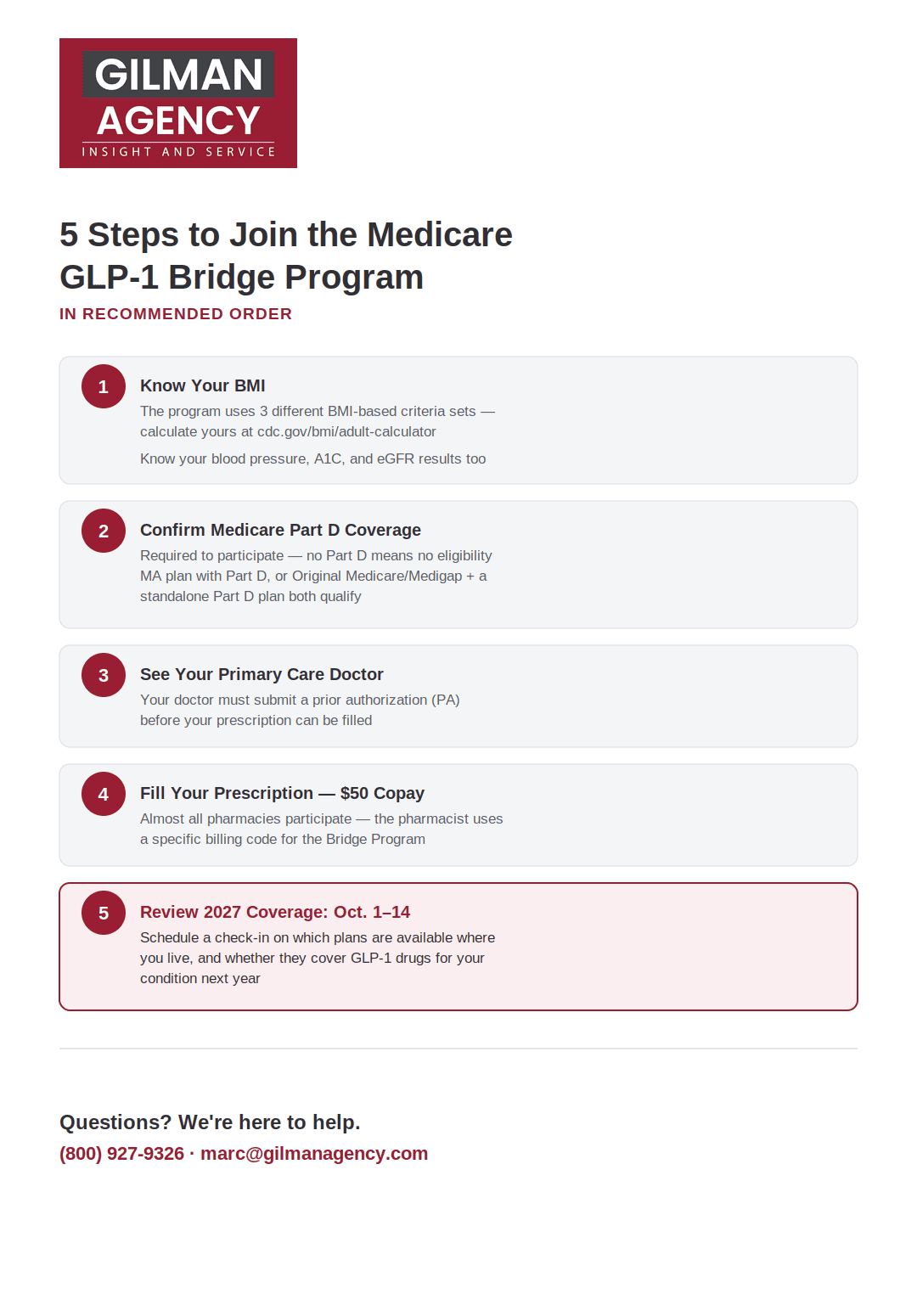
There are mandatory steps to participate in Medicare’s GLP-1 Obesity Drug Bridge Program. Here’s a summary of those steps, in the recommended order to follow them.
Step 1: Know Your BMI
The Bridge Program uses three different sets of eligibility criteria depending on your BMI (Body Mass Index), so this is the right place to start.
-
You can calculate your BMI using the CDC’s calculator at cdc.gov/bmi/adult-calculator.
-
It also helps to be familiar with your current blood pressure, A1C, and eGFR blood test results, since these factor into the program’s criteria alongside BMI.
Step 2: Confirm You Have Medicare Part D Coverage
Not having Part D coverage blocks you from participating in the program entirely. You’ll meet this requirement if:
-
You have a Medicare Advantage plan that includes Part D coverage, or
-
You have Original Medicare or a Medicare Supplement plan paired with a standalone Part D plan.
Step 3: Schedule an Appointment With Your Primary Care Doctor
Your doctor needs to submit a prior authorization (PA) on your behalf. This step has to happen before your prescription can be filled under the program.
Step 4: Fill Your Prescription — $50 Copay
Once your PA is approved, you can fill your prescription for a $50 copay.
-
Almost all pharmacies are participating in the program.
-
The pharmacist needs to use a specific billing code for the Bridge Program in order to process it correctly.
Step 5: Schedule an Appointment Between October 1–14 to Review 2027 Coverage
Before the next plan year, it’s worth reviewing your options directly:
-
Which health plans are actually available where you live.
-
Whether those plans include access to GLP-1 drugs for your specific condition.
What To Do Next
Since this program involves BMI criteria, a prior authorization from your doctor, and specific Part D coverage requirements, it’s worth confirming each step applies to your situation before assuming you’re eligible.
If you need further information about the GLP-1 Bridge Program or how it fits with your current Medicare coverage, we’re here to help — no cost, no obligation.
For additional information, please call: (800) 927-9326 or email:


