By Marc Gilman
(800) 927-9326 |
Most people worry about running out of time. In retirement planning, the bigger risk for many people is actually the opposite problem: running out of money before running out of time. That’s longevity risk — the chance that you, or you and a spouse, live longer than your retirement savings were built to support. It’s a common enough fear that nearly two out of three U.S. adults say they’re more worried about running out of money in retirement than they are about dying, according to a 2024 Allianz Life survey.
It’s a strange risk to plan for, because the thing that causes it — living a long life — isn’t a bad outcome. But a retirement plan that doesn’t account for the real possibility of a long life can turn a good outcome into a financially stressful one. Below is what the numbers actually say about this risk, and the full range of tools people use to plan around it.
Key Takeaways
-
Average life expectancy understates the real planning horizon — roughly half of any group lives longer than the average, sometimes by a decade or more.
-
For a married couple, the relevant number isn’t either spouse’s individual life expectancy — it’s the much higher probability that at least one of them lives well beyond it.
-
Retirement planning has effectively shifted from a growth question (“how large can this portfolio get”) to a duration question (“how long does this portfolio need to last”).
-
There’s no single fix for longevity risk. Social Security timing, withdrawal strategy, housing decisions, continued work, and insurance products all play a role, and most people end up using a combination.
-
Longevity risk doesn’t affect everyone equally — income, wealth, and gender all shape both how long you’re likely to live and how well-positioned you are to fund it.
What Is Longevity Risk, Exactly?
Longevity risk is simply the financial risk of living longer than expected. It shows up differently depending on how someone has structured their retirement income. For someone relying heavily on savings and investment withdrawals, it means the risk of depleting that portfolio while they’re still alive. For someone relying on fixed pension or annuity income, longevity risk is largely already addressed, since those income sources are typically guaranteed for life regardless of how long that turns out to be.
That distinction matters more than it used to. Defined-benefit pension plans, which once covered roughly half the U.S. workforce and guaranteed lifetime income automatically, have largely given way to defined-contribution plans like 401(k)s — which shift the responsibility for making savings last a lifetime from the employer onto the individual worker. For most retirees today, the honest picture falls somewhere in between: some guaranteed income from Social Security, and a meaningful reliance on personal savings for the rest. That combination is exactly where longevity risk matters most, and it’s part of why retirement planning has increasingly shifted from a growth question — how large can this portfolio get — to a duration question: how long does this portfolio actually need to last.
How Long Should You Actually Plan to Live?
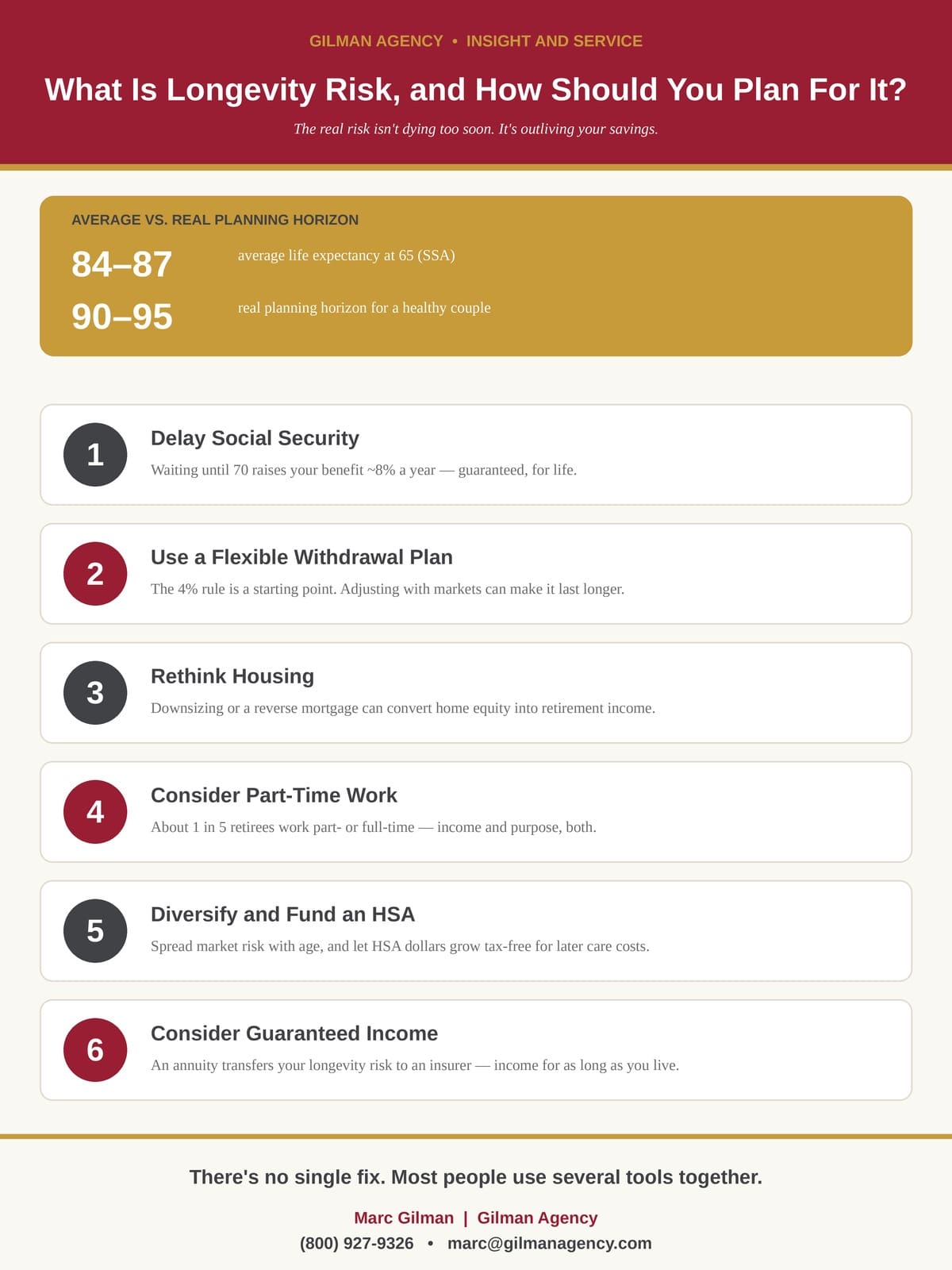
According to Social Security Administration data, average life expectancy at age 65 is now roughly 84 for men and 87 for women. Those numbers can seem hard to square with the lower “life expectancy at birth” figures sometimes cited elsewhere — U.S. life expectancy at birth is closer to 79 or 80. The explanation is straightforward: life expectancy at birth is dragged down by deaths earlier in life, so it actually rises the older you get. Someone who has already reached 65 in reasonably good health has better odds of a long life than the birth-cohort average alone would suggest.
The picture lengthens again, and changes shape, when you’re planning for a couple rather than an individual. It isn’t either spouse’s individual life expectancy that matters most for retirement planning — it’s the combined probability that at least one of them is still alive at an advanced age, which is meaningfully higher than either spouse’s odds alone. Exactly how much higher depends on which data and population you’re looking at: the Society of Actuaries estimates that for a couple both age 65, there’s roughly a 50% chance at least one spouse lives to 93; insurers pricing lifetime annuities, who rely on mortality tables specific to annuity buyers (a group that tends to live longer than the general population), often put that threshold closer to 95. Different sources, different underlying populations — but the consistent takeaway is the same: a couple’s real planning horizon runs well past either individual’s own life expectancy, and likely into the low-to-mid 90s for a healthy pair.
What Happens If Your Plan Is Built Around the Average?
A retirement plan built to run out of money right around average life expectancy is, by construction, a plan designed to fall short for roughly half the people who use it. That’s the core problem with planning to an average rather than to a realistic range of outcomes. Extending a plan from, say, 25 years to 35 years doesn’t just mean five or ten more years of withdrawals — it also means more years exposed to inflation eroding purchasing power. Social Security’s annual cost-of-living adjustment helps, but it doesn’t always keep pace with what a retiree actually needs, so a longer lifespan compounds inflation’s effect over more years, not just proportionally more of the same effect.
It doesn’t mean every retiree needs to plan for age 100 regardless of their own health and family history — but it does mean the planning conversation should include a genuine “what if I live longer than expected” scenario, run to at least the low-to-mid 90s, not just a single best-guess number.
What Are the Practical Ways to Guard Against Outliving Your Money?
There’s no single fix for longevity risk. In practice, most people rely on some combination of the following:
Social Security timing. Delaying the start of Social Security benefits past full retirement age increases the monthly benefit for as long as you live, up to age 70 — by roughly 8% for each year you wait, for a benefit that ends up 76–77% higher at 70 than at 62. For married couples, some planners also use a “split” strategy, where the lower-earning spouse claims earlier while the higher earner delays to 70; this raises the survivor benefit for whichever spouse ultimately lives longest, which is often the more consequential number for a couple’s longevity risk than either spouse’s own benefit alone. Because that increased benefit is guaranteed for life, delaying claims is one of the more direct ways to build in extra protection against a long lifespan — though it isn’t the right choice for everyone, particularly those who need the income sooner or have health reasons to expect a shorter-than-average lifespan.
A sustainable, and ideally flexible, withdrawal strategy. Rules of thumb like the traditional 4% withdrawal guideline are designed specifically to give a portfolio a strong chance of lasting 30 years or more. A more dynamic approach — withdrawing somewhat more in strong market years and less in weak ones — can extend a portfolio’s staying power further than a fixed percentage. Many retirees also use some version of a “bucket” strategy: keeping near-term spending needs in cash, intermediate needs in bonds, and longer-term growth in stocks, so a market downturn doesn’t force withdrawals from depressed stock holdings at the worst possible time. The right approach for any individual depends on their specific asset mix, time horizon, and risk tolerance, and is worth revisiting periodically rather than treated as a fixed decision made once at retirement.
Housing decisions. Downsizing to a smaller home, or relocating to a lower cost-of-living area, can free up equity and reduce ongoing expenses at the same time. A reverse mortgage is another way to convert home equity into retirement income while remaining in the home, though it comes with its own costs, rules, and long-term tradeoffs that are worth understanding fully — including the impact on any inheritance tied to the home — before deciding it’s the right tool.
Continued or part-time work. Even modest part-time income in the early years of retirement can meaningfully reduce how much a portfolio needs to be drawn down, giving invested assets more time to grow before they’re needed. This is more common than many people expect: roughly one in five retirees works part-time or full-time, with the reasons roughly evenly split between financial necessity and the social or emotional benefits of staying engaged.
Investment diversification. Spreading investments across stocks, bonds, and other asset classes — and gradually shifting toward more conservative holdings with age, as target-date funds are designed to do — helps protect a longer retirement horizon against the risk of a poorly timed market downturn.
Health savings account funding. For those with access to an HSA, contributions are tax-free, growth is tax-free, and withdrawals for medical expenses are always tax-free — with no required minimum distributions and no penalty on non-medical withdrawals after age 65. Because healthcare costs tend to rise with age, an HSA funded during working years can become a meaningful, tax-advantaged resource specifically for the later, more expensive years of a long retirement.
Insurance-based tools. Certain insurance products are built specifically to address longevity risk directly, by guaranteeing income for as long as you live regardless of how the number turns out. An income annuity, for example, converts a lump sum into a guaranteed lifetime income stream — effectively creating a personal pension, and functioning as a direct transfer of your individual longevity risk to an insurance company, the same basic mechanism insurers themselves use to offload risk in bulk. This isn’t the right fit for every retiree or every dollar of savings, and it comes with its own tradeoffs around liquidity, cost, and flexibility — but it’s one of the few tools that removes longevity risk from the equation entirely for the portion of savings allocated to it, rather than managing that risk through spending discipline alone.
Most people end up using several of these together rather than relying on just one. The right combination depends on your health and family history, how much guaranteed income you already have, your other assets, and how much investment risk and spending flexibility you’re comfortable with.
Does Longevity Risk Affect Everyone the Same Way?
Not evenly, and not just along the lines of health and family history. Women, on average, live several years longer than men, which means longevity risk is often more consequential for the surviving spouse in a couple, and especially so for women who end up managing retirement finances alone later in life. A meaningful share of retirees — more than one in ten men, and closer to one in seven women — rely on Social Security for 90% or more of their income, which leaves relatively little room to adjust if that benefit doesn’t stretch as far as expected over a longer-than-average lifespan.
There’s also a wealth dimension that’s easy to overlook: research from the National Council on Aging and the LeadingAge LTSS Center at UMass Boston found that older adults in the lowest 20% of wealth die, on average, nine years earlier than those in the top 20% — meaning financial insecurity is associated not just with a harder retirement, but with a shorter one. The same research found that a majority of older adult households couldn’t weather a major financial shock like a serious illness or a long-term care need, and roughly 60% would be unable to afford even two years of in-home long-term care. Longevity risk and long-term care risk are closely linked for a related reason: someone turning 65 today has a well-above-50% chance of needing some form of long-term care during their lifetime, and that need becomes disproportionately likely in the same extended years — the 90s and beyond — that longevity risk itself is most about planning for. For households already stretched thin, the combination of Social Security timing and a clear withdrawal or income strategy tends to matter even more than it does for households with substantial additional assets.
Where Does Insurance Planning Fit In?
Insurance is one tool among several for managing longevity risk, not the whole answer by itself. Where it tends to matter most is in providing a guaranteed income floor — Social Security plus, potentially, an annuity — that doesn’t depend on market performance or spending discipline to last as long as you do. Whether that’s worth prioritizing over other tools like delayed claiming, a flexible withdrawal strategy, or continued work depends entirely on your specific financial picture.
What To Do Next
If you haven’t sat down and modeled what your specific retirement income and assets would look like if you live well past average life expectancy — into your low-to-mid 90s, not just your mid-80s — that’s a worthwhile exercise before deciding which of these tools makes sense for you.
Contact Gilman Agency at (800) 927-9326 or to talk through your situation.
Sources: This article draws on life expectancy and income-reliance data from the Social Security Administration; a 2024 Allianz Life survey on retirement fears; Society of Actuaries mortality estimates; research from the National Council on Aging and the LeadingAge LTSS Center at UMass Boston on wealth and longevity; T. Rowe Price research on retirees who continue working; and general planning concepts related to sustainable and dynamic withdrawal strategies, the bucket approach, delayed Social Security claiming, reverse mortgages, health savings accounts, and lifetime income annuities. Individual circumstances vary significantly; this article is not a substitute for a personalized review of your own health, assets, and retirement income sources.
This article is for general informational purposes only and does not constitute tax, legal, or financial advice. Insurance products and their features vary by state and carrier. Consult a licensed insurance professional and a qualified financial advisor before making retirement income decisions.