
By Marc Gilman
For additional information, please call: (800) 927-9326 or email:
Key Takeaways:
-
Final expense insurance is typically a level premium, level benefit whole life policy — your premium and death benefit stay the same for life, designed to cover funeral and burial costs.
-
Most final expense policies are simplified issue, meaning there’s no medical exam — just health questions and two background checks that verify what you reported.
-
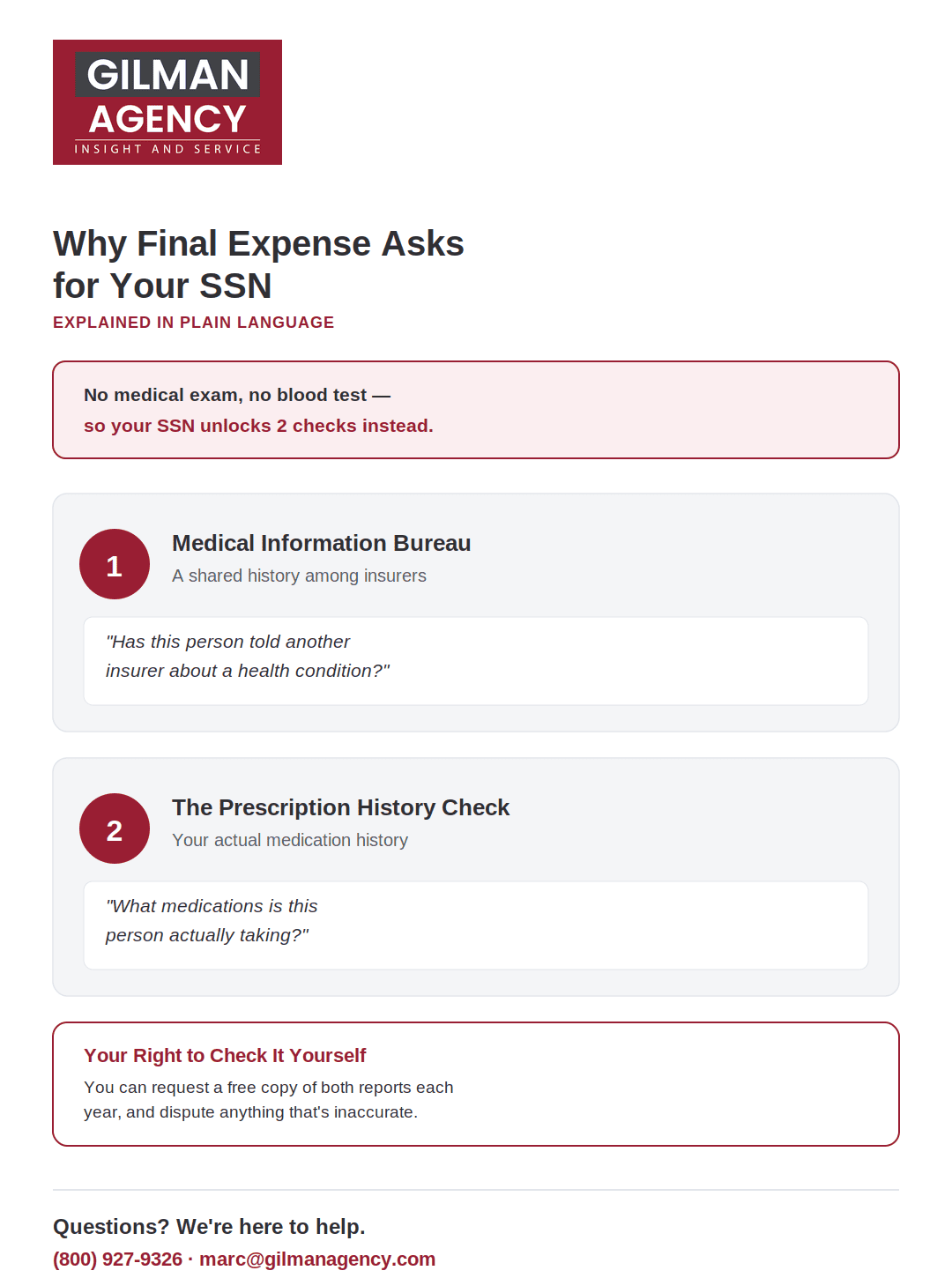
Your Social Security number is used to confirm your identity and pull two different consumer reports — a Medical Information Bureau (MIB) report and a prescription history report (commonly through Milliman IntelliScript) — the substitute for the blood and urine tests a fully underwritten policy would require.
-
The MIB and prescription databases are not the same thing. MIB reports coded conditions disclosed on past insurance applications; prescription services pull your actual medication purchase history from pharmacies.
-
The MIB is not your full medical record — it’s a coded summary of major conditions and past insurance applications, regulated by the same federal law that governs credit reports.
-
You have a legal right to a free copy of your MIB report every 12 months, and the right to dispute anything inaccurate on it.
If you’ve applied for final expense life insurance and been asked for your Social Security number, it’s a reasonable thing to want explained before handing it over. Here’s exactly what it’s used for, and why.
What Is a Level Premium Final Expense Policy?
Final expense insurance is a small whole life policy — typically $5,000 to $25,000 in coverage — designed to cover funeral costs, medical bills, and other final expenses so that burden doesn’t fall on your family. A level premium, level benefit policy means exactly what it sounds like: the premium you pay and the death benefit your beneficiary receives are both locked in from day one and never change, as long as you keep paying. This is different from a graded benefit policy, which is sometimes offered to applicants with more significant health conditions, where the full death benefit doesn’t kick in until the policy has been active for two or three years.
Why Simplified Issue Still Requires Verification
Most final expense policies are simplified issue — there’s no paramedical exam, no blood draw, no urine sample. You answer a set of health questions, and that’s the extent of the medical underwriting. This is exactly why the application is fast and accessible for people who might not qualify for a fully underwritten policy.
But an insurance company still needs some way to verify that the health questions were answered accurately — otherwise, simplified issue underwriting would be an open door for misrepresentation. That’s where your Social Security number comes in: it’s used to pull two specific reports that substitute for the exam.
The Medical Information Bureau (MIB) Check
The MIB — officially MIB Group, Inc. — is a not-for-profit, member-owned corporation that’s been around since 1902, originally formed by a group of life insurance companies to share underwriting information and reduce fraud. It’s owned by roughly 430 member insurance companies across the U.S. and Canada today, and according to the Federal Trade Commission, those member companies account for about 99% of individual life insurance policies and 80% of health and disability policies issued in the U.S. and Canada. In practical terms, if you’ve ever applied for individually underwritten life or health insurance, there’s a good chance the company you applied through is an MIB member.
A few things worth knowing about how it actually works:
-
It only receives information from member insurance companies — not directly from your doctors, hospitals, or pharmacies. If a condition was never disclosed on a past insurance application, it generally won’t be in your MIB file.
-
It’s not your full medical record. MIB reports don’t contain doctor’s notes, lab results, or detailed treatment history — just coded references to major conditions, certain lifestyle risk factors (like hazardous hobbies or a poor driving record), and previous insurance application outcomes.
-
It requires your signed authorization. Insurers can’t access it without your consent, which is part of what you’re signing when you complete the application.
-
You have a right to see it — twice, if needed. You’re entitled to one free copy of your own MIB report every 12 months, and if an insurer takes adverse action against you (like a denial) after checking your MIB file, you’re entitled to an additional free copy specifically related to that decision.
-
It’s a fraud safeguard, not a scoring tool. If you disclosed a condition to one insurer years ago but leave it off a new application, the MIB is what catches that inconsistency — it doesn’t itself decide whether you get approved or what you pay.
The Prescription Database Check
Separately from the MIB, your Social Security number is also used to check a prescription history database — most commonly through a service called Milliman IntelliScript, one of the most widely used prescription-history reporting services in the industry. It’s worth understanding this as a genuinely different tool from the MIB, not just another version of the same thing: where the MIB reports coded conditions you or others previously disclosed on insurance applications, IntelliScript pulls your actual prescription drug purchase history directly from pharmacies and pharmacy benefit managers.
The logic is straightforward: certain medications are strongly associated with certain health conditions, so a prescription history can reveal something an applicant genuinely forgot to mention, or a condition being actively managed that wasn’t disclosed. For an insurer relying on health questions instead of a medical exam, this is one of the more reliable ways to confirm the picture is accurate.
How far back does it go? Sources vary here — some report prescription history services can reach back 8 to 10 years, while Milliman’s own consumer disclosures state they generally won’t have a report on file if you haven’t applied for insurance or authorized a release within the past 7 years. Given that inconsistency, the safest assumption is that a meaningful, multi-year history is visible — not just your most recent prescriptions.
Like the MIB, this is a regulated consumer report. Milliman IntelliScript is a consumer reporting agency under the Fair Credit Reporting Act, which means you have the right to request your own report and to dispute inaccurate information on it. This matters in practice — there have been real disputes over the years about errors in prescription-history reports leading to unexpected denials or higher premiums, which is exactly why checking your own report before applying is a reasonable precaution if you have any doubt about what it might show.
What If You Don’t Provide Your SSN?
Without it, an insurer generally can’t verify your identity or complete these checks — which typically means the application can’t move forward. If you’re ever unsure whether a request for your SSN is legitimate, it’s reasonable to confirm you’re working with a licensed agent and a real insurance carrier before providing it.
What To Do Next
Understanding why these checks happen makes the application process feel a lot less like a black box — and knowing your health questions will be verified is exactly why it matters to answer them accurately the first time.
If you need further information about final expense coverage or how the application process works, we’re here to help — no cost, no obligation.
For additional information, please call: (800) 927-9326 or email:


