By Marc Gilman
Questions? Call (800) 927-9326 or email
Key Takeaways
-
If you own an old non-qualified annuity with a large embedded gain, you likely have a quiet tax problem — surrender it, and that gain comes out first as fully taxable ordinary income.
-
A 2006 federal law changed this specifically for long-term care. The Pension Protection Act’s Section 844 amended IRC Section 1035, allowing a non-qualified annuity to be exchanged tax-free into an annuity with a qualifying long-term care rider — confirmed directly in the actual Public Law text and in the IRS’s own interim guidance, Notice 2011-68.
-
Stack that with a second PPA provision, amending Section 7702B, and something genuinely unusual happens: qualified long-term care benefits are received completely tax-free. The gain doesn’t just defer — it disappears, provided the money is used for care.
-
The leverage is real, not just the tax treatment. A typical deposit creates a long-term care benefit pool worth two to three times what you put in, using an asset you already own.
-
This isn’t a fit for everyone. It solves a specific problem — an idle non-qualified annuity, an owner who may not pass full medical underwriting, and a preference for keeping unused money rather than losing it to premiums.
The Problem This Actually Solves
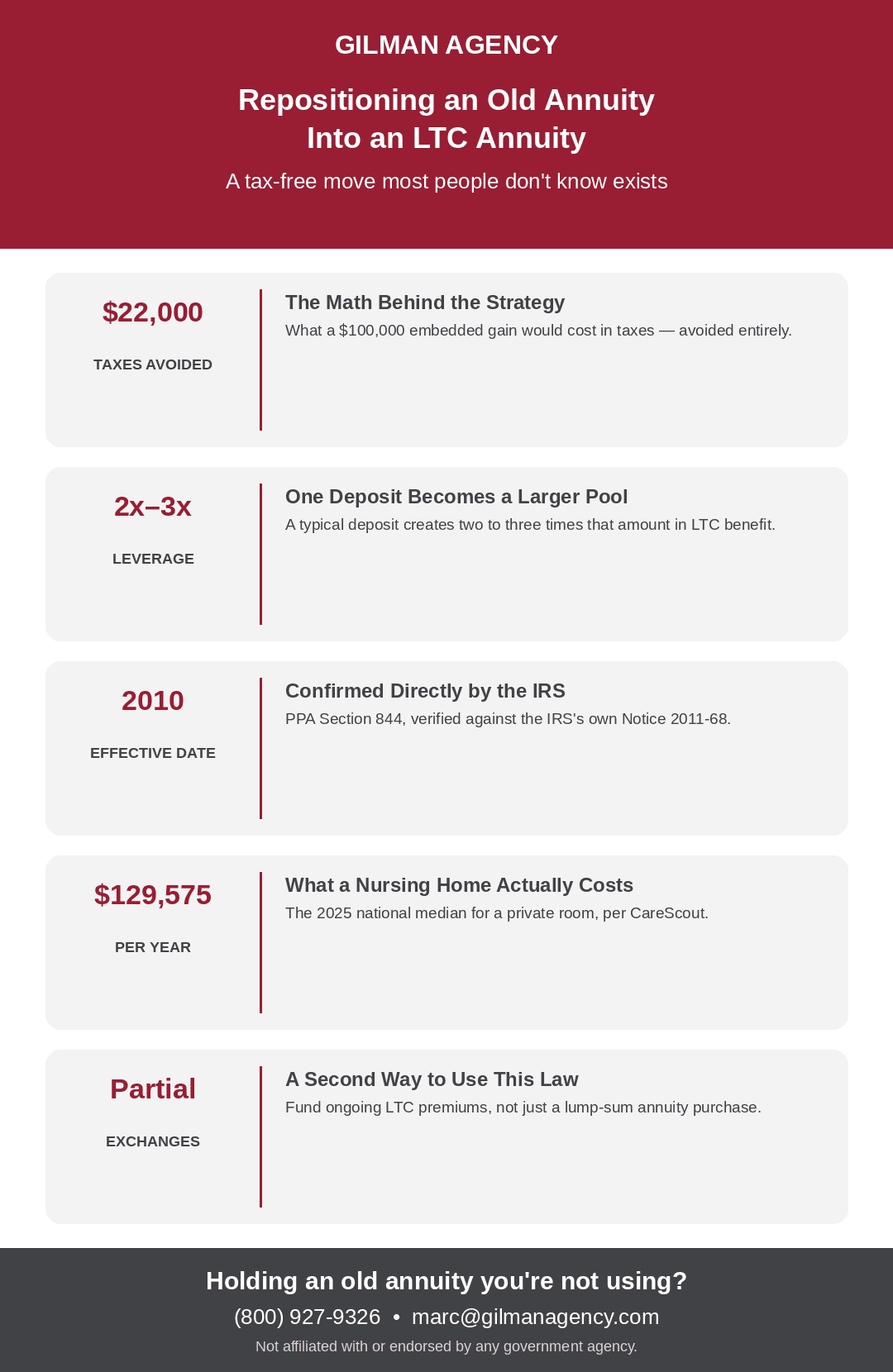
Here’s a scenario that’s more common than people realize: you’re holding an old non-qualified annuity — funded years ago with after-tax dollars — that’s grown substantially and is now just sitting there. You haven’t touched it, in part because you know exactly what happens if you do. Under standard tax rules, withdrawing from an annuity pulls out the gain first, taxed as ordinary income under last-in, first-out treatment. A $150,000 contract with a $50,000 cost basis and $100,000 of embedded gain means roughly $22,000 goes straight to taxes at a 22% effective rate — before a single dollar reaches an actual caregiver.
That’s the exact problem the Pension Protection Act of 2006 was built to address for long-term care specifically.
The Law Behind This, Confirmed Directly
Section 844 of the Pension Protection Act, Public Law 109-280, amended IRC Section 1035 so that — effective for exchanges occurring after December 31, 2009 — a non-qualified annuity can be exchanged tax-free into an annuity carrying a qualifying long-term care rider under IRC Section 7702B. This isn’t a secondhand characterization: the IRS’s own interim guidance on this exact provision, Notice 2011-68, confirms it plainly, stating that Section 1035 now applies to “the exchange of… an annuity contract for another annuity or qualified long-term care insurance contract.”
The same law also amended Section 7702B so that benefits paid for qualified long-term care expenses are received completely income-tax-free. Put those two provisions together, and you get something genuinely uncommon in tax planning: the 1035 exchange moves the embedded gain across without triggering tax, and the long-term care payout removes that gain permanently rather than simply deferring it to a later date. As financial planning researcher Michael Kitces has described it, the taxable gain doesn’t get postponed — it disappears entirely, as long as the money is used for qualified care.
A Worked Comparison
Take that same $150,000 non-qualified annuity with $100,000 of embedded gain. Two paths:
-
Surrender it directly to pay for care: the $100,000 gain comes out as ordinary income. At a 22% effective rate, roughly $22,000 goes to taxes before any money reaches a caregiver.
-
Exchange it into a PPA-qualified LTC annuity instead: the gain transfers with no tax triggered. Used for qualified care, that $22,000 is simply never owed — and the $150,000 has also been leveraged into a meaningfully larger long-term care benefit pool than the original contract value alone.
Michael Kitces’ own version of this comparison, using slightly different numbers, illustrates the same math: a $97,000 annuity with a $50,000 cost basis carries a $47,000 gain. Exchanged into a qualifying LTC contract, that $47,000 is deferred at the exchange and then never taxed at all, since qualified LTC benefits are received tax-free. Compare that to simply withdrawing from the annuity to pay for care directly — under IRC Section 72(e)(3), every withdrawal is taxable to the extent of gain, with only a narrow, age-capped itemized deduction available to offset it. The exchange path is effectively pre-tax; the direct-withdrawal path is effectively after-tax. That gap is the entire strategy.
A Related Path: Funding Ongoing LTC Premiums, Not Just a Lump Sum
Everything above assumes a single lump-sum exchange into an LTC annuity — the structure ForeCare, Annuity Care II, and CareMatters are all built around. There’s a related but genuinely distinct version of this strategy worth knowing about: using a systematic partial 1035 exchange to fund the ongoing annual premiums on a standalone, traditional long-term care insurance policy instead.
This matters because true single-premium standalone LTC policies are scarce in today’s market — most traditional LTC coverage is sold with annual premiums, not one deposit. The workaround is a partial exchange each year, moving just enough from the old annuity to cover that year’s LTC premium. Under Revenue Procedure 2008-24 (as modified by Revenue Procedure 2011-38), a partial exchange allocates cost basis pro rata between the amount moved and the amount remaining. On that $97,000 annuity with a $50,000 basis, moving $5,000 in a single year — about 5.15% of the contract — carries roughly $2,577 of basis and $2,423 of gain along with it, calculated fresh each year as the remaining contract’s value and gain shift.
This isn’t available everywhere — the LTC insurer receiving the funds has to be set up to actually process a 1035 exchange, and not every carrier is. Genworth has historically been recognized as a leader here, with a standing form specifically for setting up an ongoing annual partial exchange. As this strategy has become better known, more carriers have built out the paperwork to support it, but it’s worth confirming directly with any specific insurer before assuming it’s available.
How the Leverage Actually Works
The mechanism is fairly simple once you see it laid out. A single lump-sum deposit — commonly between $50,000 and $500,000 — buys a long-term care benefit pool typically worth two to three times that amount, with the exact multiplier depending on your age and health at issue. When a claim is approved, the contract spends your own account value first, usually over 24 to 36 months. Once that’s exhausted, a continuation-of-benefits rider takes over and keeps paying the same monthly amount for the remainder of the benefit period — this is genuinely where the leverage lives, since it’s the insurer paying beyond what you actually deposited.
Benefits are triggered the same way as any tax-qualified long-term care contract: a licensed health care practitioner certifies you can’t perform at least two of six Activities of Daily Living (bathing, dressing, eating, toileting, transferring, continence), or that you have a severe cognitive impairment — typically after a 90-day elimination period.
What That Benefit Pool Actually Buys
It’s worth sizing this against real numbers. According to CareScout’s 2025 Cost of Care Survey — the industry’s most comprehensive annual survey of long-term care pricing, based on more than 25,000 rates collected nationwide — the national median cost of a private nursing home room is $355 per day, or $129,575 a year. A semi-private room runs $315 per day, or $114,975 annually. Assisted living communities median $6,200 a month, or $74,400 a year. In-home non-medical caregiver services run $35 an hour, which annualizes to roughly $80,080 at 44 hours a week.
Against those figures, a $250,000 LTC annuity benefit pool — the kind a $100,000 deposit at a 2.5x multiplier might create — covers roughly two years of private nursing home care, or well over three years of assisted living, at today’s national medians. That’s the realistic frame for sizing a contract: work backward from how many years of care you actually want covered, not just how large a lump sum you’re comfortable deploying.
One encouraging note from the same survey: cost growth actually slowed in 2025 after several years of sharper increases, with most care settings rising just 1% to 5% year-over-year. That doesn’t make the underlying costs any less significant, but it’s a meaningfully calmer trend than the double-digit jumps some settings saw in 2024.
Reimbursement vs. Cash Indemnity: A Distinction Worth Understanding
Most LTC annuities pay on a reimbursement basis — you pay a qualified provider, submit invoices, and the insurer reimburses up to your monthly maximum. A smaller number of contracts pay cash indemnity: once a claim is approved, the insurer sends the monthly benefit directly to you, with no receipts required and no restriction on how it’s spent — which specifically means it can pay a family member providing care, not just a licensed provider. This distinction matters more than most people expect walking in, and it’s worth confirming directly which model any specific contract uses.
What Makes This a Genuine Fit — And What Doesn’t
This strategy solves a specific, real problem, not a general one. It tends to make sense if:
-
You own a non-qualified annuity you’re not actively using, especially one carrying a large embedded gain you’ve been reluctant to trigger.
-
You’ve been declined or rated for traditional long-term care insurance, or expect you might be — LTC annuities use simplified underwriting with no medical exam, though a list of knock-out health questions still applies.
-
You want long-term care protection without premiums that could rise or be forfeited — one deposit, no renewal notices, no rate increase letters.
-
You have liquid, non-qualified assets you can commit long-term without needing them for current income.
It’s a poor fit if the money represents income you’ll actually need, if your assets are entirely in IRAs or other qualified accounts (the PPA tax advantage only applies to non-qualified money), or if maximizing growth — not care protection — is the real objective. Growth in these contracts trails a plain fixed annuity, since much of the credited interest goes toward the rider charge that funds the benefit itself.
What To Do Next
If you’re holding an old non-qualified annuity you haven’t touched specifically because of the tax bill waiting on the other side, this is exactly the kind of situation this 2006 law was built for — and it remains one of the more significant tax planning opportunities still available for exactly this circumstance. Whether it fits your specific contract depends on your cost basis, your current health, and what you actually need the money to do. If you want to run the real numbers against your own contract, reach out and we’ll work through it together.
Questions? Call (800) 927-9326 or email
Sources: Pension Protection Act of 2006, Public Law 109-280, Section 844 (congress.gov; govinfo.gov); IRS Notice 2011-68, “Annuity and Life Insurance Contracts with a Long-Term Care Insurance Feature” (irs.gov); Michael Kitces, “A New Way To Pay For Long-Term Care Insurance With Favorable Tax Treatment,” Kitces.com; Jason Caudill, MBA, “Long-Term Care Annuity: How LTC Annuities Work in 2026,” My Annuity Store, updated August 2026; “CareScout Releases 2025 Cost of Care Survey Results,” Genworth Financial, Inc., March 2, 2026.