

By Marc Gilman
Questions?
Call (800) 927-9326 or email
Key Takeaways
-
Medicaid and Medicare are separate programs. A clinic that accepts Medicaid isn’t automatically enrolled in Medicare, and a clinic enrolled in Medicare isn’t automatically in every Medicare Advantage network.
-
Medicare Advantage plans are private plans with their own networks. Each plan contracts with providers separately, and an HMO generally doesn’t cover non-emergency care outside its network.
-
Plans credential providers one by one. Medicaid approval doesn’t carry over, so a clinic has to apply to each Medicare Advantage plan it wants to join.
-
Providers cite paperwork and payment. A 2025 report from the HHS Office of Inspector General says providers pointed to administrative burden and low payment rates as reasons for limiting their work with managed care plans.
-
A plan’s directory may not tell the whole story. The same report found that many plans have limited behavioral health networks and that some listed providers see no plan enrollees.
-
Check before you enroll. Call the clinic, name the exact plan and ask if they take it.
Why Is a Medicaid Clinic Not Always in Medicare Advantage Plans?
It’s a common surprise. Someone is getting counseling or substance use treatment at a clinic that takes Medicaid, then joins a Medicare Advantage plan and finds the clinic won’t bill it. The reasons usually fall into four groups.
1. The Clinic May Not Be Enrolled in Medicare at All
Medicaid is run jointly by the federal government and the states, so requirements vary by state. Medicare is run by CMS under federal rules. A provider has to enroll in each program separately, and a CMS presentation on Medicaid provider enrollment describes the two as separate processes. According to the medical billing company Aspect Billing Solutions, Medicare enrollment goes through CMS’s PECOS system and a regional Medicare contractor, Medicaid enrollment goes through the state’s own system, and “separate applications are required.” Many state-licensed substance use and behavioral health programs were built around Medicaid, private pay or grant funding and never enrolled in Medicare. Medicare also covers only certain types of providers and services, so some programs don’t fit.
If a clinic isn’t enrolled in Medicare, it can’t bill Original Medicare or a Medicare Advantage plan. That has nothing to do with the plan you picked.
2. The Clinic May Not Be in the Plan’s Network
Medicare Advantage plans are offered by private insurance companies. Each one builds a network of doctors, clinics and hospitals, and each one contracts separately. A clinic can be in one plan’s network and not another’s.
How much that matters depends on the plan type. According to Medicare Interactive’s plan comparison chart:
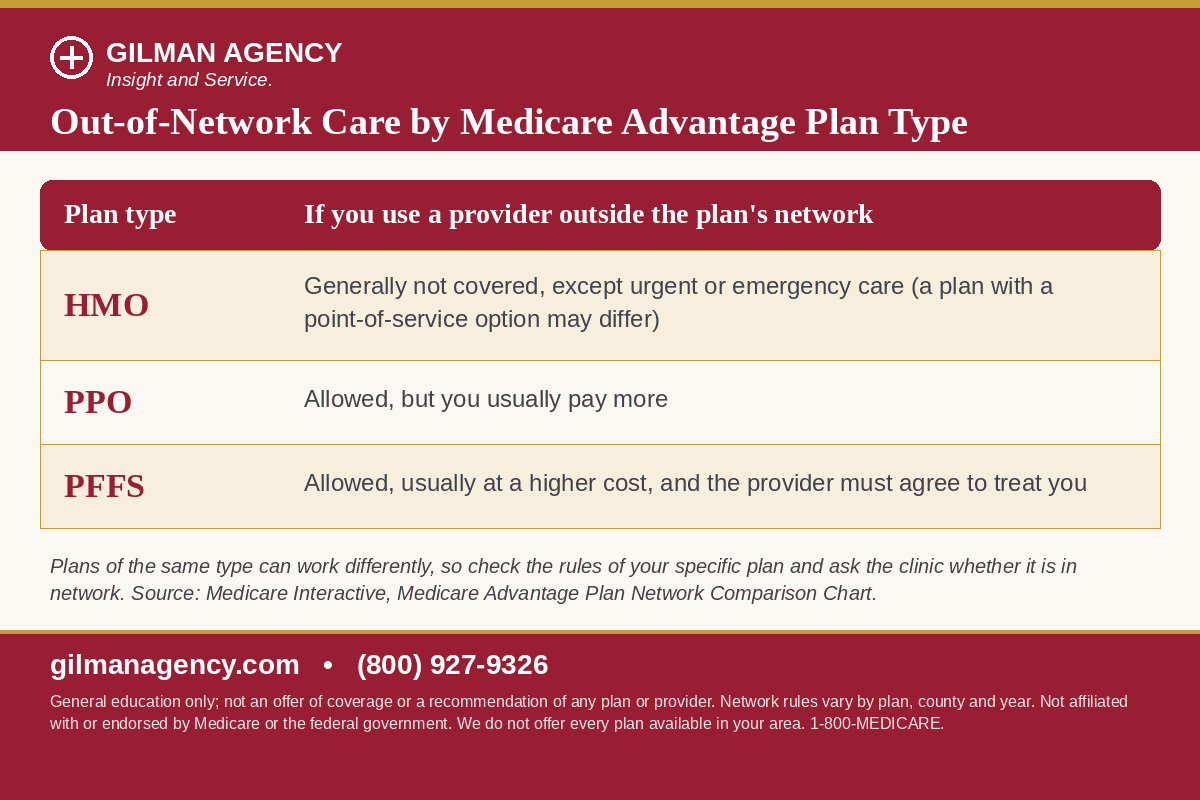
Plans of the same type can work differently, so check the rules of the specific plan.
Joining a network also means getting credentialed. Federal rules require Medicare Advantage organizations to have written policies for selecting and evaluating providers (42 CFR 422.204). For physicians and other health professionals, that includes a signed application, primary-source verification of licensure or certification, a check of disciplinary status and confirmation of eligibility for Medicare payment. Plans must recredential at least every three years. A CMS presentation on Medicare Advantage credentialing adds that the plan is ultimately responsible for verifying network providers’ credentials, even when it hands the work to another company, and that it must check federal exclusion and Medicare opt-out status. Plans must also verify that other types of providers are licensed and meet applicable state and federal requirements, and they must make sure covered basic benefits are delivered by providers that meet Medicare requirements. That is a separate process from Medicaid enrollment, with its own application and timeline, and a clinic approved for Medicaid still has to go through it with each plan it wants to join. A revenue cycle consulting firm, MBW RCM, describes commercial payer credentialing as averaging 90 to 120 days, though it doesn’t address Medicare Advantage specifically. If a clinic isn’t credentialed with your plan, the plan may deny the claim, and you could be left with the bill, depending on your plan type and the rules that apply. This is one more reason to confirm network status before your first visit.
3. Paperwork and Payment
Even clinics that are enrolled in Medicare may choose not to join Medicare Advantage networks. In October 2025, the HHS Office of Inspector General (OIG) reported that many Medicare Advantage and Medicaid managed care plans have limited behavioral health provider networks. Providers pointed to administrative burden and low payment rates as reasons for limiting their willingness to work with these plans.
Plan-specific prior authorization, billing rules and claim denials are part of what providers describe. Health plans often see it differently. In a 2024 TechTarget article about hospitals leaving Medicare Advantage networks, a SCAN Health Plan executive said contract rates are not the main driver and that health systems often haven’t changed their infrastructure to match how Medicare Advantage works. Both views exist, and the answer can differ from one clinic and one plan to the next.
4. A Plan’s Provider Directory May Not Match Reality
The OIG report also found that many plans’ networks were further limited by “inactive” providers, sometimes called “ghost” providers, who gave no services to enrollees. Most of the inactive providers shouldn’t have been in the plan directories. Some no longer worked at any listed location, and others said they wouldn’t see plan enrollees.
For you, that means a name on a plan’s online directory isn’t proof that the clinic will schedule you.
What If I Have Both Medicare and Medicaid?
People with both are sometimes called “dual eligible.” If you’re in that group, one option to ask about is a Dual Eligible Special Needs Plan, or D-SNP, which is a Medicare Advantage plan designed for people with both Medicare and Medicaid. Whether one is available, and which providers it includes, depends on your state and county. Original Medicare is another route, since a clinic that is enrolled in Medicare can usually bill it. Ask both your state Medicaid office and your agent how your coverage would work together.
How Do I Check Before I Enroll?
-
Make a list of your providers, including any behavioral health or substance use clinics.
-
Call each clinic’s billing or intake office. Say the plan’s exact name and type (for example, HMO or PPO) and ask: “Are you in network for this plan, and are you accepting new patients on it?”
-
Ask if they’re enrolled in Medicare. If not, they can’t bill any Medicare plan.
-
Check the plan’s directory, then confirm by phone. Directories can be out of date.
-
Ask about prior authorization and what happens if a service is denied.
-
Look at your timing. Annual Enrollment runs October 15 to December 7, 2026.* If you’re already in a Medicare Advantage plan, there is also a Medicare Advantage Open Enrollment Period from January 1 to March 31 each year, in which you can switch to another Medicare Advantage plan or return to Original Medicare.
Where Does Insurance Planning Fit In?
Coverage that looks good on paper doesn’t help if your clinic isn’t in it. We start with the providers and services you rely on, then compare the plans available to you in New Hampshire and Massachusetts, and we look at how those plans work with any Medicaid coverage you have. We can also tell you which questions to ask a clinic before you switch.
What To Do Next
Want help checking whether your providers are in a plan before you enroll? We’re happy to walk through it with you. You may also like our free 2027 AEP Self-Service Guide.
Questions? Call (800) 927-9326 or email
Prefer we reach out to you instead? Complete our Permission to Contact form and a licensed Gilman Agency agent will follow up.
*Some Medicare Advantage plans may set enrollment caps for 2027 and could close to new enrollment before December 7. Check with the plan.
Sources: 42 CFR 422.204, “Provider selection and credentialing” (eCFR); CMS, “Credentialing by Medicare Advantage Organizations” (Region II presentation, undated); CMS, 2019 National Provider Enrollment Conference, “Medicaid Provider Enrollment” (Mar. 2019); HHS Office of Inspector General, “Many Medicare Advantage and Medicaid Managed Care Plans Have Limited Behavioral Health Provider Networks and Inactive Providers,” OEI-02-23-00540 (issued Oct. 2, 2025); Victoria Bailey, “What Is Behind Rampant Medicare Advantage Contract Terminations?” TechTarget (Feb. 6, 2024); Medicare Interactive (Medicare Rights Center), “Medicare Advantage Plan Network Comparison Chart”; MBW RCM, “Understanding Payer-Specific Credentialing” (Jan. 18, 2025); Aspect Billing Solutions, “Medicare vs. Medicaid Credentialing: Key Differences” (Nov. 6, 2025); Medicare Agents Hub, “Why does a Medicaid provider, including many substance and behavioral disorder clinics, not accept Medicare Advantage plans?”
Gilman Agency is not affiliated with or endorsed by Medicare, Medicaid, the HHS Office of Inspector General or the federal government. This article is for general educational purposes and is not an offer of coverage or a recommendation of any specific plan, provider or treatment. Provider participation, network rules and plan availability vary by plan, county and year and can change. Confirm with the provider and the plan before you enroll. This is not legal, tax or medical advice. We do not offer every plan available in your area. For more information, contact Marc Gilman, licensed insurance agent, at (800) 927-9326, or call 1-800-MEDICARE for a full list of your options.


