
By Marc Gilman
📞 Call (800) 927-9326 or (603) 493-1394 | ✉️
Most retirement planning focuses on building savings and creating income you can count on. One of the biggest risks that gets overlooked is the cost of long-term care — and the fact that more than half of Americans turning 65 today will need it at some point. Here are the four main ways people plan for it, and how to think about which one fits your situation.
Key Takeaways
-
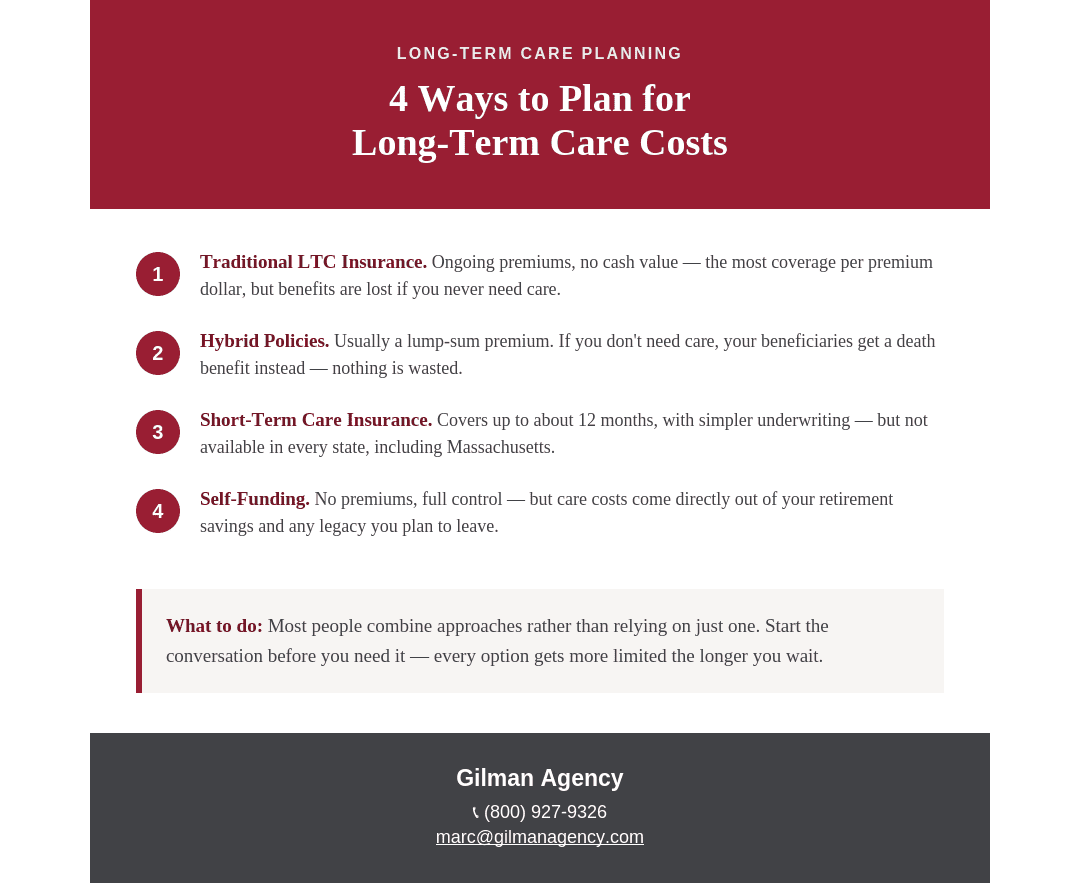
There are four main approaches to funding long-term care: traditional insurance, hybrid policies, short-term care insurance, and self-funding.
-
Each option makes a different trade-off between cost, flexibility, and what happens to your money if you never need care.
-
Short-term care insurance isn’t available everywhere — it’s prohibited in Massachusetts, so it’s not a universal option depending on where you live.
-
Starting earlier generally means more options, lower costs, and easier qualification across all four approaches.
-
Most people end up combining strategies rather than relying on just one.
Option 1: Traditional long-term care insurance
Traditional LTC insurance works the way most people think of insurance: you pay regular premiums, and if you need qualifying long-term care, the policy pays out toward your care costs. There’s generally no cash value and no death benefit — if you never need care, the premiums you paid don’t come back.
This option tends to offer the most coverage per premium dollar, since none of your payment is being set aside for a guaranteed payout to your heirs. The trade-off is the classic “use it or lose it” concern, plus the reputation (mostly earned by policies sold before the industry had solid claims data) for premium increases over time. Newer policies are priced with much more claims history behind them, which has meant greater rate stability in recent years.
Option 2: Hybrid (asset-based) policies
Hybrid policies combine life insurance or an annuity with long-term care benefits. If you need care, the policy pays out toward those costs. If you don’t, your beneficiaries receive a death benefit instead. This structure directly solves the “use it or lose it” problem — the money is never simply wasted.
Hybrid policies are usually funded with a single lump-sum premium rather than ongoing payments, which also means rate increases generally aren’t a concern the way they can be with traditional policies. The trade-off is cost: hybrid coverage typically runs three to four times more than a comparable traditional policy for the same underlying care benefit, since you’re also purchasing that guaranteed payout.
Option 3: Short-term care insurance
Short-term care insurance is designed to cover a shorter window — often up to about 12 months — rather than years of extended care. It’s meant to bridge a gap after a hospitalization, surgery, or a temporary health event, and typically comes with easier underwriting and a lower premium than traditional long-term care insurance.
One important caveat if you’re comparing this option: short-term care insurance isn’t available in every state. It’s specifically prohibited in Massachusetts, so if you live there, this isn’t part of your realistic option set, regardless of how it’s marketed nationally. We’ve written a full breakdown of how short-term care insurance works, and where it is and isn’t available, in a separate post.
Option 4: Self-funding
Some people plan to pay for care directly out of savings, investments, or retirement income, without purchasing any dedicated insurance product. This gives you complete control and no premiums to pay, but it also means care costs come directly out of the same pool of money you’re relying on for retirement income and any legacy you want to leave.
Self-funding can be a reasonable strategy for people with substantial liquid assets and a clear financial plan, but it’s worth being honest about the numbers: national median costs run into the tens of thousands of dollars per year, and a multi-year care need can meaningfully erode retirement savings, affect what’s available to a surviving spouse, or reduce what you’re able to leave to heirs.
How do these options actually compare?

What To Do Next
-
Don’t assume it’s an either/or decision. Many people combine approaches — for example, a smaller traditional or short-term policy alongside self-funded savings for anything beyond that.
-
Start the conversation before you need it. Every one of these options gets more expensive, more restricted, or harder to qualify for the longer you wait, especially once health issues appear.
-
If you’re in Massachusetts, remember short-term care insurance isn’t on your list of options — traditional, hybrid, and self-funding are where your planning should focus.
-
Work with an independent agent who can show you real options across multiple carriers and product types, not just one company’s version of one of these four approaches.
📞 Call (800) 927-9326 or (603) 493-1394, or email — we’re happy to walk through which combination of these approaches fits your health, assets, and goals.
Sources:
-
U.S. Department of Health and Human Services, ASPE, “Projections of Risk of Needing Long-Term Services and Supports at Ages 65 and Older,” January 2021
-
CareScout Cost of Care Survey, July–December 2024


