
By Marc Gilman
📞 Call (800) 927-9326 or (603) 493-1394 | ✉️
Chronic Condition Special Needs Plans are growing fast across the country, but New Hampshire has a wrinkle that makes them matter more here than in most states: we have no Dual Eligible Special Needs Plans (D-SNPs) at all. That makes New Hampshire the one state in the country where C-SNP enrollment actually outweighs D-SNP enrollment among the relatively small number of NH residents in any special needs plan. If you’re a Medicare beneficiary here with a qualifying chronic condition, a C-SNP may be one of the only specialized plan options available to you — which is exactly why getting the enrollment process right matters.
Key Takeaways
-
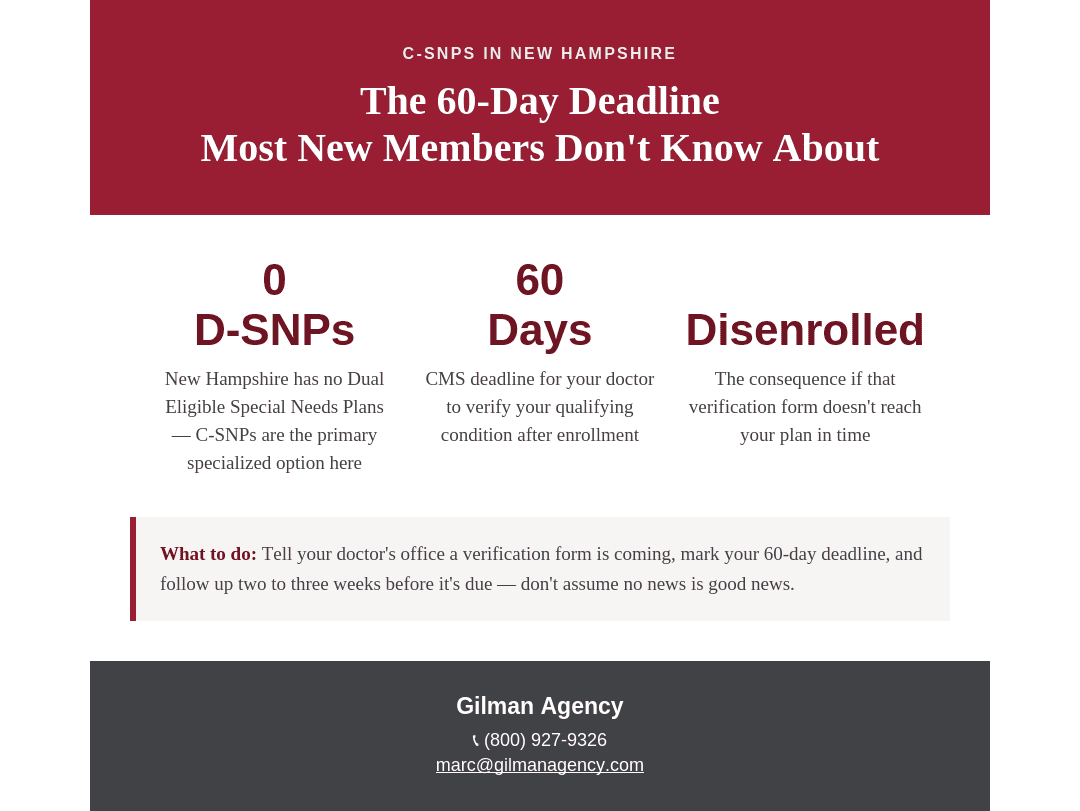
New Hampshire has no D-SNPs or MMPs, so C-SNPs are the primary special needs plan option available to NH Medicare beneficiaries.
-
C-SNP enrollment doesn’t end at sign-up. CMS requires your treating provider to verify your qualifying condition within 60 days of your plan’s effective date, or you can be disenrolled.
-
This verification step depends entirely on a busy doctor’s office completing and submitting a form — it is not automatic, and it is not always fast.
-
A local agent who understands this process can track the deadline, follow up with your provider’s office, and step in before a routine paperwork delay turns into a lost enrollment.
-
We recently tracked a Manchester client’s verification for the full 60-day window, right up to the deadline itself.
Why New Hampshire’s C-SNP market looks different
Most states with meaningful special needs plan enrollment lean heavily on D-SNPs, since dual-eligible beneficiaries (those who qualify for both Medicare and Medicaid) represent the largest share of SNP membership nationally. New Hampshire doesn’t have that option. With no D-SNPs or Medicare-Medicaid Plans available here, C-SNPs carry more relative weight in our state’s Medicare Advantage landscape than they do almost anywhere else in the country.
That doesn’t mean special needs plans are common in New Hampshire overall — they’re still a small share of our state’s total Medicare Advantage enrollment. But among NH residents who do enroll in a special needs plan, C-SNPs are the more established, more available option. If you have a qualifying chronic condition like diabetes, chronic heart failure, or a cardiovascular condition, a C-SNP is worth understanding, because it may be the only specialized plan built around your specific health needs that’s actually offered in your county.
Enrollment isn’t the finish line — verification is
Here’s the part that catches a lot of people off guard, and it’s the reason this post exists: getting approved for a C-SNP is not the end of the process.
By federal rule, once you enroll in a C-SNP, your insurance carrier has 60 days from your plan’s effective date to get your qualifying chronic condition verified directly by your treating provider — not by you, and not based on a diagnosis code from an old claim. CMS specifically prohibits carriers from using a previous claim or prior proof of diagnosis to satisfy this requirement. Your doctor’s office has to complete a Chronic Condition Verification form and submit it to the plan, confirming in writing that you’re being actively treated for the condition that qualified you for the plan.
If that verification doesn’t come through within the 60-day window, CMS requires the carrier to disenroll you from the C-SNP, generally effective at the end of the following month. You wouldn’t lose Medicare coverage altogether — you’d have a Special Enrollment Period to pick another Medicare Advantage plan or return to Original Medicare — but you’d lose the C-SNP itself, along with whatever condition-specific drug pricing and supplemental benefits came with it.
The catch is that this entire process depends on a form getting completed inside a doctor’s office. It’s not something that happens automatically in the background, and it’s rarely anyone’s top priority on a given day. Insurance verification paperwork competes with patient care, other insurance forms, and everything else that comes across a front desk.
A real example: tracking a verification down to the wire
We recently worked with a new client, a Manchester resident who we initially met at the Frail and Elderly Shelter, through exactly this process. After enrollment, we started tracking the 60-day verification window immediately, the same way we do for every C-SNP enrollment. Over the following weeks, we followed up repeatedly to make sure the verification request had actually reached the client’s primary care provider’s office and hadn’t been set aside.
The deadline landed on a Friday, July 31st — the 60th day. The form wasn’t filed until 4:15 that afternoon, with less than a hour to spare before the close of business. Without that persistent follow-up, this client would have been disenrolled from their C-SNP simply because the health insurer’s request was ignored for two months, through absolutely no fault of their own.
This is not a rare situation. It’s the normal, predictable friction of a process that depends on a third party — a provider’s office — completing paperwork on a government deadline they didn’t choose and don’t get paid extra to prioritize.
What this means for you
If you’re considering a C-SNP, or you’ve recently enrolled in one, a few things are worth doing:
-
Tell your doctor’s office as soon as your enrollment is approved. Let them know a Chronic Condition Verification form is coming from your plan, so it doesn’t land as a surprise.
-
Know your 60-day deadline. Mark your plan’s effective date and count 60 days forward. That’s your real deadline, even if it feels far off at first.
-
Don’t assume “no news is good news.” A missing verification often just means the form is sitting unprocessed, not that anything is wrong with your eligibility.
-
Follow up yourself, or have someone follow up for you. A phone call to your provider’s office two or three weeks before the deadline can be the difference between a smooth enrollment and a disenrollment notice.
What To Do Next
This is exactly the kind of process where working with a local, independent agent pays off. We don’t just help you pick a plan and disappear — we track the verification deadline for every C-SNP client, follow up directly with provider offices when needed–we’ve even visited in person when necessary, and step in before a paperwork delay becomes a coverage problem. That’s the value of working with someone who handles this process regularly, rather than navigating it alone for the first time.
📞 Call (800) 927-9326 or (603) 493-1394, or email if you want to know if you qualify for a C-SNP.
Sources:


