By Marc Gilman
Call (800) 927-9326 | Email
Yes. But which part of Medicare pays, and what you owe, depends on how the drug is given. An injection or infusion at your doctor’s office is usually covered by Part B. Pills and pens you use at home are covered by your Part D drug plan.
That difference matters when you compare 2027 plans before Annual Enrollment ends December 7.
Osteoporosis is often called a “silent” disease because there are usually no symptoms until a bone breaks, sometimes from something as minor as bending, lifting or a small fall. According to the National Institutes of Health, it’s the major cause of fractures in postmenopausal women and older men. Risk rises with age and is higher for women, people with a family history, and people who take long-term steroids or certain other medications.
Key Takeaways
-
Part B covers clinic-given drugs like denosumab (Prolia and its biosimilars), romosozumab (Evenity) and zoledronic acid infusions (Reclast). You generally pay 20% after the Part B deductible.
-
Part D covers pills and self-injected pens like alendronate and teriparatide (Forteo). Part D out-of-pocket costs are capped at $2,400 in 2027.
-
Medigap can pay your 20% for Part B drugs. Medicare Advantage plans set their own cost-sharing and often require prior authorization.
-
Bone density tests are covered once every 24 months for people who qualify, at no cost when the provider accepts assignment.
-
A home health nurse can give the injection at no cost for the visit, but only for women who meet strict conditions.
Which Part of Medicare Pays for Your Drug?
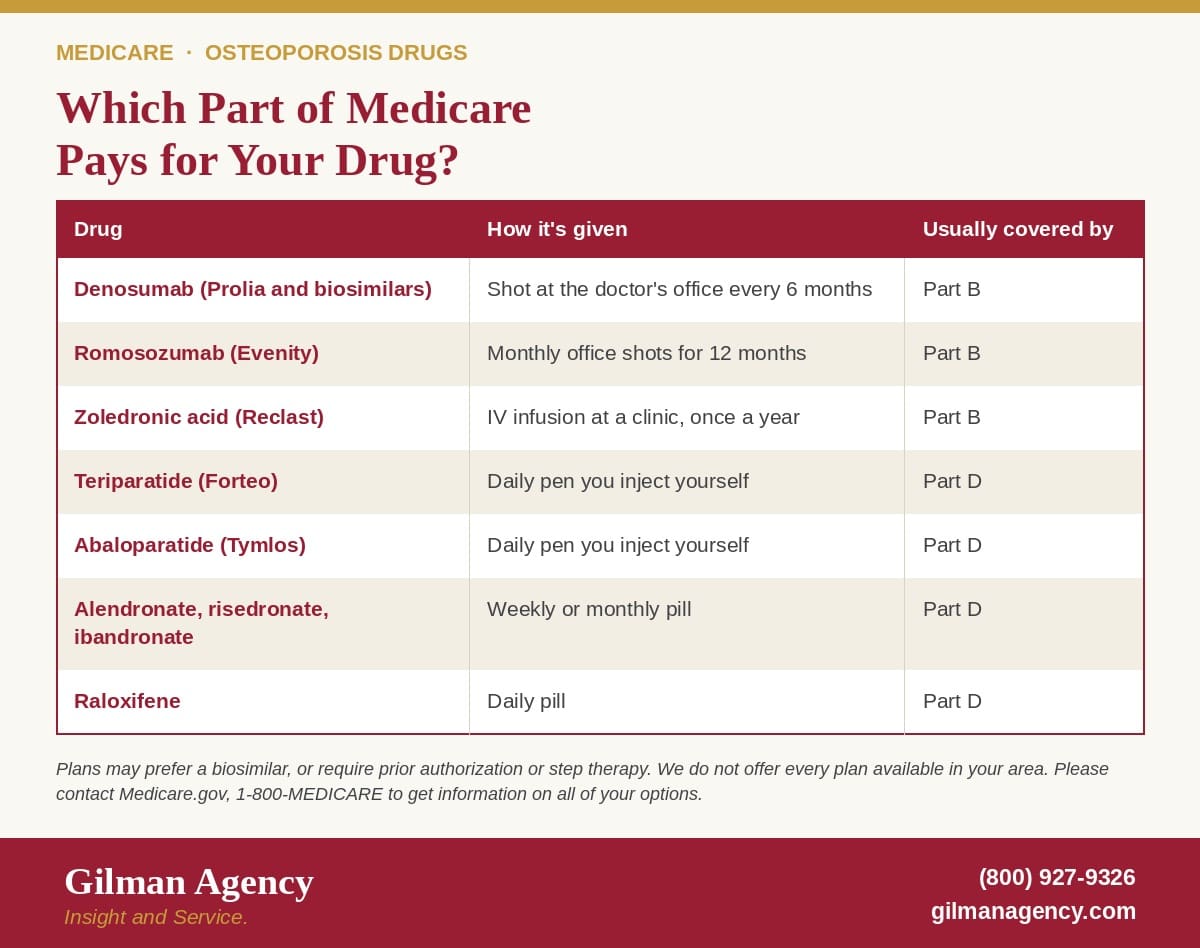
The rule of thumb: if a nurse or doctor gives it to you in the office, it’s Part B. If you take it at home, it’s Part D. Several lower-cost biosimilar versions of denosumab are now available, and many plans prefer them over Prolia.
What You’ll Pay in 2027
With Original Medicare (Part B drugs): after the Part B deductible ($283 in 2026; Medicare announces the 2027 amount this fall), you generally pay up to 20% of the Medicare-approved amount for the drug. For some Part B drugs whose prices have risen faster than inflation, Medicare lowers your coinsurance; the drugs and savings change every quarter.
With a Medigap plan: most Medigap plans pay that 20% for you. Plans K and L pay part of it.
With Medicare Advantage: the plan sets its own cost-sharing for Part B drugs, often 20% coinsurance, up to the plan’s yearly out-of-pocket limit.
With Part D (pills and self-injected pens): what you pay depends on your plan’s deductible and the drug’s tier. Self-injected pens like teriparatide are often on a specialty tier. Your total out-of-pocket for covered Part D drugs is capped at $2,400 in 2027, and the Medicare Prescription Payment Plan lets you spread those costs into monthly payments. If your income is limited, Extra Help can lower your drug costs.
One thing to know: drug-maker copay coupons generally can’t be used with Medicare.
Prior Authorization and Step Therapy
Original Medicare doesn’t require prior authorization for Part B osteoporosis injections. Your doctor documents medical need, and Medicare pays its share.
Medicare Advantage plans and Part D plans often require:
-
Prior authorization: proof of medical need, such as a low bone density score or a past fracture from a minor fall.
-
Step therapy: trying a lower-cost drug first, often an oral pill like alendronate, before covering an injection.
-
A preferred version: some plans cover a denosumab biosimilar instead of Prolia.
If you can’t take pills (for example, because of stomach problems or kidney disease), your doctor can request an exception with supporting records.
Home Health Injections
Medicare also covers certain osteoporosis injections given at home by a home health nurse, but only if you’re a woman with osteoporosis who:
-
Meets the criteria for Medicare home health services
-
Has a bone fracture that a provider certifies is related to postmenopausal osteoporosis
-
Has a provider who certifies you can’t give yourself the injection or learn how, and your family or caregivers are unable or unwilling to give it
You pay nothing for the nurse visit, and generally up to 20% for the drug after the Part B deductible.
Bone Density Tests
Part B covers a bone density test (often a DEXA scan) once every 24 months, or more often if medically necessary, if you meet at least one of these:
-
You’re a woman whose doctor has determined you have low estrogen and are at risk for osteoporosis
-
Your X-rays show possible osteoporosis, low bone mass or spinal fractures
-
You take prednisone or a similar steroid, or are about to start
-
You’ve been diagnosed with primary hyperparathyroidism
-
Your doctor is checking whether an osteoporosis drug is working
You pay nothing for the test if your provider accepts assignment. If you’re already on an osteoporosis drug, the follow-up scan is also how your doctor shows a plan that the treatment is working or needs to change.
What your T-score means
The most common test is a DXA (or DEXA) scan of the hip and spine. For women after menopause and men 50 and older, results come as a T-score, which compares your bone density with a healthy young adult’s:
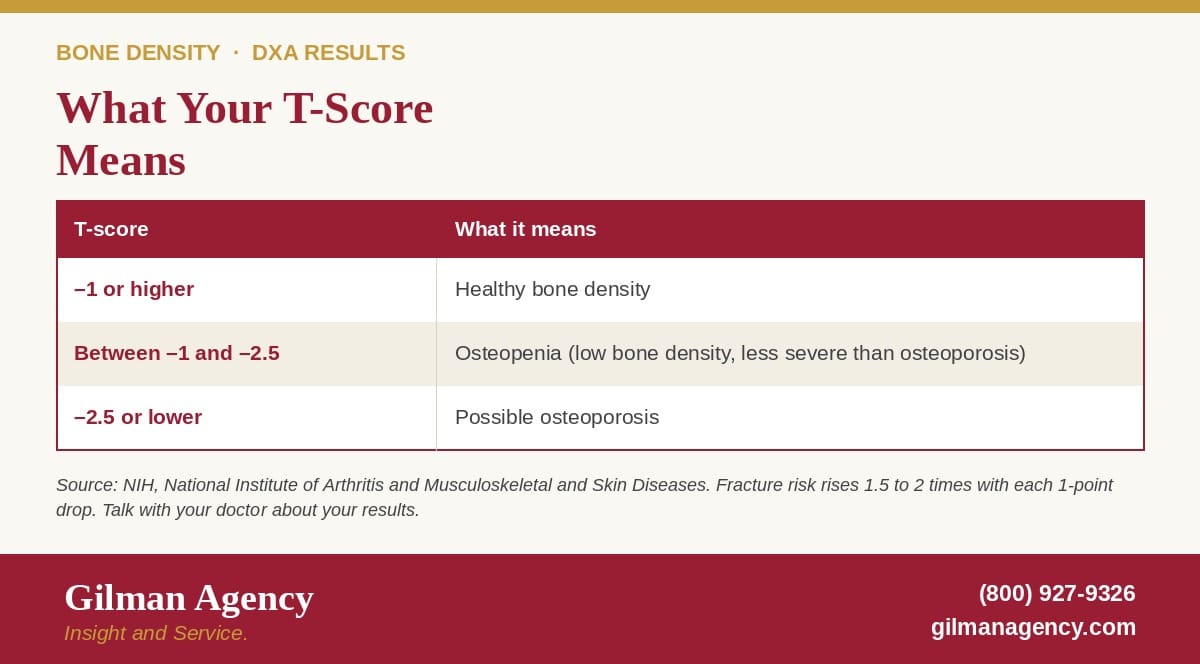
According to the NIH, the risk of a broken bone goes up 1.5 to 2 times with each 1-point drop in your T-score. The U.S. Preventive Services Task Force recommends bone density testing for women over 65, and for younger women past menopause who are at higher risk of a fracture. Men concerned about their bone health should talk with their doctor.
Questions To Ask Before Choosing a 2027 Plan
-
Is my drug covered by Part B or Part D? That decides which part of the plan to check.
-
For a Part B injection on Medicare Advantage: what’s the coinsurance, and does the plan require prior authorization or step therapy?
-
For a Part D pill or pen: is it on the 2027 drug list, on which tier, and with what restrictions?
-
Does the plan prefer a biosimilar over the brand my doctor prescribes?
-
Is my rheumatologist, endocrinologist or infusion center covered by the plan?
What To Do Next
If you take or are starting an osteoporosis drug, we can check how each 2027 plan covers it, including prior authorization rules and your total costs, before Annual Enrollment ends December 7.
Call Gilman Agency at (800) 927-9326 or email .
Sources
-
Medicare.gov, Osteoporosis drugs
-
Medicare.gov, Bone mass measurements
-
National Institute of Arthritis and Musculoskeletal and Skin Diseases (NIH), Osteoporosis
-
NIAMS, Bone Mineral Density Tests: What the Numbers Mean
-
CMS, 2026 Medicare Part B deductible ($283), November 2025
-
Inflation Reduction Act Part D out-of-pocket cap: $2,400 for 2027
We do not offer every plan available in your area. Please contact Medicare.gov, 1-800-MEDICARE to get information on all of your options.
This article is for educational purposes only and isn’t medical advice. Talk with your doctor about which osteoporosis treatment is right for you. Coverage, prior authorization rules and costs vary by plan. Gilman Agency is not affiliated with or endorsed by the U.S. government or the federal Medicare program.