
By Marc Gilman
Questions? Call (800) 927-9326 or email
Key Takeaways
-
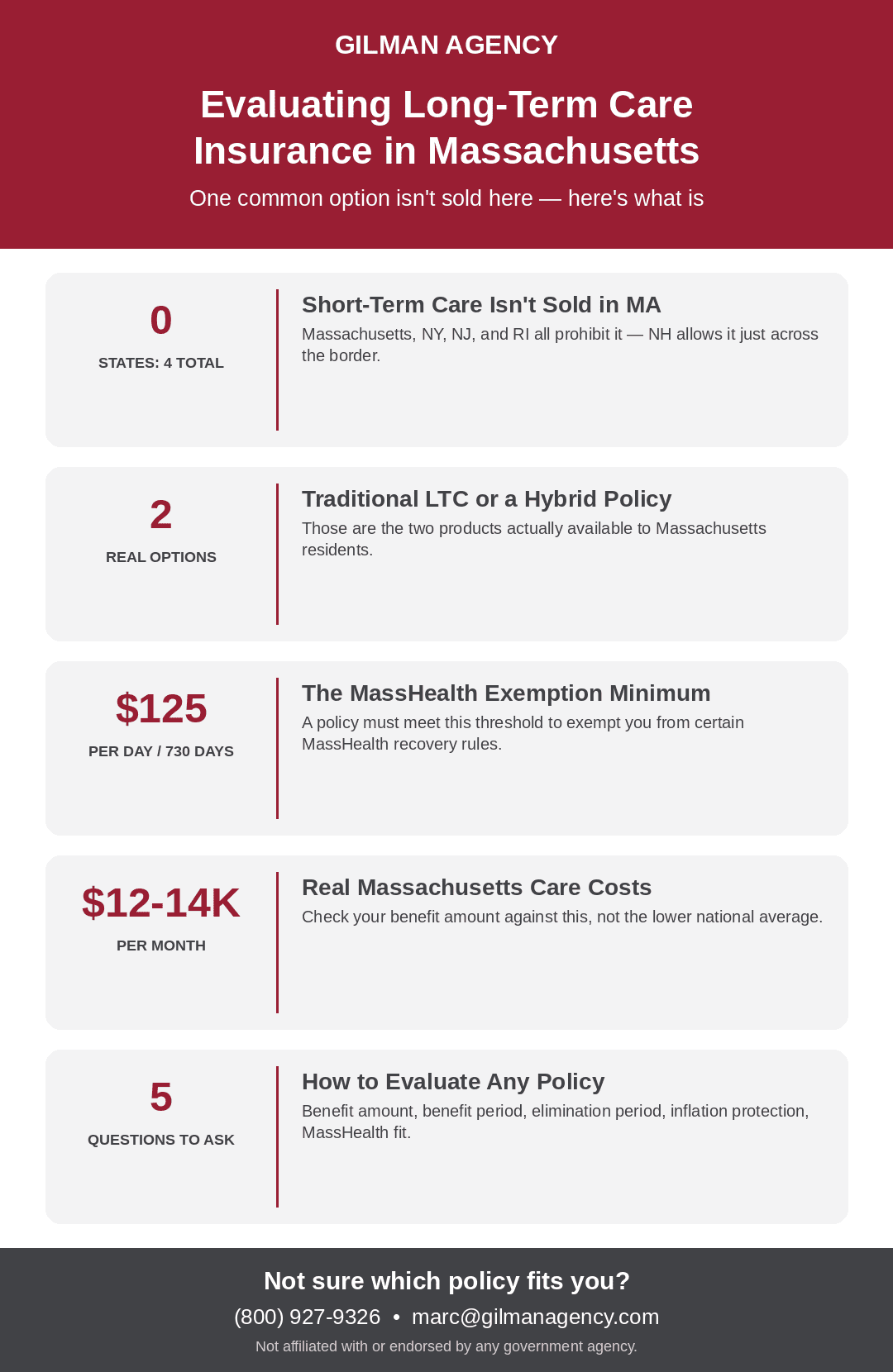
Massachusetts prohibits standalone short-term care insurance — one of only four states, along with New York, New Jersey, and Rhode Island, that doesn’t allow it. If you’ve seen it recommended in general advice online, it likely doesn’t apply to you.
-
That leaves Massachusetts residents with two real paths: traditional long-term care insurance and hybrid life/LTC or annuity/LTC policies.
-
Traditional coverage gets harder to qualify for with age — roughly 44% of applicants aged 70–74 and over half of applicants 75+ are denied nationally.
-
Massachusetts has no LTC Partnership program, but a policy that meets specific state requirements can still exempt you from certain MassHealth eligibility and estate recovery rules.
-
Evaluating a policy means checking five things: daily/monthly benefit, benefit period, elimination period, inflation protection, and whether it meets Massachusetts’s MassHealth exemption requirements.
Start Here: One Option Isn’t on the Table
Before comparing anything else, it’s worth ruling this out clearly: short-term care insurance — the standalone product that covers a shorter benefit period with easier underwriting — is not sold in Massachusetts. The state prohibits it because these policies provide benefits substantially similar to long-term care insurance without meeting Massachusetts’s minimum LTC insurance regulatory standards. New York, New Jersey, and Rhode Island have the same restriction; New Hampshire, just across the border, allows it.
This matters because a lot of general advice online treats short-term care plans as a go-to option for people who don’t qualify for traditional LTC insurance. In Massachusetts, that door simply isn’t open — so the evaluation has to start from the two products that actually are.
Your Two Real Options in Massachusetts
Traditional long-term care insurance is the most comprehensive option if you can qualify. Structurally, these policies work the same way regardless of carrier: a licensed health care practitioner certifies you as chronically ill, you satisfy an elimination period (the waiting period before benefits start), and benefits continue — as reimbursement against actual costs, or as a cash benefit — until your policy limit is reached.
Hybrid policies pair life insurance or an annuity with long-term care benefits. Underwriting is typically more forgiving than traditional LTC insurance, which makes this the more realistic path for many people in their 70s. If care is never needed, your beneficiaries still receive a death benefit — which is part of why this category has grown in popularity as traditional LTC insurance underwriting has tightened industry-wide.
How to Actually Evaluate a Policy
Whichever category you’re comparing within, the same five questions determine whether a policy is actually good, not just available:
-
What’s the daily or monthly benefit amount? Compare it against real Massachusetts care costs — a semi-private nursing home room here runs roughly $12,000–$14,000 a month, well above the national average, so a benefit sized for national averages may fall short.
-
How long does the benefit period last? This is what separates a policy built for a shorter recovery from one built for the multi-year scenario. Know which risk you’re actually buying protection against.
-
What’s the elimination period? Traditional policies often carry a 90-day wait before benefits begin; some carriers offer a cash-benefit option with no elimination period at all. That distinction can matter as much as the benefit amount itself.
-
Does it include inflation protection? Without it, a benefit that looks generous today buys meaningfully less a decade or two from now.
-
Does it meet Massachusetts’s requirements for a MassHealth exemption? This is Massachusetts-specific and easy to miss if you’re comparing quotes from a national site.
The Massachusetts-Specific Piece: MassHealth Exemptions
Massachusetts doesn’t participate in the federal LTC Partnership program that gives states like New Hampshire dollar-for-dollar Medicaid asset protection. But Massachusetts has its own separate mechanism: if your long-term care insurance policy meets specific state requirements — generally, covering at least $125 per day for at least 730 days, with no elimination period longer than 365 days — you can qualify for exemptions from certain MassHealth eligibility and estate recovery rules, even without the Partnership program’s dollar-for-dollar mechanism.
This means the specific numbers in a Massachusetts policy matter more than they might elsewhere. A policy that looks perfectly reasonable on price and daily benefit could still fall short of the coverage minimums needed to actually secure this protection — worth confirming explicitly rather than assuming.
A Practical Evaluation Checklist
Before you commit to any policy in Massachusetts:
-
Confirm it’s traditional LTC insurance or a hybrid policy — not a short-term care product, which won’t be legally available here in the first place
-
Check the daily/monthly benefit against real Massachusetts care costs, not national averages
-
Confirm the benefit period matches the risk you’re actually protecting against
-
Ask directly whether the policy meets the $125/day, 730-day minimum for the MassHealth exemption, if that protection matters to you
-
Get your health history assessed early — underwriting eligibility, not just price, is what actually narrows your options as you age
What To Do Next
Evaluating long-term care coverage in Massachusetts starts with knowing which products are actually available here — and short-term care insurance, despite showing up in a lot of general advice, isn’t one of them. From there, it’s a matter of comparing traditional and hybrid policies against your real numbers: Massachusetts care costs, your health, and the specific coverage thresholds that unlock MassHealth protections.
If you want help running your specific numbers against these criteria, reach out and we’ll work through it together.
Questions? Call (800) 927-9326 or email


