
By Marc Gilman
(800) 927-9326 |
Key Takeaways
-
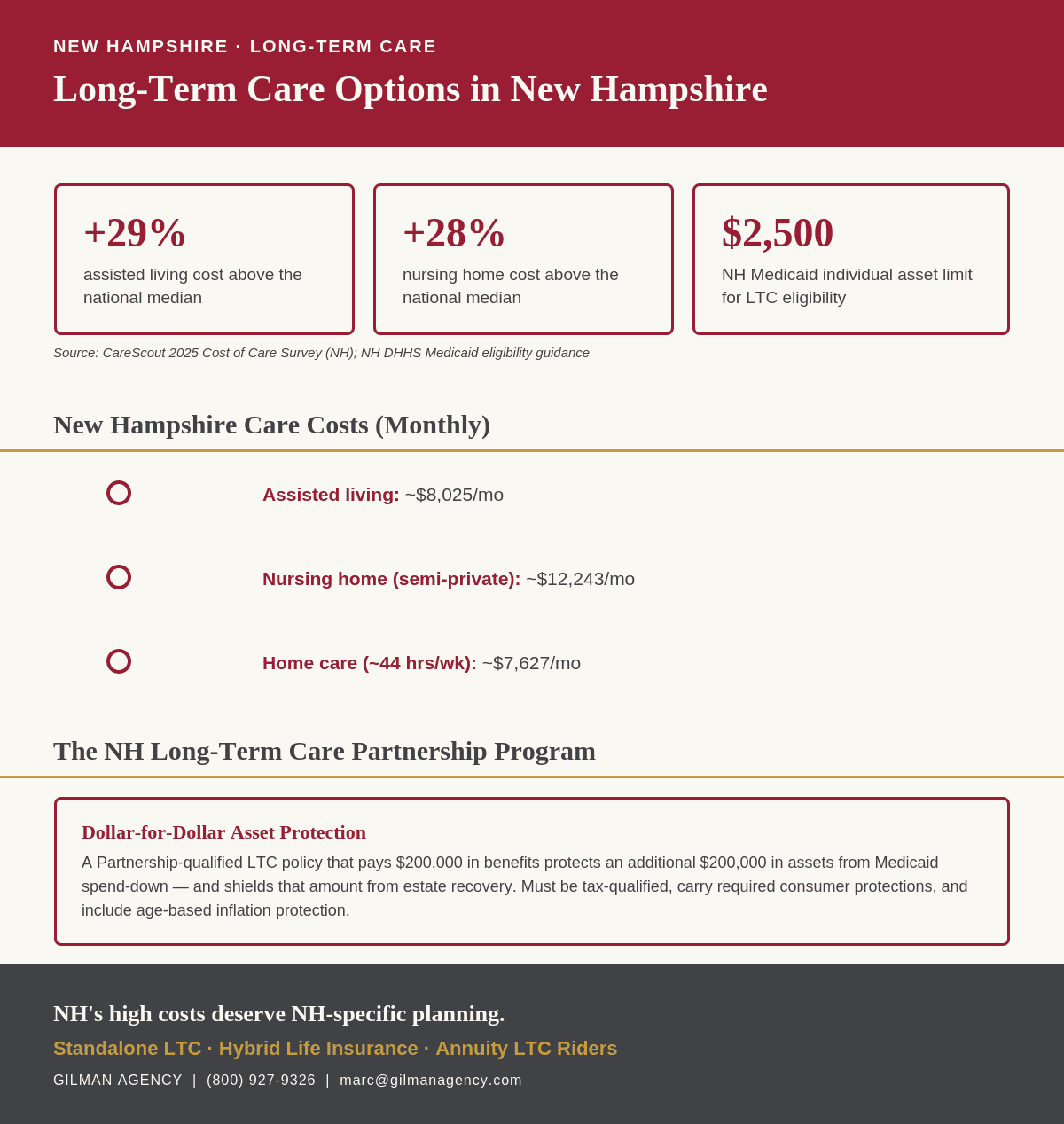
New Hampshire’s long-term care costs run well above the national average — nursing home care runs roughly 28% higher, assisted living about 29% higher, and home care about 14% higher than national medians.
-
New Hampshire participates in the federal/state Long-Term Care Partnership Program, which offers dollar-for-dollar asset protection from Medicaid spend-down requirements for qualifying policyholders.
-
New Hampshire’s Medicaid asset limit for long-term care eligibility is just $2,500 for an individual, making the state’s high care costs and thin Medicaid cushion a combination worth planning around early.
-
Standalone LTC insurance, hybrid life/LTC policies, and annuity LTC riders are all available in New Hampshire, and the right fit depends on your health, assets, and planning goals.
Why Does New Hampshire Need Its Own Conversation About Long-Term Care?
Long-term care planning isn’t one-size-fits-all, and New Hampshire is a case in point. The state consistently ranks among the more expensive states in the country for senior care, which means the national averages you’ll see in most retirement planning articles understate what care actually costs here.
Based on current cost-of-care survey data, New Hampshire runs meaningfully above the national line across every care setting:
-
Assisted living in New Hampshire runs about $8,025 a month, roughly 29% above the national median of $6,200.
-
Nursing home care (semi-private room) runs about $12,243 a month, roughly 28% above the national median.
-
Home care runs about $7,627 a month for a typical 44-hour-a-week schedule, about 14% above the national median.
-
Memory care, when needed, typically runs about 25% above standard assisted living rates.
For a household planning retirement income, that gap between the national number and the New Hampshire number can be the difference between a plan that holds up and one that doesn’t.
How Does New Hampshire Medicaid Fit Into the Picture?
Medicaid is the payer of last resort for long-term care, in New Hampshire as everywhere else — but it comes with a catch that surprises a lot of people: you generally have to spend down your assets to qualify first.
In New Hampshire, an individual must generally spend down countable assets to $2,500 before qualifying for Medicaid long-term care coverage. A community spouse (the spouse who isn’t the one needing care) is generally allowed to retain between roughly $32,532 and $162,660 in assets, depending on the couple’s circumstances. New Hampshire also enforces the standard federal five-year lookback period on asset transfers, so last-minute gifting or transfers aren’t a workaround.
Given the state’s high care costs, a household without other planning tools in place can burn through savings quickly before Medicaid becomes available — which is exactly the gap the state’s Partnership Program was built to address.
What Is the New Hampshire Long-Term Care Partnership Program?
New Hampshire participates in the federal/state Long-Term Care Partnership Program, and it’s one of the more valuable — and underused — tools available to Granite State residents planning for long-term care.
Here’s how it works: if you buy a Partnership-qualified long-term care insurance policy, every dollar that policy pays out in long-term care benefits protects an additional dollar of your assets from the Medicaid spend-down requirement. If your policy pays out $200,000 in care benefits over time, you can protect an additional $200,000 in assets while still qualifying for Medicaid if your care needs eventually exceed what your policy covers. Those protected assets are also generally shielded from Medicaid’s estate recovery process.
To qualify as a Partnership policy in New Hampshire, a policy must:
-
Be federally tax-qualified
-
Include required consumer protections
-
Carry inflation protection tied to your age at the time you buy the policy (compound inflation protection for younger buyers, a reduced requirement for older buyers)
Not every long-term care policy sold in New Hampshire is Partnership-qualified, so it’s worth confirming a specific policy’s status before assuming it carries this protection.
Where Does Insurance Planning Fit In?
Given New Hampshire’s cost profile, a few structures are worth understanding as you weigh your options:
-
Standalone LTC insurance (Partnership-qualified) pairs dedicated care coverage with New Hampshire’s dollar-for-dollar Medicaid asset protection — often the strongest fit for households who want both near-term coverage and a Medicaid backstop.
-
Hybrid life insurance with an LTC rider lets care costs be paid from the policy’s death benefit while you’re alive, with any unused benefit passing to your family if long-term care is never needed.
-
Annuity LTC riders can provide an enhanced payout for qualifying care expenses, often with more flexible underwriting than traditional LTC policies — useful for those who may not qualify medically for standalone coverage.
Which structure fits best depends on your health, your assets, and how much of the decision is about protecting savings for a spouse versus funding a specific care need. For a deeper walk-through of how these structures compare, see our complete guide to long-term care insurance — or talk it through with a licensed advisor familiar with New Hampshire’s specific rules, rather than working from national averages alone.
What To Do Next
New Hampshire’s combination of high care costs and a low Medicaid asset threshold makes early planning more valuable here than in many other states. Gilman Agency can walk you through Partnership-qualified standalone policies, hybrid life insurance, and annuity LTC riders side by side, and help you see how each would actually hold up against New Hampshire’s cost of care.
Call us at (800) 927-9326 or email to schedule a review.
Sources: CareScout Cost of Care Survey 2025 (New Hampshire data); New Hampshire Insurance Department, Long-Term Care Partnership Policies; N.H. Admin. Code Ins 3602; New Hampshire Medicaid eligibility guidance (Department of Health and Human Services asset and income limits, 2026).


