
By Marc Gilman
Questions? Call (800) 927-9326 or email
Key Takeaways
-
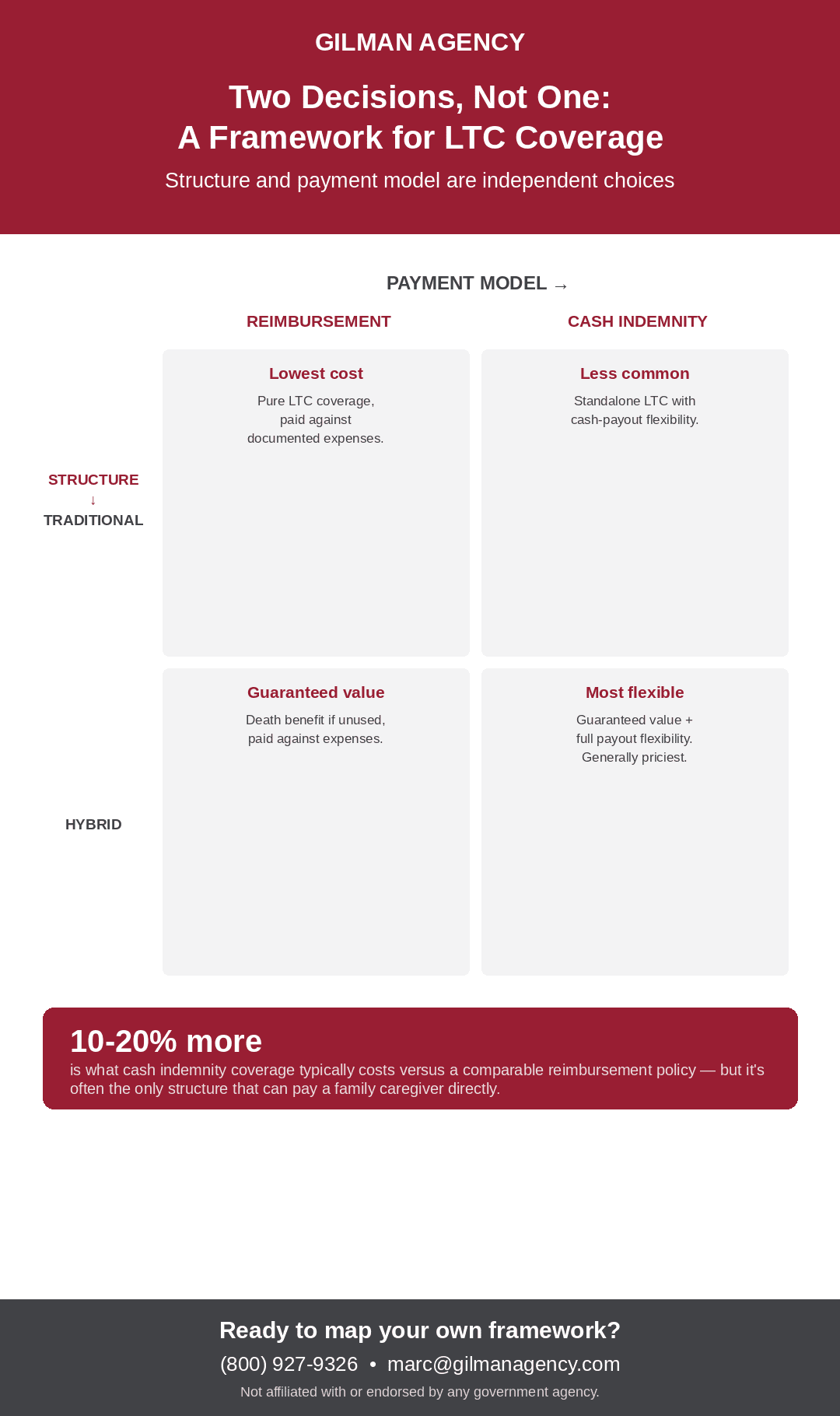
Choosing long-term care coverage actually involves two separate decisions, not one: the policy’s overall structure (traditional or hybrid), and how it pays benefits (reimbursement or cash indemnity).
-
Reimbursement policies pay your actual documented care costs up to a monthly cap, generally require receipts, and typically don’t cover informal care from family members.
-
Cash indemnity policies pay the full monthly benefit once you qualify, with no receipts required — and critically, most allow you to pay a family member, like a spouse or adult child, to provide your care.
-
That flexibility costs more: cash indemnity designs typically run 10–20% more than comparable reimbursement contracts.
-
Tax treatment differs slightly too: reimbursement benefits are generally tax-free without a dollar cap; cash indemnity benefits are tax-free up to the IRS per-diem limit ($430/day in 2026), with amounts above both that limit and actual expenses potentially taxable.
Two Separate Decisions, Not One
Across this whole series, we’ve covered a lot of individual pieces — annuity-based LTC underwriting, tax rider distinctions, ADL triggers, disqualifiers, funding strategies. This final piece is about pulling those threads into one practical framework: when you’re actually choosing a policy, you’re making two genuinely independent decisions, and it’s worth treating them separately rather than as one blended choice.
Decision 1: Traditional or Hybrid?
This is the structural question — does your premium buy pure long-term care coverage, or coverage combined with a life insurance or annuity component?
-
Traditional LTC insurance is pure coverage: lower cost, but a genuine use-it-or-lose-it design. If you never need care, the premiums you paid provide no return.
-
Hybrid (linked-benefit) policies combine LTC coverage with life insurance or an annuity, guaranteeing value either way — a death benefit if you don’t use the LTC portion. That guarantee typically costs 2–3 times more than traditional coverage for identical LTC benefits.
Neither is universally “better” — it depends on your risk tolerance for the premiums simply going unused, and how much you value a guaranteed outcome regardless of whether you ever file a claim.
Decision 2: Reimbursement or Cash Indemnity?
This is the payment-model question, and it’s just as consequential — arguably more so at actual claim time, even though it gets far less attention when people are shopping for coverage.
How Reimbursement Works
A reimbursement policy pays your actual documented care costs, up to your policy’s monthly or daily cap. If your benefit is $6,000/month and your actual care costs $5,000, the policy pays $5,000 — the unused $1,000 typically stays available in your benefit pool for future months. This generally requires submitting receipts and claims, and most reimbursement policies won’t pay for informal care provided by a spouse or family member — only licensed care providers or facilities qualify.
How Cash Indemnity Works
A cash indemnity policy pays the full monthly benefit amount once you’re certified as qualifying (the same 2-of-6 ADL or cognitive impairment standard covered in an earlier post) — regardless of your actual care costs. No receipts, no claims process for ongoing payments: the certification happens, and the money is sent. You decide how it’s spent.
The Practical Difference That Matters Most: Family Caregivers
This is, in practice, the single biggest reason people choose cash indemnity over reimbursement: most indemnity policies allow you to pay a family member — a spouse, adult child, or sibling — to provide your care. Reimbursement policies generally don’t permit this. If a spouse or adult child is going to lose income providing care for you, an indemnity policy is often the only structure that can actually compensate them for it.
The Cost of That Flexibility
Cash indemnity coverage isn’t free flexibility — it typically costs 10–20% more than a comparable reimbursement policy, since the insurer’s expected payout is higher (every qualifying month results in the full benefit being paid, rather than only the amount actually used).
The Tax Nuance
Reimbursement benefits are generally tax-free without a specific dollar cap, since they’re tied directly to documented expenses. Cash indemnity benefits are tax-free up to the IRS per-diem limit — $430/day in 2026 — or your actual qualified care expenses, whichever is higher. If your indemnity payout exceeds both that daily limit and your actual expenses, the excess may be taxable.
Putting the Two Decisions Together
Since these are independent choices, you end up with real combinations worth understanding, not just a single spectrum:
-
Traditional + reimbursement — the lowest-cost, most conventional combination. Pure LTC coverage, paid against actual documented expenses.
-
Traditional + cash indemnity — less common, but available: standalone LTC coverage with the flexibility of a cash payout, including potential family caregiver compensation.
-
Hybrid + reimbursement — guaranteed value (a death benefit if unused), paid against documented expenses if a claim occurs.
-
Hybrid + cash indemnity — the combination increasingly common in today’s hybrid market: guaranteed value and maximum payout flexibility, generally the most expensive combination but also the most flexible.
What To Do Next
Across this whole series — underwriting, tax treatment, claim triggers, funding strategies, and now this final structural framework — the throughline has been the same: long-term care coverage isn’t one product with minor variations, it’s a set of genuinely different structural choices that should be matched deliberately to your specific situation, not chosen by default. If you want to work through which combination of these choices actually fits your circumstances, reach out and we’ll map it out together.
Questions? Call (800) 927-9326 or email


