
By Marc Gilman
Questions? Call (800) 927-9326 or email
Key Takeaways
-
You can use HSA funds tax-free to pay qualified long-term care insurance premiums — one of the few exceptions to the general rule that HSAs can’t be used for health insurance premiums.
-
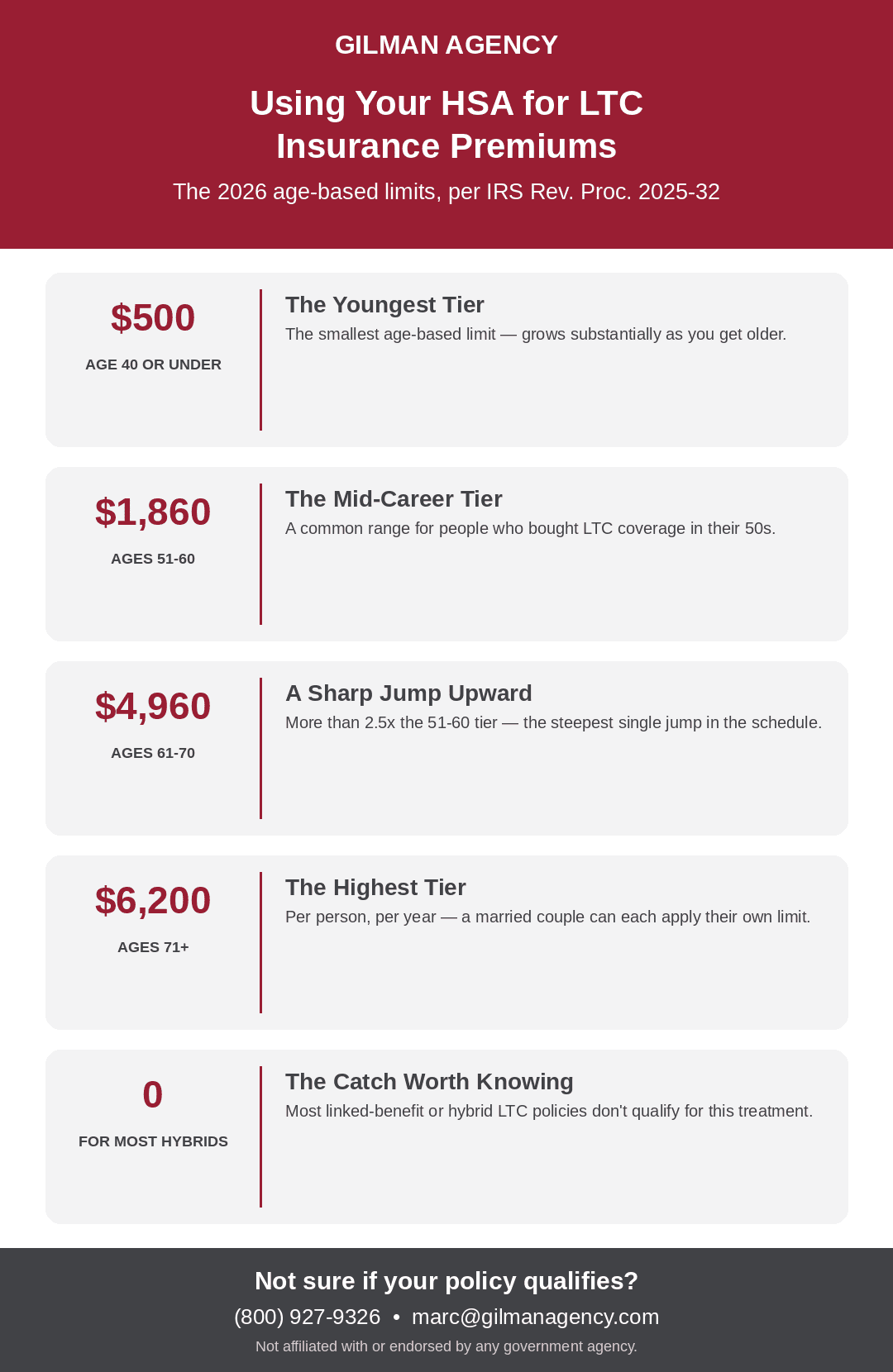
The amount you can withdraw tax-free is capped by an age-based schedule, set annually by the IRS under IRC Section 213(d)(10). For 2026: $500 (age 40 or under), $930 (41–50), $1,860 (51–60), $4,960 (61–70), and $6,200 (71+).
-
These are the same limits that apply to the itemized medical expense deduction — the HSA route and the Schedule A deduction route share one age-based cap, not two separate ones.
-
Most hybrid or linked-benefit life/LTC policies do not qualify for this treatment — only premiums for tax-qualified LTC coverage under IRC 7702B count, and most modern hybrid designs aren’t structured that way.
-
A separate SECURE 2.0 provision, effective for distributions after December 29, 2025, allows certain retirement plan distributions for LTC insurance to avoid the 10% early withdrawal penalty — a related but distinct mechanism from the HSA rule.
Why This Is a Genuinely Useful HSA Strategy
Health Savings Accounts generally can’t be used to pay health insurance premiums — that’s a widely known HSA limitation. Long-term care insurance is one of the specific exceptions. If you have a tax-qualified LTC policy, you can withdraw HSA funds tax-free to cover the premium, up to the same age-based limit that governs the itemized medical expense deduction.
This makes an HSA a genuinely efficient way to fund LTC coverage: your contributions were likely already tax-deductible (or pre-tax through payroll), the funds grow tax-free, and now the withdrawal for a qualified LTC premium is also tax-free — a rare triple tax advantage in the tax code.
The 2026 Age-Based Limits
These figures come from IRS Revenue Procedure 2025-32, Section 4.27, which sets the annual inflation-adjusted caps under IRC Section 213(d)(10):
-
Age 40 or under: $500
-
Age 41–50: $930
-
Age 51–60: $1,860
-
Age 61–70: $4,960
-
Age 71 and older: $6,200
Your applicable limit is based on your attained age as of December 31 of the tax year — not your age when you purchased the policy or when you paid the premium. These limits are per insured person, so a married couple each paying LTC premiums can apply their own age-based limit separately — a 65-year-old and a 68-year-old spouse, for example, would each use the $4,960 figure independently, not a combined household cap.
What Counts, and What Doesn’t
This is the detail that trips people up most: the HSA tax-free treatment only applies to premiums for tax-qualified LTC insurance under IRC Section 7702B. According to the American Association for Long-Term Care Insurance, most of today’s popular linked-benefit or hybrid life insurance policies do not qualify for this tax treatment, even though they provide LTC-style benefits. If you’re funding a hybrid policy rather than a standalone tax-qualified LTC contract, don’t assume the HSA route (or the itemized deduction) automatically applies — confirm with your carrier or advisor whether your specific policy, or the LTC-rider portion of it, is structured as tax-qualified.
A Related, But Separate, Retirement Plan Provision
Worth knowing about, even though it’s a different mechanism entirely: SECURE 2.0 added a new exception to the 10% early withdrawal penalty for certain long-term care insurance distributions from defined contribution retirement plans (like a 401(k)), effective for distributions made after December 29, 2025. This applies specifically to distributions used to pay for certified long-term care insurance for the employee or their spouse — but only if the retirement plan itself permits it, and it doesn’t make the premium itself tax-deductible. It’s a genuinely useful option for some people, but it’s governed by separate rules from the HSA strategy above, with its own documentation and plan-availability requirements.
What To Do Next
If you have an HSA and a tax-qualified long-term care policy, paying the premium with HSA funds — up to your age-based limit — is one of the more efficient tax moves available, since it stacks tax-free growth with a tax-free qualifying withdrawal. The two things worth confirming before you rely on this: whether your specific policy actually qualifies as tax-qualified LTC coverage under 7702B, and what your exact age-based limit is for the current tax year. If you want help sorting out either of those, reach out and we’ll work through it together.
Questions? Call (800) 927-9326 or email


