
By Marc Gilman
📞 Call (800) 927-9326 or email to talk through your long-term care planning options.
If you ask most people whether Medicare covers nursing home care, they’ll say yes. The answer is actually more complicated — and for families who discover the nuance after a need arises, the distinction between what Medicare covers and what it doesn’t can mean tens of thousands of dollars in unexpected costs.
Fidelity estimates that a 65-year-old retiring in 2025 can expect to spend an average of $172,500 on medical and healthcare expenses throughout retirement — and that figure doesn’t include long-term care. For a married couple, the average is $345,000. Long-term care is an entirely separate financial exposure.
The confusion almost always comes down to two terms that sound similar but describe fundamentally different things: short-term care and long-term care. Medicare covers one, to a point. It does not cover the other at all.
Key Takeaways
-
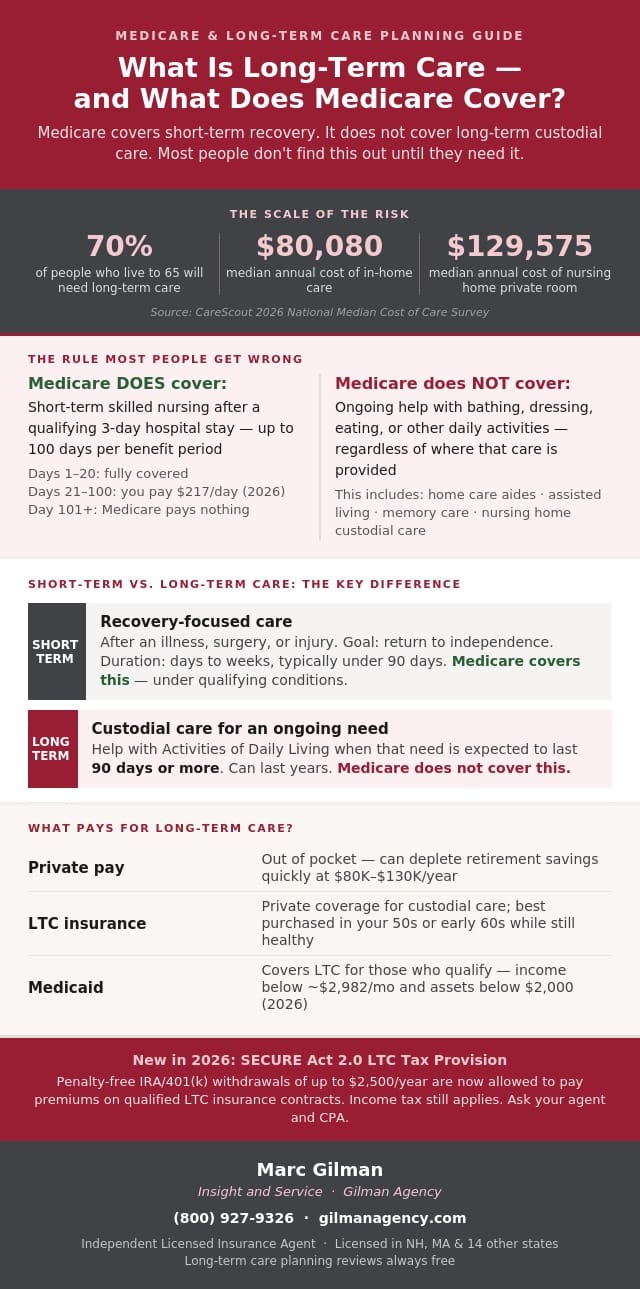
Long-term care is ongoing assistance with Activities of Daily Living — bathing, dressing, eating, transferring, toileting, and continence — expected to last 90 days or more. It is not medical treatment in the traditional sense.
-
Short-term care is temporary, recovery-focused care after an illness, surgery, or injury — expected to improve over time.
-
Medicare covers short-term skilled nursing care for up to 100 days per benefit period, but only under specific conditions — and only if the care qualifies as medically necessary.
-
Medicare does not cover long-term custodial care — the kind that helps someone with daily living activities on an ongoing basis. This is one of the most common and costly misconceptions in retirement planning.
-
Paying for long-term care typically falls to one of three sources: private pay, long-term care insurance, or Medicaid for those who qualify.
-
Short-term care insurance is a separate product — easier to qualify for, covers care for up to one year — that can bridge gaps Medicare doesn’t cover.
What is long-term care?
Long-term care isn’t a place. It’s a category of need.
Long-term care refers to the ongoing assistance a person requires when they can no longer independently perform what are called Activities of Daily Living, or ADLs. There are six:
-
Bathing
-
Dressing
-
Eating
-
Transferring (getting in and out of bed, chairs, or a wheelchair)
-
Toileting
-
Continence
When a person needs substantial assistance with at least two of these six activities — and that need is expected to last 90 days or more — they have crossed the clinical and legal threshold for long-term care. That 90-day expectation is the key dividing line in both insurance definitions and Medicare’s own coverage rules.
Long-term care also includes people living with severe cognitive impairment — Alzheimer’s disease, other forms of dementia — who require substantial supervision for their safety even if they can physically perform the ADLs.
Care can be delivered in a number of settings:
-
In-home care — a paid caregiver comes to the person’s home
-
Assisted living facility — residential community with personal care support
-
Memory care — specialized residential care for cognitive impairment
-
Nursing home — round-the-clock medical supervision and personal care
-
Adult day care — supervised daytime programming outside the home
The setting varies by individual need, preference, and budget. What makes it long-term care in any of these settings is the ongoing, custodial nature of the assistance — help with daily life, not treatment expected to restore function.
What is short-term care, and how does it differ?
Short-term care is recovery-focused care after an acute health event — a surgery, a fall, a stroke, a serious illness. The goal is rehabilitation: helping someone regain strength, function, and independence so they can return to their previous level of activity.
A person who has a hip replacement, spends three nights in the hospital, and then transfers to a skilled nursing facility for physical therapy is receiving short-term care. The expectation is recovery. The stay is time-limited. The care is medically intensive.
The key differences:

The 90-day threshold is the practical boundary. Short-term care is what happens in the weeks after a health event. Long-term care is what continues when someone’s ability to manage daily life doesn’t return — or when cognitive or chronic conditions require sustained, ongoing help.
What does Medicare cover for short-term care?
Medicare does cover short-term skilled nursing care — but only when three conditions are met:
1. A qualifying hospital stay. You must have been admitted as an inpatient to a hospital for at least three consecutive days. Time spent under observation status — which is technically outpatient care even if you spend nights in the hospital — does not count toward the three-day requirement.
2. Transfer to a Medicare-certified skilled nursing facility within 30 days of the qualifying hospital stay.
3. The care must be skilled and medically necessary. Medicare covers physical therapy, occupational therapy, speech therapy, IV medications, wound care, and other skilled nursing services — care that requires licensed clinical professionals and is ordered by a physician. It does not cover room and board or custodial assistance as standalone services.
When all three conditions are met, Medicare Part A covers skilled nursing facility care as follows:
-
Days 1–20: Medicare pays 100% of covered costs (after the Part A deductible of $1,736 in 2026)
-
Days 21–100: You pay $217 per day in coinsurance in 2026; Medicare pays the remainder
-
Day 101 and beyond: Medicare pays nothing. You are responsible for the full daily cost.
Medicare can also cover short-term home health services — skilled nursing visits, therapy, wound care at home — if you are homebound and a physician orders it. These are time-limited visits tied to a specific medical need, not ongoing personal care.
One important caveat: Medicare coverage can end before 100 days if the skilled care component is no longer needed or if you stop making measurable progress in rehabilitation. Coverage is not guaranteed for the full 100 days — it continues only as long as the care qualifies as skilled and is improving your condition.
What does Medicare not cover?
Here is where the misconception most often creates a problem.
Medicare does not cover custodial care — assistance with ADLs (bathing, dressing, eating, transferring) when there is no expectation of improvement. Once care becomes about maintaining function or providing daily living support rather than restoring function, it falls outside Medicare’s scope.
This means Medicare does not cover:
-
Ongoing home care by a personal care aide or home health aide providing help with ADLs (as opposed to skilled nursing visits)
-
Assisted living facility costs — room, board, and personal care support
-
Memory care facilities
-
Adult day care
-
Nursing home care beyond 100 days, or any nursing home care that is custodial rather than skilled
The confusion is understandable. Medicare does cover nursing home stays — but only in a skilled nursing facility, only for short-term rehabilitation, and only under the specific conditions above. The nursing home that provides ongoing custodial care for a person with Alzheimer’s or advanced Parkinson’s is not a service Medicare pays for.
Who does pay for long-term care?
When Medicare’s coverage ends — or never begins — there are three primary ways long-term care gets funded:
Private pay. The individual or family pays out of pocket. Long-term care costs in 2026 vary significantly by setting. According to CareScout’s national median figures, the annual cost breakdown looks like this:
-
In-home non-medical caregiver: $80,080/year
-
Assisted living facility: $74,400/year
-
Nursing home, shared room: $114,975/year
-
Nursing home, private room: $129,575/year
These are national medians — costs in New England tend to run above national averages. For someone who needs several years of care, the total exposure can easily exceed what most families have set aside in retirement savings.
Long-term care insurance. A private insurance product specifically designed to cover custodial care costs — in-home, assisted living, or nursing home — when the policyholder meets the clinical threshold (typically 2 of 6 ADLs for 90 days). Most LTC insurance policies include an elimination period — typically 30 to 90 days — similar to a deductible in time, before benefits begin paying. This is worth understanding because it means even someone with an LTC policy may have a gap period at the start of a claim.
Medicaid. For those who qualify — based on income and asset limits set by each state — Medicaid does cover long-term custodial care, including nursing home care indefinitely. In 2026, a single Medicaid nursing home applicant typically must have income below approximately $2,982 per month and countable assets below $2,000. Medicaid is the largest single payer for long-term care in the United States, but it is a program of last resort designed for those who have exhausted or transferred their own assets.
The scale of the need is worth underscoring. An estimated 70% of people who live to age 65 will need some type of long-term care during their lifetime, according to widely cited research. Other studies using narrower definitions put the figure closer to 56%. Either way, the majority of seniors will face this expense — and most haven’t planned for it specifically. Fidelity’s estimate that a 65-year-old retiring in 2025 will spend an average of $172,500 on healthcare in retirement doesn’t include long-term care at all. The two exposures are separate and need to be planned for separately.
What does long-term care insurance cover?
Long-term care insurance is designed to cover the costs of custodial and personal care — as opposed to medical treatment alone. Once your policy has been activated (meaning you’ve met the clinical trigger and satisfied the elimination period), it can pay for a range of care types and settings:
-
In-home care — personal care aides, home health aides, and skilled nursing visits at your residence
-
Adult day care — supervised daytime programming that provides care, social engagement, and respite for family caregivers
-
Assisted living facilities — residential communities providing room, board, and daily personal care support
-
Memory care — specialized residential care for people with Alzheimer’s disease or other cognitive impairment
-
Nursing home care — 24-hour skilled care and personal supervision in a licensed nursing facility
-
Respite care — short-term relief for a primary family caregiver, allowing them to rest without leaving the person unattended
-
Short-term hospice care — comfort-focused care for those with a terminal prognosis
-
Alternative or community care — depending on the policy, some plans cover care in settings beyond traditional facilities
The specific settings and services covered vary by policy. Traditional LTC insurance typically pays a daily or monthly benefit amount — for example, $150 or $200 per day — that you use toward eligible care costs. Hybrid policies, which combine a permanent life insurance death benefit with LTC riders, may pay benefits differently but cover the same general categories of care.
Most policies also include an inflation protection option — typically 3% annually — to help benefits keep pace with rising care costs over time. Given that home care costs have risen at roughly 7.9% annually over the past five years (AARP Public Policy Institute, 2026), inflation protection is worth understanding when comparing policies.
Two important product distinctions:
Traditional LTC insurance functions like most insurance — you pay premiums in exchange for future benefits. The policy has no cash value; if you never need care, premiums are not returned. Premiums are not guaranteed and can be increased by the carrier with state regulatory approval.
Hybrid (life/LTC) policies combine a permanent death benefit with LTC riders. If you need care, the policy pays LTC benefits. If you never need care, a death benefit passes to beneficiaries. Premiums are typically guaranteed. These policies are generally funded with a single premium or limited-pay structure rather than ongoing monthly premiums.
Is there a tax advantage to funding long-term care insurance?
Starting January 1, 2026, a new provision under the SECURE Act 2.0 (Section 334) makes it meaningfully easier for some Americans to fund long-term care insurance using retirement savings.
What the provision does: It removes the 10% early withdrawal penalty on distributions from qualified retirement accounts — IRAs, 401(k)s, 401(a)s, 403(a)s, 403(b)s, and 457(b)s — when those funds are used to pay premiums on a qualified long-term care insurance contract. Distributions are capped at the lesser of $2,500 or 10% of your vested balance per year.
Who benefits most: The 10% early withdrawal penalty normally applies to distributions taken before age 59½. This provision specifically removes that penalty for LTC premium payments — meaning someone in their 40s or early 50s with substantial retirement savings can now use up to $2,500 per year from those accounts to fund an LTC policy without the standard 10% penalty.
Important: income tax still applies. The provision waives the penalty, not the income tax. Withdrawals are still included in ordinary income for the year. For retirees already past 59½, the penalty doesn’t apply regardless, though the same ability to use retirement funds applies.
Product qualification matters. Not all long-term care insurance policies qualify under this provision. Only IRC 7702B-qualified long-term care insurance contracts are eligible. Hybrid life/LTC products that combine life insurance with LTC benefits qualify only if the LTC component meets the 7702B standard — meaning the policy is structured as a qualified long-term care contract, not simply as an accelerated death benefit rider.
Products confirmed as qualifying for the 2026 provision include several hybrid and traditional LTC policies from carriers such as Brighthouse, EquiTrust, Lincoln Financial, Minnesota Life, Nationwide, and OneAmerica. Products that use accelerated death benefit riders for chronic illness — rather than a 7702B-qualified LTC structure — do not qualify for this specific tax treatment.
Why $2,500 matters more than it sounds: For LTC policies structured as limited-pay plans — where premiums are paid over 10 or 20 years rather than for life — the $2,500 annual withdrawal can represent a meaningful portion of the annual premium. These plans are increasingly popular because they offer guaranteed premium amounts, eliminating the risk of future rate increases. Using pre-retirement savings to fund a limited-pay plan also spreads the income tax impact over multiple years rather than creating a single large taxable event.
Consult a tax advisor. The specifics of how this provision interacts with your income, state taxes, and overall retirement picture vary by individual. A CPA or tax advisor should be involved in any decision to use retirement account distributions to fund LTC premiums.
What about short-term care insurance?
Short-term care insurance is a separate product category — distinct from both LTC insurance and Medicare — worth understanding because it fills a different gap.
Where traditional LTC insurance covers care expected to last 90 days or more, short-term care insurance is designed for care lasting up to one year. It typically has:
-
Fewer health questions and easier underwriting than LTC insurance
-
A shorter waiting (elimination) period
-
Lower premiums
Short-term care insurance can be useful in several situations. It can cover the gap during the elimination period of an LTC policy. It can serve as standalone coverage for someone who doesn’t qualify for traditional LTC insurance due to health conditions. And it can help with the type of short-term care costs that Medicare may not fully cover — such as the $217/day coinsurance for SNF days 21–100 in 2026.
It is worth noting that short-term care insurance is not available in all states. Massachusetts, for example, does not permit the sale of short-term care insurance products as defined under those policy structures.
Frequently Asked Questions
Does Medicare cover home health care? Medicare covers skilled home health visits — nursing, therapy, wound care — when you are homebound and a physician orders the services. It does not cover ongoing personal care, home health aide visits for ADL assistance, or companion care as standalone services.
Does Medicare Advantage cover long-term care? Medicare Advantage plans provide all the same core benefits as Original Medicare, and some plans include supplemental benefits like adult day care or limited home care hours. However, no Medicare Advantage plan covers long-term custodial care in the way a dedicated LTC insurance policy does. The supplemental home care hours offered by some plans are modest and tied to specific conditions.
What triggers a long-term care insurance policy? Most policies trigger when a licensed healthcare practitioner certifies that you are unable to perform at least two of the six ADLs without substantial assistance, and that need is expected to last at least 90 days — or when you have a qualifying cognitive impairment requiring substantial supervision. Following certification, the elimination period (typically 30–90 days) must be satisfied before benefits begin.
At what age should I think about long-term care planning? Earlier than most people assume. Over 40% of people receiving long-term care are under age 65. LTC insurance is underwritten based on health, and waiting until a health condition develops may make it difficult or impossible to qualify. The ideal window to apply is generally in your 50s or very early 60s while you’re still relatively healthy — buying coverage earlier typically means locking in lower premiums. The same coverage costs significantly more when purchased at 65 versus 55, and a serious health event between those two points can make coverage unavailable entirely.
If I have a Medicare Supplement (Medigap) plan, does that cover long-term care? No. Medigap plans cover the cost-sharing gaps in Original Medicare — primarily the Part B 20% coinsurance, the Part A hospital deductible, and in some plans, the SNF days 21–100 coinsurance. They do not extend Medicare’s coverage to custodial care, and they do not cover long-term nursing home or assisted living costs.
Long-term care planning is one of the decisions people most often delay — and one where the cost of waiting is most significant. If you’d like to talk through your situation, understand what’s available in New Hampshire or Massachusetts, and compare options before a need arises, we’re glad to help.
📞 (800) 927-9326 | ✉️
📰 Related: Retiring and Still the Caregiver? Why Business Owners Should Consider a Hybrid Life Policy · How Much Life Insurance After the Kids Are Grown · Medicare Advantage vs. Original Medicare


