
By Marc Gilman
Questions? Call (800) 927-9326 or email
Key Takeaways
-
Retirement researchers have a name for this gap: the “annuity puzzle.” Economic models consistently predict much higher annuity demand than what actually happens — people who would clearly benefit from guaranteed income simply don’t buy it.
-
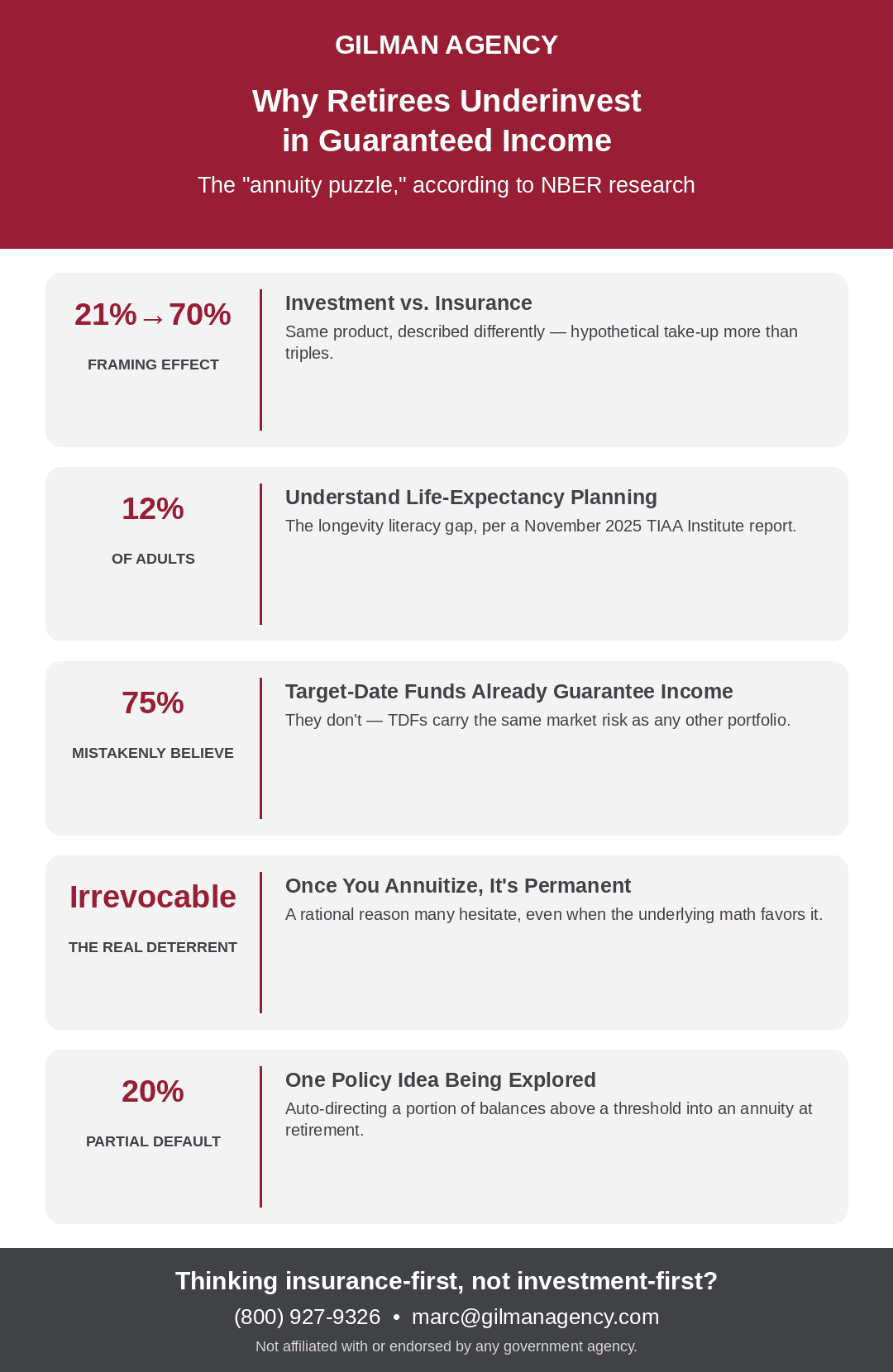
How an annuity is described changes people’s willingness to buy it dramatically. In one study cited by the researchers, hypothetical take-up was just 21% when annuities were framed as an investment, but jumped to 70% when framed as insurance — same product, completely different framing.
-
Longevity literacy is a real, measurable gap: only 12% of adults demonstrate a strong understanding of life-expectancy planning, according to a November 2025 TIAA Institute report.
-
Three-quarters of people mistakenly believe target-date funds already provide guaranteed income — they don’t — according to MFS Investment Management’s 2025 Global Retirement Survey, revealing a real disconnect between what people think they have and what they actually have.
-
Irrevocability is a major, underappreciated deterrent. Once you annuitize, you generally can’t undo it — and that permanence alone keeps many people from acting, even when the underlying numbers favor guaranteed income.
A Real, Well-Documented Puzzle
This isn’t a minor academic curiosity. A team of six leading retirement researchers — including Wharton’s Olivia Mitchell, Moshe Milevsky of York University’s Schulich School of Business, and behavioral economists from UCLA, Cornell, and the University of Illinois — recently examined why annuity uptake remains far below what standard economic models predict people should want, given how effectively annuities protect against outliving your savings.
Their conclusion is worth sitting with directly: “No single innovation or regulatory change will reliably deliver the outcomes predicted by idealized economic models.” In other words, this isn’t a problem with one simple fix — it’s a combination of how products are designed, how policy shapes defaults, and how people actually think and feel about giving up control of their money.
The Single Biggest Lever: How Annuities Get Framed
Here’s the finding that stands out most. Research published in the American Economic Review, cited in this paper, tested how framing alone affects people’s willingness to consider an annuity. When the exact same product was described as an investment, hypothetical take-up was just 21%. When described as insurance, take-up jumped to 70% — more than triple.
This matters beyond academic interest. If an annuity gets discussed the same way a mutual fund or stock allocation would — in terms of rate of return — it naturally gets compared unfavorably to market investments and loses on that comparison. But that’s the wrong comparison. An annuity isn’t competing with your stock portfolio for the best return; it’s protecting against a risk your portfolio can’t protect against on its own — the risk of living longer than your money lasts.
The Longevity Literacy Gap
Part of why guaranteed income gets undervalued is straightforward: most people don’t have an accurate sense of how long they might actually live. The TIAA Institute’s November 2025 research found that only 12% of adults demonstrate a strong understanding of life-expectancy planning. Interestingly, the researchers note that general financial literacy has a mixed relationship with annuity demand — but annuity-specific knowledge is positively associated with actually wanting one. In other words, it’s not about being financially sophisticated in general — it’s about understanding annuities specifically, which most people never get real exposure to.
The Target-Date Fund Confusion
This is one of the more striking findings in the whole paper: according to MFS Investment Management’s 2025 Global Retirement Survey, three-quarters of people believe their target-date fund already provides guaranteed income. It doesn’t. A target-date fund adjusts your investment mix as you age, but it carries the same market risk as any other investment portfolio — there’s no guarantee built in at all.
This gap between what people think they have and what they actually have is exactly why the researchers see real value in combining target-date funds with an annuity component, rather than assuming one or the other. If you genuinely believe your retirement savings already include guaranteed income protection, you’re less likely to go looking for it elsewhere — even when you don’t actually have it.
Irrevocability: The Deterrent Nobody Talks About Enough
Even when people understand the value of guaranteed income, a separate obstacle gets in the way: once you annuitize, that decision is generally permanent. The researchers specifically flag this as a major deterrent to adoption — and it’s a rational one. Committing a large sum of money to an irreversible decision is genuinely uncomfortable, regardless of how sound the underlying math is.
This is part of why some newer product designs and proposals include time-limited trial periods or limited underwritten exit windows, letting someone cancel a contract without surrender charges during an initial period. The goal is to reduce the psychological weight of “forever” without eliminating the actual guarantee.
What’s Changing on the Policy Side
A few developments worth knowing about, even if they don’t immediately affect an individual decision:
-
The Department of Labor has been clarifying how annuities can serve as default investments inside employer retirement plans. In September 2025, the DOL’s Employee Benefits Security Administration issued an advisory opinion confirming that a specific in-plan lifetime income strategy (AllianceBernstein’s, combining a target-date-style approach with an annuity component) meets the requirements to serve as a Qualified Default Investment Alternative under ERISA.
-
Some researchers and policymakers are exploring partial default annuitization — for example, automatically directing a portion (such as 20%) of a retirement balance above a certain threshold into an annuity at a specific age, unless the participant opts out. This mirrors how automatic enrollment already boosted retirement savings rates, applied instead to the payout phase.
What This Means for You
The research here isn’t really telling you whether to buy an annuity — it’s explaining why so many people who might benefit from one never seriously consider it. If any of these patterns sound familiar — thinking of an annuity purely as an investment rather than insurance, assuming your target-date fund already has you covered, or avoiding the decision because it feels too permanent — that’s worth examining directly rather than letting the default (not deciding) make the decision for you.
What To Do Next
Guaranteed income that doesn’t move with the market is a genuinely different tool than a stock or bond portfolio, solving a different problem — and the research suggests most people underuse it not because the math doesn’t work, but because of how it’s framed, understood, and psychologically experienced. If you want to look at whether guaranteed income has a place in your own retirement plan, reach out and we’ll work through it together, insurance-first rather than investment-first.
Questions? Call (800) 927-9326 or email
Source: Emily Boyle, “Ways to Piece Together the ‘Annuity Puzzle,'” PLANSPONSOR, May 2026, reporting on a National Bureau of Economic Research working paper authored by Hal Hershfield (UCLA), Suzanne Shu (Cornell), Jeffrey Brown (University of Illinois), Abigail Hurwitz (Hebrew University of Jerusalem), Moshe Milevsky (York University), Olivia Mitchell (The Wharton School), and Tamiko Toland (401(k) Annuity Hub).


