
By Marc Gilman
(800) 927-9326 |
If you’re comparing ways to fund future long-term care costs without buying a standalone LTC policy, you’ve probably run into two products that get discussed almost interchangeably: an annuity with a long-term care rider, and a life insurance policy with a long-term care or accelerated death benefit rider. They solve a similar problem — the fear that a standalone policy’s premiums are “wasted” if you never need care — but they get there in genuinely different ways, funded differently, taxed differently, and suited to different situations.
Key Takeaways
-
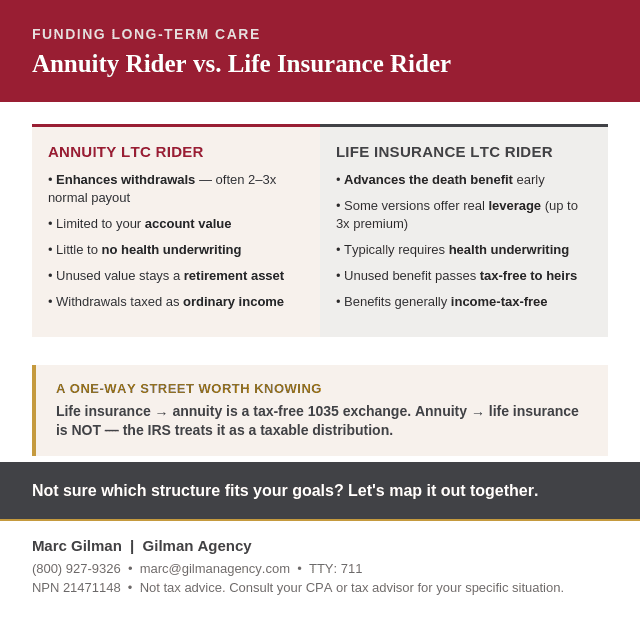
An annuity LTC rider enhances withdrawals from an existing retirement asset — often doubling or tripling the normal payout. Simpler versions are limited to the account’s remaining value, but some Annuity/LTC combination products can pay out well beyond it, similar to a leveraged life insurance rider.
-
A life insurance LTC rider advances a portion of the death benefit while you’re alive; some versions reduce the death benefit dollar-for-dollar, while others create a separate LTC benefit pool that can exceed the death benefit itself.
-
If you never need care, an annuity’s remaining value continues as a normal retirement asset; with life insurance, your beneficiaries receive the full, unreduced death benefit.
-
These products are taxed differently, and a real asymmetry exists in how you can move money between them: a life insurance policy can be exchanged tax-free into an annuity, but not the reverse.
-
Annuities generally involve little to no health underwriting, while life insurance-based riders typically require some — meaning your current health can steer you toward one option over the other.
-
Both product types must comply with NAIC model regulations and IRS §7702B to legally market long-term care tax benefits, which gives you real, specific consumer protections.
What’s the Core Difference Between These Two Approaches?
At the most basic level: an annuity with an LTC rider is built around managing retirement income and longevity risk, with long-term care as an enhancement layered on top. A life insurance policy with an LTC rider is built around leaving a death benefit for beneficiaries, with long-term care access carved out of that same benefit while you’re still alive. One starts as an income tool; the other starts as a legacy tool. Everything else about how these products behave follows from that starting point.
How Does an Annuity’s Long-Term Care Rider Actually Work?
Like life insurance riders, this comes in more than one structure, and it’s worth knowing which one you’re looking at.
A simple enhanced-withdrawal rider doubles or triples your normal monthly payout from a fixed or indexed annuity once you meet the policy’s care criteria, for a defined period. The benefit is bound by your account value: you’re accelerating access to money that’s already yours within the contract, not accessing a separately-funded pool.
An Annuity/LTC combination product, by contrast, can provide LTC benefits that exceed the original account value — genuine leverage, similar to a life insurance extension-of-benefits rider. As one real illustration: a $200,000 non-qualified annuity repositioned into this kind of plan can provide up to $600,000 in total LTC benefits, paid out over several years. These products also tend to have more flexible underwriting, which can make them a fit for people who were declined for or priced out of traditional LTC coverage.
The practical takeaway: don’t assume “annuity LTC rider” means the same thing across every product. Ask specifically whether the benefit is capped at your account value or structured to pay out more.
How Does a Life Insurance LTC Rider Actually Work?
This is where it’s worth slowing down, because “life insurance with an LTC rider” actually describes two different products with meaningfully different economics.
The simpler, more common version — an acceleration rider — lets you access part of your death benefit early for qualified care expenses, but reduces the death benefit dollar-for-dollar. If you have a $500,000 policy and use $250,000 for care, your beneficiaries receive the remaining $250,000. Straightforward, lower-cost, but no extra leverage: you’re simply front-loading money you’d otherwise leave behind.
The less common version — an acceleration-plus-extension-of-benefits rider — creates a genuinely separate LTC benefit pool on top of the death benefit. This is where the “leverage” people talk about actually comes from. As one real illustration: a $10,000/year premium over 10 years ($100,000 total) can provide a $150,000 death benefit and up to $450,000 in available LTC benefits — three times the total premium paid, in care funding alone. This version costs more and requires more underwriting, but it’s structurally different from simple acceleration, not just a bigger version of it.
Regardless of which structure, the typical monthly benefit available for nursing home care runs around 2% of the policy’s face value per month, with home care usually capped around half that. A $200,000 policy, for example, might provide roughly $4,000/month for nursing home care or $2,000/month for home care — though the exact percentage and whether acceleration is capped at 50% of the death benefit or allows the full amount varies by carrier and product.
What Happens If You Never Need Care?
This is the “wasted premium” fear both products are designed to address, and they handle it differently.
With an annuity LTC rider, nothing is lost — the remaining contract value simply continues functioning as a normal retirement annuity, passing to beneficiaries or continuing as income per the contract’s terms. With a life insurance LTC rider, if you never draw on it, your named beneficiaries receive the full, unreduced death benefit. Either way, you’re not looking at the true “use it or lose it” outcome a standalone LTC policy carries — but the form the unused benefit takes is different.
How Are These Taxed, and Can You Move Money Between Them?
Annuity withdrawals are taxed as ordinary income on the earnings portion, not capital gains — a real difference from life insurance, where death benefits are generally received income-tax-free by beneficiaries, and policy loans against cash value aren’t taxable as long as the policy stays in force.
There’s a genuinely important asymmetry worth knowing if you’re considering funding one of these with an existing asset: a life insurance policy can be exchanged tax-free into an annuity (a 1035 exchange), but an annuity cannot be exchanged tax-free into a life insurance policy — the IRS treats that direction as a taxable distribution. If you’re sitting on an old annuity and considering a life-insurance-based hybrid LTC product instead, that’s not a clean, tax-free move the way the reverse would be. Worth discussing with a tax advisor before assuming you can simply convert one into the other.
Who Tends to Be a Better Fit for Each?
A few patterns worth considering, though this is ultimately a conversation for your specific situation:
-
Health matters. Annuities generally involve little to no health underwriting, while life insurance-based riders typically do, with underwriting weighted more toward general mortality risk than LTC-specific factors. If health issues would complicate qualifying for life insurance — or you were previously declined for traditional LTC coverage — an Annuity/LTC combination product’s more flexible underwriting may be the more accessible path.
-
What you’re funding it with matters. If you have an existing lump sum or retirement asset you want to redeploy specifically for income plus a care safety net, an annuity rider fits naturally. If your priority is legacy protection with LTC as a living benefit layered on top, a life insurance rider fits that goal more directly.
-
Your primary goal matters. If maximizing available care funds is the priority, an acceleration-plus-extension life insurance structure can provide genuine leverage beyond the premium paid. If preserving flexibility and keeping money working as a retirement asset is the priority, the annuity route keeps things simpler.
Where Does Insurance Planning Fit In?
Both product types are legally required to meet specific regulatory standards to be marketed as covering long-term care — compliance with NAIC model regulations and IRS §7702B for tax-qualified treatment — along with real consumer protections like a detailed policy summary at delivery and monthly benefit reporting once you’re drawing on either kind of rider. Gilman Agency can help you understand how a specific product is structured, what it would actually pay out in your situation, and how it fits alongside your broader Medicare and retirement planning — though for the tax and legal specifics of moving existing assets into either product, that’s a conversation for your CPA or financial advisor too.
What To Do Next
If you’re weighing these two approaches, start by identifying what you’re actually trying to protect — income, legacy, or both — and what asset you’d realistically use to fund it. That answer points toward one structure more clearly than a generic comparison ever could.
Call (800) 927-9326, or email to talk through your situation. TTY: 711.
By Marc Gilman, Gilman Agency
Sources: American Council of Life Insurers (ACLI), presentation to the NAIC Senior Issues Task Force, “Understanding Long-Term Care Riders on Life & Annuity Products” (August 2025); National Council on Aging, “What Are the Three Types of Long-Term Care Insurance?”; U.S. Administration for Community Living, “Using Life Insurance to Pay for Long-Term Care”; Western & Southern Financial Group, “Annuity vs Life Insurance”; Mariner Wealth Advisors, “Long-Term Care Insurance: Rider or Stand-Alone Policy?”; LTCI Partners, “6 Tax-Smart Strategies to Fund a Long-Term Care Insurance Policy.”


